

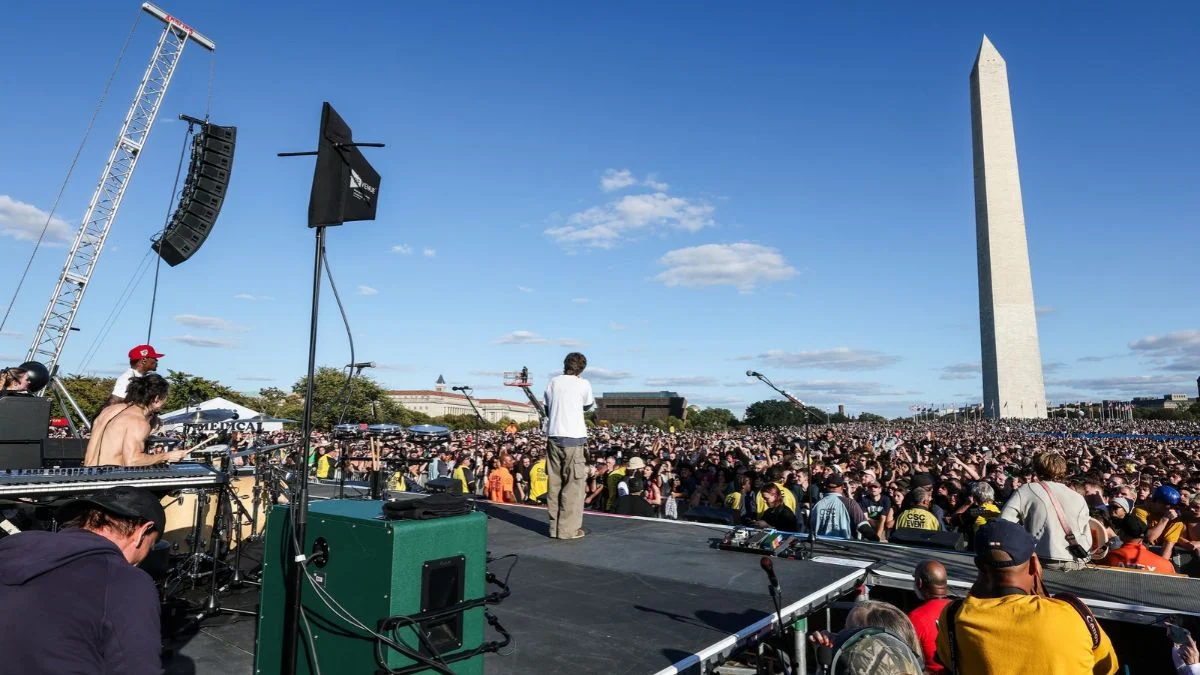
WASHINGTON, D.C. — In a defining moment for modern punk and hardcore, Baltimore’s own Turnstile closed out the latest leg of their blockbuster "Never Enough Tour" with an unforgettable, free-admission benefit concert on the National Mall. Drawing an estimated 60,000 fans to the shadow of the Washington Monument on Saturday, October 24, the band transformed a standard tour finale into a massive testament to the power of community, DIY ethics, and global solidarity.
Staged in partnership with Human Concern International, the event was originally conceived as a localized fundraising effort to support critical humanitarian relief initiatives in Palestine, Sudan, and Lebanon. Yet, the overwhelming response from the public far exceeded expectations. When the concert was first announced earlier in October, organizers set an ambitious goal of raising $100,000. By Sunday morning, following an influx of donations tied to the event, that figure had more than doubled, surpassing $220,000.
For a genre historically rooted in underground spaces, sweat-drenched basements, and marginalized DIY venues, scaling up to the National Mall—the symbolic front lawn of American democracy—represented a monumental achievement. More than just a concert, the gathering felt like a cultural watershed, echoing the legendary free performances of Washington, D.C. punk icons Fugazi in the 1990s, while firmly establishing Turnstile as a generational force in rock music.
Main Facts
The scale of Saturday’s event shattered expectations across both the music industry and local municipal planning boards.
- The Attendance: An estimated 60,000 attendees flooded the National Mall, creating one of the largest standalone punk and hardcore gatherings in U.S. history.
- The Cause: Partnering with Human Concern International, the band organized the event to direct 100% of proceeds toward humanitarian aid efforts for crisis-affected populations in Palestine, Sudan, and Lebanon.
- The Financial Impact: Sashing their initial $100,000 target out of the water, supporters and attendees helped push total fundraising past the $220,000 mark by the end of the weekend.
- The Performance: Despite dealing with a painful ankle injury sustained earlier in the tour, frontman Brendan Yates powered through a blistering, 19-song, 75-minute set.
- The Context: The concert capped off a banner year for Turnstile, which included their first-ever Grammy wins (including Best Rock Album for NEVER ENOUGH), a landmark Saturday Night Live debut earlier in October, and a massive North American tour.
Chronology: From Underground Roots to the National Mall
To understand the weight of Turnstile’s Washington Monument performance, one must look at the trajectory that brought the band to this stage.
The Rise of a Hardcore Giant
Emerging from the vibrant, tight-knit Baltimore-Washington D.C. hardcore scene, Turnstile spent over a decade cutting their teeth in cramped DIY spaces, community centers, and small clubs. Frontman Brendan Yates grew up in nearby Burtonsville, Maryland, deeply embedded in the regional punk ethos that prioritized community building, inclusivity, and direct action.
Over successive releases—culminating in their breakout 2021 album GLOW ON and the critically acclaimed 2026 follow-up NEVER ENOUGH—Turnstile began pushing the sonic boundaries of hardcore. They incorporated melodic hooks, alternative rock textures, and infectious groove elements without sacrificing the visceral energy of their live shows. This evolution earned them mainstream crossover appeal while retaining the fierce loyalty of their underground fanbase.
2026: A Banner Year
The road to the Washington Monument was paved with milestone achievements. Earlier in 2026, Turnstile took home their first two Grammy Awards, clinching the trophy for Best Rock Album for NEVER ENOUGH. Just weeks before the National Mall show, the band made their mainstream television debut on Saturday Night Live, introducing millions of viewers to their high-octane brand of aggressive, melodic punk.
The Lead-Up and the Performance
When Turnstile announced the free benefit show earlier in October, it sent shockwaves through the punk community. Organizing a massive public gathering on the National Mall requires navigating complex municipal logistics, security clearances, and permits—hurdles the band and their team cleared in record time.
The days leading up to the show were not without physical toll. Reports surfaced that Brendan Yates spent the day prior to the concert icing a severely injured ankle, the result of high-flying stage antics over weeks of relentless touring. Yet, when the band took the stage on Saturday afternoon against the backdrop of the towering obelisk, any physical limitations vanished.
Launching straight into "BIRDS" and "REAL THING," Yates commanded the massive open-air space with the same ferocious intensity he once brought to basement shows. The 19-song setlist spanned the band’s catalog, weaving through fan favorites like "MYSTERY," "HOLIDAY," "BLACKOUT," and "NEVER ENOUGH," before closing out with "T.L.C. (Turnstile Love Connection)."
Midway through the set, Yates paused to address the sea of humanity stretching out before the stage. Thanking the crowd for showing up in support of the humanitarian benefit, he led the tens of thousands in attendance in a resounding, unified chant: "Free Palestine! Free Sudan! Free Lebanon!"
Supporting Data & Setlist Breakdown
The synergy between the band’s musical output and their philanthropic mission is best illustrated by the numbers and the structure of the event itself.
Financial and Attendance Metrics
- Initial Fundraising Goal: $100,000
- Final Raised Amount: $220,000+
- Estimated Crowd Size: 60,000 people
- Set Duration: 75 minutes
- Total Songs Performed: 19
The Historic Washington Monument Setlist
- BIRDS
- REAL THING
- ENDLESS
- I CARE / DULL
- DON’T PLAY
- DROP
- WILD WRLD
- MYSTERY
- SUNSHOWER
- 7
- KEEP IT MOVING
- CANNED HEAT
- SOLE
- MAGIC MAN
- LOOK OUT FOR ME
- HOLIDAY
- BLACKOUT
- NEVER ENOUGH
- T.L.C. (TURNSTILE LOVE CONNECTION)
Official Responses and Perspectives
The resonance of the event extended far beyond the concertgrounds, drawing commentary from cultural historians, local journalists, and the band members themselves.
Brendan Yates on the Homecoming
Speaking with The Washington Post ahead of the performance, Yates reflected on what returning to the D.C. area meant to him and his bandmates.
"This is a scene that raised us," Yates shared, acknowledging the foundational role that the mid-Atlantic punk circuit played in shaping their artistic identities. Bringing a massive benefit concert to the National Mall was, in many ways, a way of paying that foundational community back by extending their reach outward to those suffering in global conflict zones.
The Punk Community and Historical Echoes
Veterans of the local D.C. punk scene were quick to draw parallels between Turnstile’s performance and the historic free shows played by Fugazi near the Washington Monument in the 1990s. Both bands utilized their platform to challenge commercial norms, refusing to gatekeep their art behind exorbitant ticket prices while using large public spaces to foster civic engagement.
Human Concern International also expressed profound gratitude for the partnership, noting that the unprecedented surge in donations will directly fund medical supplies, food security, and emergency shelter initiatives in regions facing catastrophic humanitarian crises.
Implications: What This Means for Rock and Activism
Turnstile’s successful deployment of a free, 60,000-person benefit concert on the National Mall carries significant implications for the future of rock music, political activism, and live entertainment.
1. Proving the Viability of Large-Scale DIY Ethics
For decades, the music industry has operated under the assumption that massive crowds can only be corralled through high-priced ticket models, dynamic pricing algorithms, and corporate sponsorships. Turnstile proved that a band can scale up to arena- and stadium-level audience sizes while maintaining a core ethos of accessibility and radical generosity. By making the show entirely free and relying on direct donations, they demonstrated that modern music fans are eager to support artists who center community welfare over profit margins.
2. The Resurgence of Overt Political Solidarity in Mainstream Rock
In an era where many mainstream artists shy away from taking definitive stances on global geopolitical crises for fear of alienating corporate partners or streaming algorithms, Turnstile leaned directly into discomfort. By using a performance broadcast globally via social media to elevate the struggles of Palestine, Sudan, and Lebanon, they set a new benchmark for how contemporary rock bands can leverage their cultural capital to demand global justice.
3. What’s Next for Turnstile?
With the North American leg of the "Never Enough Tour" officially in the books, Turnstile shows no signs of slowing down. The band is slated to appear at Tyler, the Creator’s prestigious Camp Flog Gnaw carnival in Los Angeles this November, before diving back into an extensive international festival circuit in 2027.
As they step into this new echelon of global stardom—cemented by Grammy gold, late-night television appearances, and historic public gatherings—Turnstile has proven that they can conquer the mainstream without ever losing touch with the underground spirit that built them.
 Raul Delapena Setiawan
 Nana
