

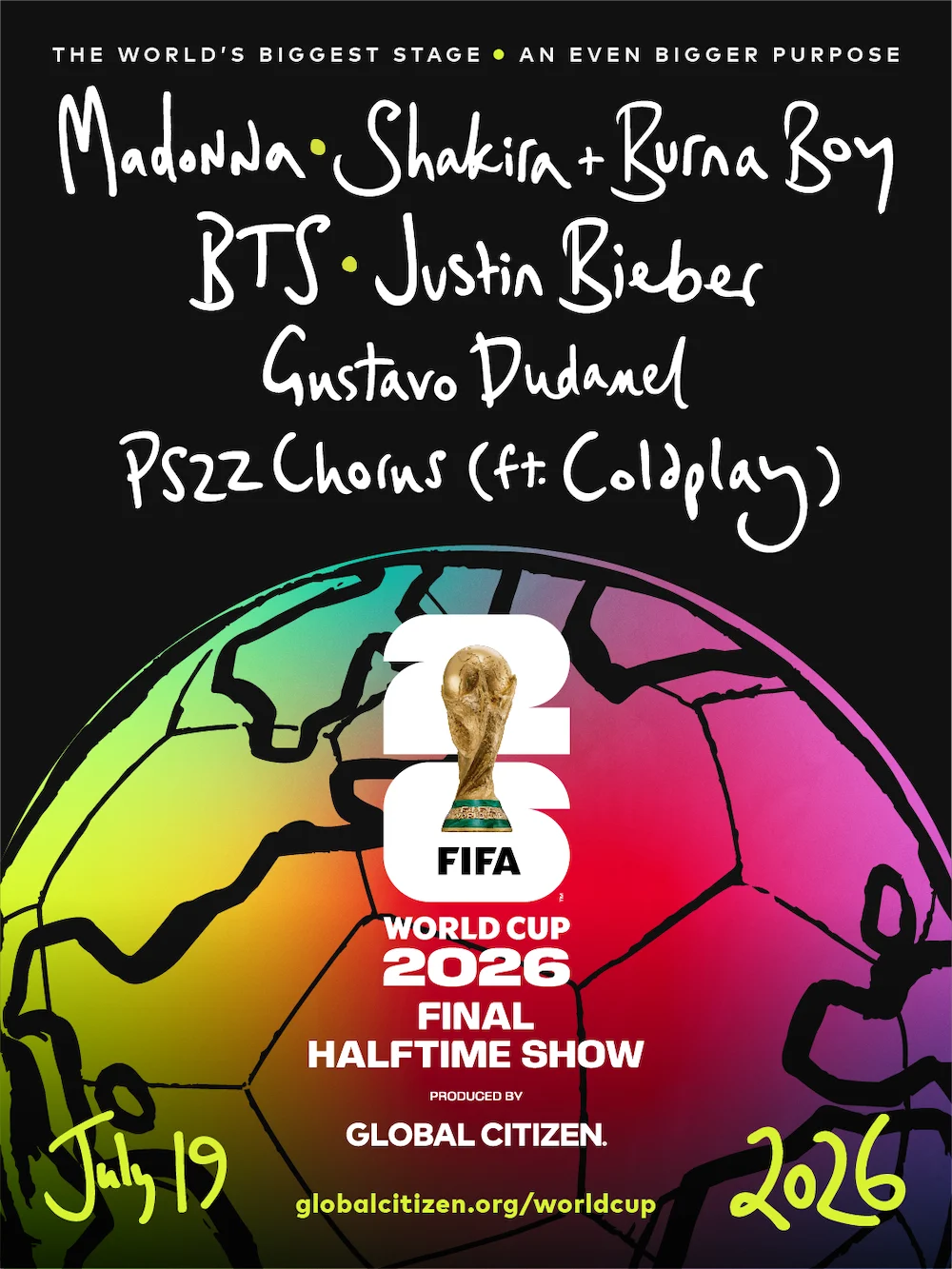
The intersection of global sport and pop culture has reached a new, unprecedented zenith. FIFA and Global Citizen have officially announced that pop sensation Justin Bieber will join an already monumental bill for the first-ever FIFA World Cup Final halftime show. The performance, scheduled for July 19th at the New York New Jersey Stadium (MetLife), promises to be a watershed moment in broadcast history, bringing together music’s biggest titans to celebrate the culmination of the 2026 FIFA World Cup.
Bieber joins a co-headlining roster that includes the incomparable Madonna, the rhythmic force of Shakira, and the global phenomenon BTS. This collaboration marks a paradigm shift for the tournament, introducing a spectacle format that, while long-established in American football, is entirely new to the world’s most popular sport.
A Staggering Lineup of Global Talent
The halftime show, which is slated to run for 11 minutes, has been meticulously curated by Coldplay frontman Chris Martin. Martin’s involvement extends beyond simple curation; he has been instrumental in aligning the artistic vision of the show with the mission of Global Citizen.
In addition to the quartet of headliners, the performance will feature an eclectic mix of talent designed to bridge generational and cultural divides. Afrobeats icon Burna Boy will bring his signature energy to the stage, joined by the world-renowned conductor Gustavo Dudamel, whose presence promises a sophisticated, symphonic element to the production. The New York-based PS22 Chorus is also set to perform, adding a touch of local community spirit to the grand event. Furthermore, Coldplay themselves will join the festivities, ensuring that the musical landscape of the evening is as diverse as the international audience watching at home.
In a whimsical turn, the organizers have confirmed that beloved characters from Sesame Street and The Muppets—including icons such as Kermit the Frog and Miss Piggy—will make appearances, adding an element of global charm that resonates across all age demographics.
The Mission: More Than Just Music
While the spectacle promises to be a feast for the senses, the primary objective of the event is altruism. The halftime show serves as the centerpiece for the FIFA Global Citizen Education Fund, a joint initiative established to raise $100 million. The funds are earmarked to expand access to education and foster football-related opportunities for underprivileged children worldwide.
"I’m grateful to be part of this Halftime Show, and even more grateful knowing it’s already helping expand access to education for children around the world," Justin Bieber stated in an official press release.
The campaign has already seen significant success, with over $50 million raised to date. FIFA has further bolstered this effort by pledging $1 from every ticket sold to 2026 World Cup matches directly to the initiative. Hugh Evans, Co-Founder and CEO of Global Citizen, described the magnitude of the event by drawing comparisons to historical humanitarian milestones. "This is the single largest gathering of artists united for a cause since Live Aid, and it could well be the most-watched 11 minutes of broadcast music performance in history," Evans noted.
The Mechanics of a Global Broadcast
The logistical scale of the 2026 World Cup final is staggering. With a worldwide audience potentially reaching into the billions, this broadcast is positioned to eclipse the viewership of any other musical event in history. To put the scale into perspective, the 2022 FIFA World Cup Final in Qatar, which saw Argentina clash with France, captured an estimated 1.5 billion viewers. By contrast, the 2026 Super Bowl, while a powerhouse of American entertainment, pulled in an average of 125.6 million US viewers.
The halftime show is designed to be a seamless, high-production broadcast that transcends borders. By moving away from the US-centric model of traditional halftime shows, the 2026 performance aims to utilize the universality of music to speak to a global citizenry. The integration of characters from The Muppets alongside international stars like Shakira and BTS serves as a deliberate effort to create a visual language that requires no translation.
Tournament Chronology: The Road to MetLife
As the announcement of the halftime lineup reverberates through the media, the 2026 FIFA World Cup itself is entering its most intense phase. The tournament has been a marathon of skill and strategy, and the final stretch is now upon us.

The quarterfinals are set to commence this Thursday, featuring a high-stakes showdown between France and Morocco. Friday will see Spain face off against Belgium, while Saturday promises a double-header: Norway takes on England, and Argentina faces Switzerland. The victors of these matches will advance to the semifinals next week, setting the stage for the championship match on July 19th.
For the finalists, the halftime show will represent a moment of reprieve and celebration. It is a unique challenge for the production team, who must transform the field of play into a high-tech stage and back into a pristine pitch within a matter of minutes, ensuring that the athletes’ focus remains on the match itself.
Strategic Implications and Future Precedents
The decision to implement a halftime show at the 2026 World Cup is a bold strategic move by FIFA. Critics have historically argued that the beauty of football lies in the purity of the sport, untainted by the commercial or theatrical excess of American-style halftime entertainment. However, FIFA’s partnership with Global Citizen reframes this addition not as a distraction, but as a vehicle for social change.
By tying the show to a $100 million fundraising goal, FIFA is effectively insulating the performance from accusations of "corporate clutter." Instead, it creates a symbiotic relationship where the entertainment industry provides the visibility, and the sporting industry provides the platform.
Furthermore, the influence of Chris Martin as curator suggests that the show will prioritize musical cohesion over the "glitz-first" approach often associated with massive televised events. The inclusion of artists as varied as Gustavo Dudamel and BTS indicates that the production team is aiming for a "global mosaic" effect, reflecting the tournament’s own international composition.
The Cultural Impact of the 2026 Final
As the tournament moves toward its conclusion, the cultural weight of the 2026 World Cup is becoming increasingly apparent. The choice of New York New Jersey Stadium (MetLife) as the venue for the final and the halftime show is significant. As a hub of global culture, the region is well-equipped to handle the influx of visitors and the technical demands of such a high-profile production.
For the artists involved, the performance is a career-defining opportunity. For Justin Bieber, it is a return to the world’s biggest stage, while for BTS, it represents the continued solidification of K-pop as the dominant global musical force. For legends like Madonna and Shakira, it is an opportunity to remind the world of their enduring relevance and ability to unite audiences across generations.
The 11-minute performance will not just be an interlude between two halves of football; it will be a testament to the power of collective action. Whether it is the education fund reaching its $100 million goal, or the visual spectacle of world-class performers occupying the same stage, the 2026 FIFA World Cup Final is poised to be etched into the history books as the moment when the world truly stopped to watch.
Conclusion
As July 19th approaches, the world’s attention is split between the tactical battles on the pitch and the burgeoning anticipation for the halftime show. With the lineup now finalized and the cause clearly defined, the event represents the pinnacle of modern sports and entertainment integration.
The success of the 2026 FIFA World Cup Final will be measured not only by the final score on the scoreboard but by the lasting legacy of the Global Citizen Education Fund and the memories created by the most ambitious halftime show in history. As Chris Martin, the headliners, and the myriad of international performers prepare to take the stage at MetLife, they do so with the knowledge that they are participating in a moment that transcends sport—a moment that seeks to educate, unite, and inspire a global audience of billions.
 Ammar Sabilarrohman
 Lina Irawan
 Nana Muazin
