

The global podcasting industry has reached a staggering valuation of $9.2 billion, a figure that highlights the medium’s transition from a niche hobbyist pursuit to a cornerstone of modern digital media. However, for years, the true scale of this economy remained obscured by fragmented data and the exclusion of burgeoning revenue streams like video-integrated podcasts and direct consumer monetization.
With the release of the second edition of the Owl & Co. Global Podcast Economy Report, the industry now has a clearer, more comprehensive map of its financial ecosystem. This report, which has become a primary reference point for major media outlets including Bloomberg and Forbes, as well as venture capital firms evaluating the sector, suggests that the industry is not just growing—it is maturing.
The Architecture of the $9.2 Billion Industry
To understand the scale of this $9.2 billion figure, one must look beyond traditional ad-spend metrics. For a long time, the podcasting industry relied on a narrow definition of revenue, primarily focusing on mid-roll advertising. Owl & Co.’s latest analysis broadens this lens to include five distinct revenue streams:
- Traditional Advertising: The bedrock of the industry, now bolstered by programmatic insertion and sophisticated targeting.
- Video Podcasting: A critical, high-growth area. As platforms like YouTube and Spotify have pivoted toward visual-first audio, the monetization of video feeds has become a primary driver of industry expansion.
- Consumer Revenue: Including subscriptions, premium memberships, and crowdfunded support, which provides creators with stable, recurring income independent of the volatile ad market.
- Licensing and Intellectual Property: The transition of audio narratives into television, film, and book adaptations.
- Branded Content and Partnerships: The integration of corporate sponsors into the fabric of the storytelling process.
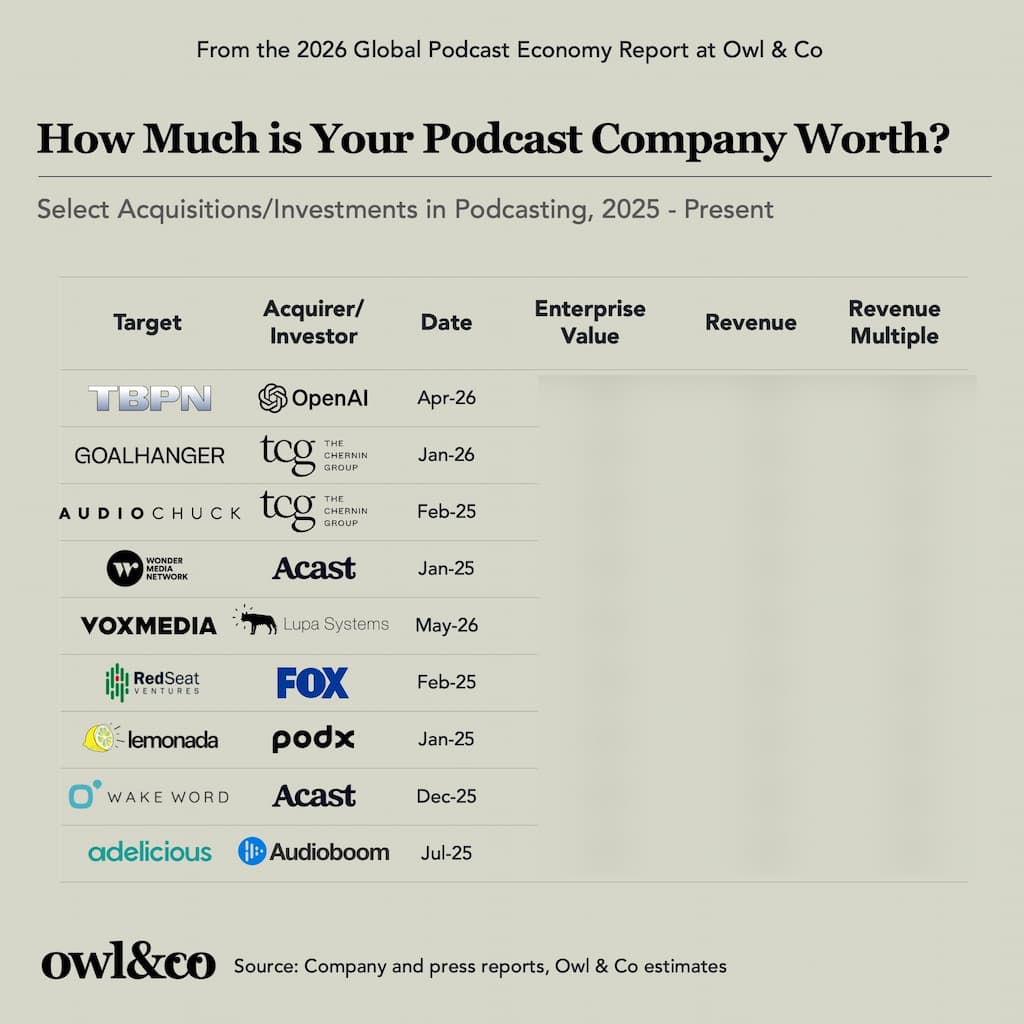
The Subscriber edition of the report offers a granular look at how these streams coalesce, providing growth rates by specific company, a breakdown of the "long tail" of independent creators, and a detailed audit of 16 months of Mergers & Acquisitions (M&A) activity.
A Chronology of Industry Maturation
The rise of the $9.2 billion podcast economy did not occur in a vacuum. It was the result of a multi-year convergence of technological accessibility and shifting consumer habits.
- 2020–2021 (The Acceleration): The pandemic served as a massive catalyst for audio consumption. With listeners stuck at home, both production and consumption of podcasts surged. This period saw a massive influx of capital, with high-profile acquisitions and the entry of major tech giants into the audio space.
- 2022–2023 (The Correction): The "gold rush" phase hit a reality check. Investors began demanding clearer paths to profitability. This led to a consolidation phase, where companies focused on efficiency, technical infrastructure, and the diversification of revenue streams beyond just ads.
- 2024–2025 (The Integration Phase): This period marked the dominance of the "video-first" strategy. Platforms began treating audio as a multi-modal product. Data from platforms like Spotify and Apple Podcasts shows that the most successful shows are now those that exist as high-quality video content simultaneously.
- 2026 (The Current Landscape): We are now in a phase of sophisticated measurement. The Owl & Co. report reflects this, providing the first truly "accounted-for" view of the entire industry, acknowledging that previous estimates were undercounting the total value of the market by failing to capture the full scope of creator-led monetization.
Supporting Data: The Pulse of the Market
The current market data reveals a landscape defined by both massive incumbents and a vibrant, albeit challenging, long tail.

The Powerhouses
As of mid-2026, the charts remain dominated by established giants. The Daily remains a juggernaut in the Apple Podcasts ecosystem, while The Joe Rogan Experience continues to hold the #1 spot on Spotify in the United States. These shows serve as the "anchor tenants" of the podcasting world, driving millions of users to the platforms and setting the benchmark for ad rates.
Emerging Segments and Growth
Data from the last quarter highlights significant activity in specific niches:

- Education for Kids: Categories like The Way the World Works (a Tuttle Twins podcast) are seeing massive growth, particularly in international markets like Ireland, suggesting that the "family and education" sector is ripe for further monetization.
- Science and Niche Interest: Bedtime Astronomy has surged to #1 in its category in Ireland, proving that hyper-niche content can capture loyal, highly engaged audiences that advertisers are increasingly willing to pay a premium to reach.
- Entertainment Analysis: The Rest Is Entertainment has secured the top spot in the TV & Film category in the United Kingdom, indicating that podcasts analyzing other media forms are becoming a dominant sub-genre.
Official Perspectives and Industry Insights
Industry leaders are increasingly focusing on "enterprise value"—the metrics that determine whether a podcast company is a sustainable business or merely a temporary project.
Justin Jackson, co-founder of Transistor, recently discussed the current state of the industry on The Sound Off Podcast. His insights highlight a critical shift: the focus is moving away from "subscriber count" alone toward "community retention" and "audience monetization."

Furthermore, the Podnews Weekly Review has pointed to interesting fluctuations in the distribution landscape. Recent reports indicate that Overcast, the independent player in the podcast player market, is experiencing notable growth. This is a critical observation for the industry: while Spotify and YouTube dominate the top-line revenue, there remains a significant, high-value audience that prefers independent, open-ecosystem listening apps. This "long tail" of listeners is often more resistant to churn and highly valuable for niche advertisers.
Implications: Where the Industry Goes from Here
The implications of a $9.2 billion valuation are profound.

1. The Death of the "Free-For-All" Era
As the industry scales, the demand for better data, more consistent measurement, and standardized ad-tech is reaching a fever pitch. Investors are no longer willing to throw money at "potential." They want to see the hard metrics provided by comprehensive reports like Owl & Co.’s.
2. The Video Imperative
The success of video-integrated podcasts is no longer an optional strategy; it is a requirement. Shows like Mindy’s Comedy Archives—which pair oral histories with visual portraiture—are setting a new standard for how podcasts can offer a multi-sensory experience. Producers who ignore the visual component of their show do so at their own peril.

3. Geopolitical and Cultural Relevance
Podcasting has also become a critical tool for civic discourse. The success of programs like Ernstfall — What if Russia Attacks NATO? demonstrates that long-form audio can handle complex, high-stakes simulations that would be difficult to capture in traditional news formats. By translating these simulations into English for an international audience, the creators have tapped into a global demand for deep, analytical content that goes beyond the 24-hour news cycle.
4. Professionalization of Support
Organizations like Chasing the Rainbows, which produces Cry It Out Loud, showcase how podcasts are being used as essential infrastructure for non-profits. The ability to provide "unfiltered real stories" about difficult topics like infant loss and infertility demonstrates that the medium is a powerful tool for community building and support, not just entertainment.

Conclusion
The podcasting industry has outgrown its infancy. With a valuation of $9.2 billion, it now stands alongside film, television, and publishing as a major pillar of the global creative economy.
For those looking to navigate this landscape, the lesson is clear: the winners will be those who can balance the scale of massive, platform-dominant shows with the intimate, high-value engagement of niche communities. Whether through better data, diversified revenue streams, or the seamless integration of audio and video, the podcast business is entering its most sophisticated chapter yet. As we look toward the remainder of 2026, the question is no longer whether podcasting is a viable business, but rather, who will be the next to define its future.

For those seeking a deeper dive, the Owl & Co. Global Podcast Economy Report remains the definitive resource. Readers can access the report using the code PODNEWS2026 for a 10% discount on Individual or Team editions through July 10th.
 Nila Kartika Wati
 Nana Wu
 Basiran
