

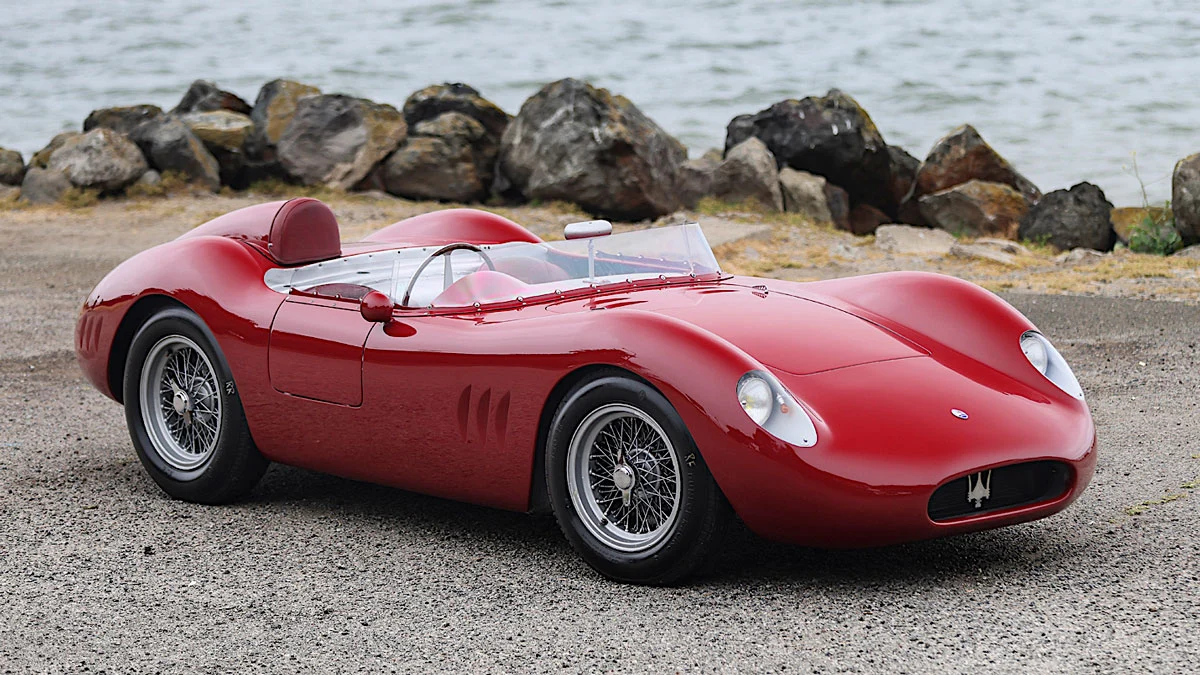
In the hallowed circles of vintage motorsport, few marques command the same level of reverence as the trident of Maserati. Among the most evocative machines to emerge from the company’s Modena workshops is the 1957 Maserati 200SI, a vehicle that embodies the raw, unbridled spirit of the golden age of sports-car racing. With its sinuous, hand-beaten aluminum bodywork by the legendary Carrozzeria Fantuzzi and a racing pedigree that spans continents, this particular chassis—No. 2425—stands as a testament to automotive endurance.
Next month, as the automotive world descends upon Northern California for the prestigious Monterey Car Week, this storied racer will take center stage at the Pebble Beach Auctions, presented by Gooding & Company. Scheduled for August 14 and 15, the sale represents a significant opportunity for collectors to acquire a piece of history that has been driven by legends, restored by masters, and campaigned at the world’s most demanding circuits.
The Genesis of a Racing Icon
To understand the significance of the 200SI, one must look back to the mid-1950s, a period defined by an intense technical arms race between Italian titans. By 1955, Maserati found itself in a strategic battle against Ferrari and the overwhelming success of the latter’s 500 Mondial. The response from Modena was the 200S, a masterpiece of lightweight engineering.
Designed as an open-cockpit two-seater, the 200S featured a then-revolutionary 2.0-liter, twin-cam four-cylinder engine. Housed within a bespoke tubular chassis and draped in the exquisite, low-slung bodywork of Fantuzzi, the car was built for agility and mechanical precision. It was an immediate sensation on the tarmac. Under the stewardship of French ace Jean Behra, the 200S secured an overall victory at the 1956 Gran Premio di Roma, while the legendary Stirling Moss piloted the model to a podium finish at the Supercortemaggiore race at Monza.

As the sport evolved, so did the regulatory landscape. In 1957, new international racing requirements mandated that sports cars be equipped with a wraparound windshield, two functional doors, and space for a spare wheel. Maserati responded with the "Sport Internazionale" (200SI), an evolution of the platform that maintained the car’s performance while adhering to the evolving standards of the FIA. Only 20 examples were ever constructed, making chassis No. 2425 an exceptionally rare specimen of Italian engineering.
A Chronology of Competition and Custodianship
The history of chassis No. 2425 is not merely a record of ownership; it is a vivid timeline of post-war racing culture. Following its departure from the Modena race shop in 1957, the car joined the esteemed Centro Sud race team. Its debut season was nothing short of spectacular, with driver Giorgio Scarlatti achieving a class victory and a third-place overall finish at the grueling 670-mile Giro di Sicilia. Shortly thereafter, at the Grand Prix de Cadours in France, André Loens steered the Maserati to a decisive overall victory, besting stiff competition from Ferrari’s 500 Testa Rossa and the nimble Porsche 550 RS.
By the end of the 1957 season, the red racer had crossed the Atlantic, arriving at the Dallas-based Carroll Shelby Sports Cars dealership. It did not sit idle for long. Dick Hall, the proprietor, quickly enlisted his younger brother, Jim Hall—who would later become a titan of American racing innovation—to campaign the car. Over the following months, the 200SI saw action at iconic American venues, including the Hourglass Field races in San Diego, the SCCA Nationals in Palm Springs, and the demanding circuits of Laguna Seca and Riverside.
The 1960s ushered in a series of dedicated privateer owners who kept the car active in SCCA competition. Lieutenant-Colonel Bob Kuhn campaigned the car throughout the 1958 season, while in 1962, the car was acquired by Otto Klein. A fascinating figure in his own right, Klein was a U.S. Navy veteran and a key architect of the Clean Air Act. He utilized the Maserati for three years before selling it in 1972 to prominent collector Wayne Golomb. Recognizing the need for a comprehensive renewal, Golomb commissioned a full mechanical restoration, during which the engine displacement was increased to 2.5 liters to suit the car for vintage events.

The 1980s and 90s saw the car cycle through the hands of several elite dealers and collectors, including two entries in the Mille Miglia Storica—a testament to the car’s "roadability." In 1995, British collector Phillip Marcq took stewardship, commissioning yet another comprehensive restoration to bring the car back to its peak aesthetic and mechanical form.
Modern Stewardship and Technical Integrity
In the early 2000s, the Maserati entered the collection of German enthusiast Wolfgang Wegner-Bscher. In a move that highlighted his commitment to preservation, Wegner-Bscher opted to conserve the original engine, commissioning renowned specialist Olaf Kuester to build a perfect replica of the 2.0-liter twin-cam unit for use in competition. This allowed the car to remain a competitive presence at historic festivals at Spa, Vallelunga, and the Nürburgring without risking the integrity of its original powerplant.
Since 2007, the car has been in the care of Warren "Ned" Spieker, the founder of Spieker Properties. A fixture in the California collector scene, Spieker has actively campaigned the Maserati at the Monterey Historics, ensuring that the 200SI remains a living, breathing machine rather than a static museum piece.
Market Positioning and Future Value
The road to the current auction has been one of careful market adjustment. Last year, the car was presented at the RM Sotheby’s Monterey auction with an estimate of $2.8 million to $3.2 million. Despite spirited bidding that reached $2.35 million, the car remained unsold. Subsequent efforts via private brokerage and an online listing on Bring a Trailer also fell short of the reserve, though the car attracted significant global interest.

David Brynan, a senior car specialist at Gooding & Company, suggests that the current market environment, combined with a recalibrated pricing strategy, makes this the perfect time for a serious collector to step forward. "I think these Maserati 200SIs have reached a point where they are seriously good value," Brynan notes. "Compared to a Ferrari 500 Testa Rossa, which commands nearly double the price, the 200SI offers a superior experience in terms of driving dynamics and versatility."
Implications for the Collector
The 200SI is not a car for the casual investor; it is a car for the connoisseur who intends to utilize it as it was meant to be used. Its "roadable" nature makes it a prime candidate for the most prestigious motoring rallies on the planet, from the Colorado Grand to the Goodwood Revival.
As it heads to the block with a new estimate of $2.25 million to $2.75 million, the car is offered with its original Tipo 4CF2 engine, a spare transmission and differential, the official Maserati Certificate of Origin, and a valid FIA Historic Technical Passport. For a collector looking to bridge the gap between historic significance and modern usability, chassis No. 2425 offers an unparalleled opportunity. It is a machine that has survived the rigors of 1950s European road racing, the heat of the Southern California track scene, and the evolving tastes of the modern market, remaining, above all else, a thrilling expression of the Italian racing spirit.
As August approaches, all eyes will be on Pebble Beach to see if this Maserati, with its rich, unbroken chain of ownership and its visceral, twin-cam roar, finds its next long-term custodian. Regardless of the final hammer price, the legacy of this 200SI is already secure—it is, as Brynan concludes, a "great ’50s sports race car that has done it all."
 Basiran
 Siti Muinah
 Nana
Nana
