

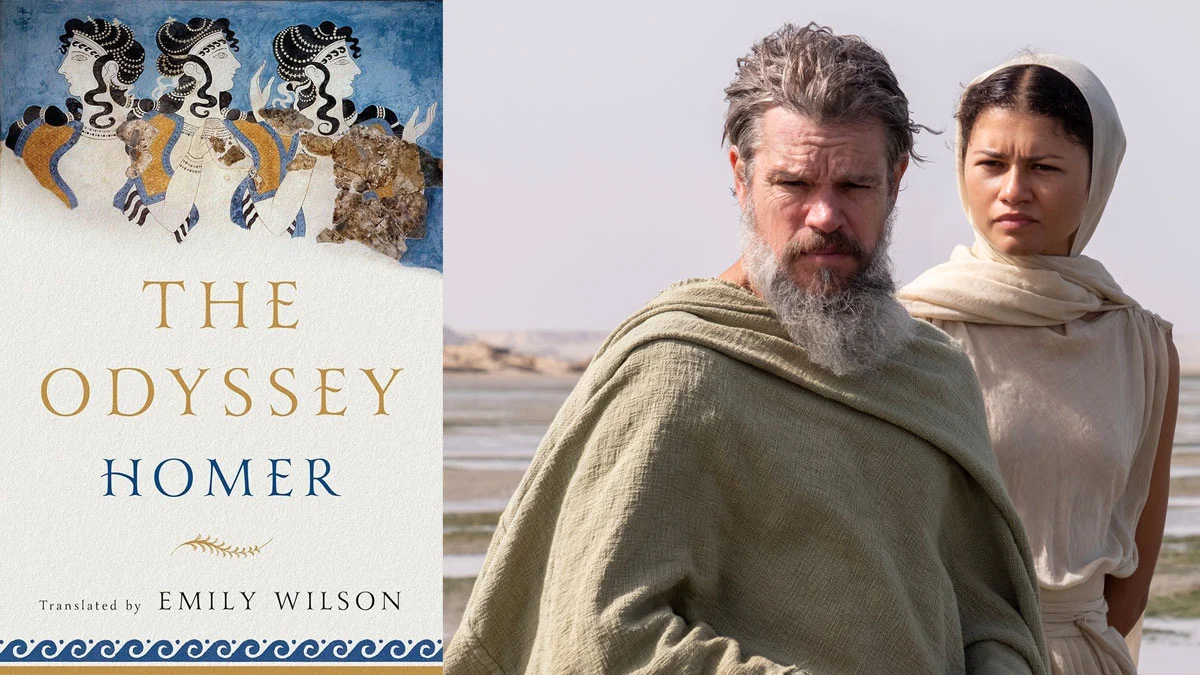
Whenever a high-profile cinematic adaptation of a literary titan hits the screen, it invariably triggers a resurgence of interest in the source material. From the gothic moors of Wuthering Heights to the graphic-novel panels of Watchmen, audiences are drawn to the original ink on the page to see how a director chooses to interpret the "definitive" text. However, few projects carry the weight of expectation surrounding Christopher Nolan’s upcoming adaptation of Homer’s The Odyssey.
Consisting of 12,109 lines organized into 24 distinct "books," the Homeric epic has long been viewed as a daunting, impenetrable fortress of ancient Greek literature. For decades, readers were often discouraged by translations that prioritized ornate, archaic, and overly academic prose. That changed in 2017 when classicist Emily Wilson released her groundbreaking translation, effectively dismantling the barriers between the ancient world and the modern reader. As anticipation for Nolan’s film—starring Matt Damon as the titular hero and Charlize Theron as the nymph Calypso—reaches a fever pitch, Wilson’s work stands as the definitive way to prepare for the cinematic event of the year.
The Evolution of the Epic: A Chronological Overview
To understand the significance of Wilson’s work, one must first look at the history of the poem’s transmission. Homer’s Odyssey was never intended to be a silent, academic chore; it was an oral performance, a living story meant to be heard, felt, and understood by a general audience.
- 8th Century BCE: The poem is composed, likely by a single poet or a tradition of poets, capturing the collective memory of the Bronze Age collapse and the subsequent Greek "Dark Ages."
- 17th–19th Century: Translations like those of Alexander Pope established a tradition of "elevated" English. These versions used grand, heroic couplets that favored a specific, aristocratic register, which eventually became the standard for scholars but alienated the average reader.
- 2017: Emily Wilson publishes her translation, the first by a woman to be published in English. She consciously rejects the "ornate" tradition, opting for a fluid, iambic, and—most importantly—readable style.
- 2026: Christopher Nolan’s The Odyssey is scheduled for theatrical release on July 17th, bringing the ancient tale to a new generation through the medium of IMAX-scale spectacle.
The Philosophy of Translation: Wilson’s Modern Approach
Wilson’s decision to modernize the text was not born of a desire to simplify, but to clarify. In her introduction, she writes, "The notion that Homeric epic must be rendered in grand, ornate, rhetorically elevated English has been with us since the time of Alexander Pope. It is past time, I believe, to reject this assumption."
Her translation captures the psychological nuance of characters like Calypso and Odysseus. Consider the exchange in Book 5, "From the Goddess to the Storm," where Calypso, having been ordered by the gods to release her captive lover, confronts him with a mixture of divine jealousy and human vulnerability:
The goddess-queen began. “Odysseus,
son of Laertes, blessed by Zeus—your plans
are always changing. Do you really want
to go back to that home you love so much?
Well then, good-bye! But if you understood
how glutted you will be with suffering
before you reach your home, you would stay here
with me and be immortal—though you might
still wish to see that wife you always pine for.
And anyway, I know my body is
better than hers is. I am taller too.
Mortals can never rival the immortals in beauty.”
Odysseus, a character defined as much by his cunning and diplomatic tact as by his physical strength, replies with the practiced ease of a man who knows how to survive a goddess’s wrath:
So Odysseus, with tact,
said “Do not be enraged at me, great goddess.
You are quite right. I know my modest wife
Penelope could never match your beauty.”
Wilson strips away the Victorian-era artifice to reveal the raw, human insecurity beneath the divine posturing. It is this accessibility that makes her version the perfect primer for Nolan’s interpretation.
Navigating the Culture Wars
Despite the literary merit of her work, Wilson has recently found herself at the center of a peculiar, often illogical, internet discourse. As anticipation for the Nolan film builds, a segment of the online population has attempted to gatekeep the "traditional" reading of Homer, often framing Wilson’s accessible, modern translation as an affront to "Greatness" and "Masculinity."
In a recent interview with Vulture, Wilson expressed a weary detachment from these conflicts. "It’s people who don’t care about the poem," she explained. "Yet when it comes to this culture-war internet discourse, they perform anger about it and a protectiveness of it. It has to do with an idea of a totally stable notion of greatness and masculinity: My identity as a man taps into this tradition, and the tradition has always been this way, and my imagined idea about ancient literature confirms that. Anything that challenges that interpretation of what ancient history is threatens their identity in terms of their gender and racial identities."
This reaction highlights a fundamental misunderstanding of the classical canon. History is not a static museum exhibit; it is a living conversation. By claiming that ancient literature must be preserved in a specific, rigid amber, these critics ignore the fact that the Odyssey has always been a story of change, identity, and the struggle to return home.
The Intersection of Literature and Cinema
The upcoming film by Christopher Nolan presents a fascinating juxtaposition. While the book allows for internal monologue and the slow, rhythmic appreciation of language, the film will offer the visceral power of visual storytelling.
Nolan is known for his technical precision and his obsession with time and structure—themes that are inherent to the Odyssey itself. Where the book gives us the flow of the language, the cinema gives us the spectacle of the Aegean, the terror of the cyclops, and the physical presence of figures like Theron’s Calypso.
The medium of film inherently changes the way we digest the story. In reading, we fill in the gaps with our own imagination; in viewing, we surrender our vision to the director. However, both formats serve the same ultimate goal: to explore what it means to be human in the face of insurmountable obstacles.
Implications: Why We Still Need the Odyssey
Why does a poem written nearly 3,000 years ago still demand our attention? Why do we continue to adapt it, translate it, and argue over it?
The answer lies in the universality of its themes. The Odyssey is not just a tale of a hero returning from war; it is a meditation on the nature of home, the complexity of grief, the fluidity of identity, and the petty jealousies that plague both gods and mortals. Wilson’s translation excels because she emphasizes the humanity of the characters. She reminds us that these were people who, like us, were "consumed by the same aching woes and petty jealousies and potential for joy."
When we read Wilson’s Odyssey, we are reading a time capsule of ancient traditions, but we are also reading a mirror held up to our own lives. We may not be slaughtering livestock to welcome guests into our homes today, but we are still searching for our place in the world, trying to balance our ambitions with our loyalties, and struggling against the "storms" of our own making.
Conclusion: A Call to Read
As July 17th approaches and the hype surrounding the film reaches its peak, the best way to engage with the material is to go straight to the source. Skip the vitriol of the online culture wars and the shallow takes on social media. Instead, pick up Emily Wilson’s translation.
You may not finish all 12,109 lines before the opening credits roll, but you will arrive at the theater with a deeper understanding of the soul of the story. You will see the nuance in Theron’s portrayal of Calypso and the calculated intelligence in Damon’s Odysseus. Most importantly, you will have participated in the ongoing, multi-millennial conversation that makes the Odyssey one of the greatest stories ever told.
The text is available, the story is timeless, and the conversation is waiting for you. Read the words, see the film, and decide for yourself what the journey means.
 Ammar Sabilarrohman
 Lina Irawan
 Nana Muazin
