

The transformation of the automotive industry toward full electrification has often been met with skepticism by purists, particularly regarding the loss of the visceral, analog connection between driver and machine. For decades, the Alpine A110 has stood as a beacon of lightweight agility and balanced handling—a French masterpiece that prioritized finesse over brute force. Now, that icon is entering a new era. The long-theorized electric iteration of the A110 is no longer a mere design study or a digital rendering; it is a functioning, high-performance reality.
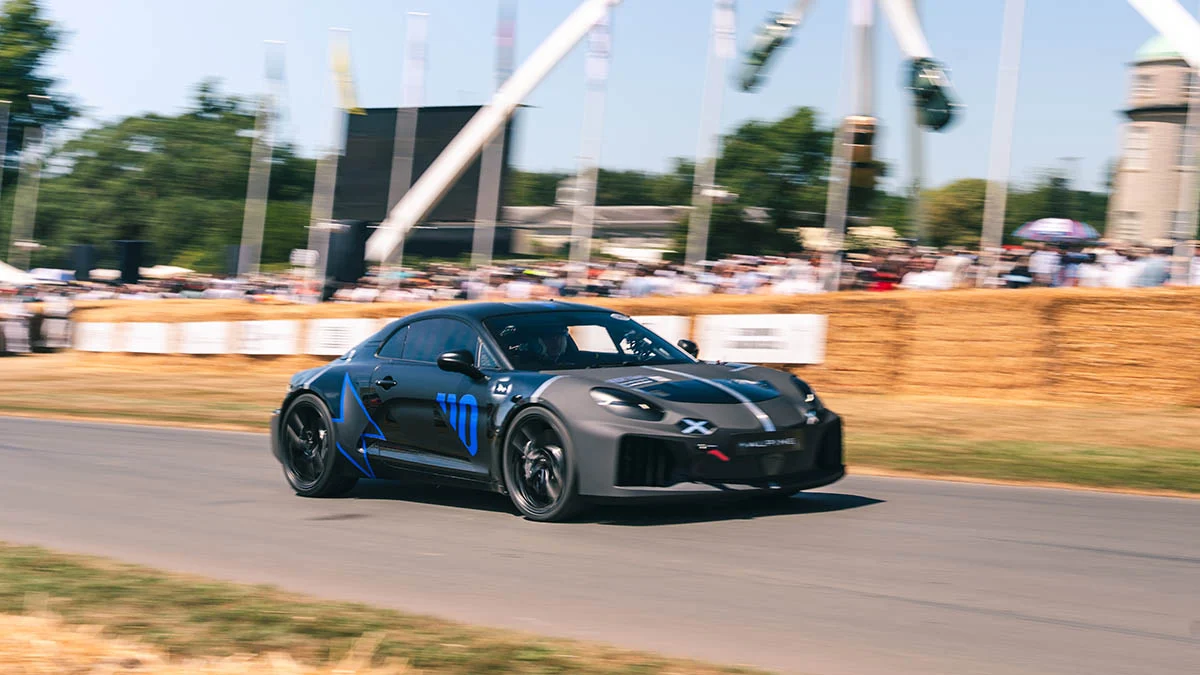
At the prestigious Goodwood Festival of Speed, Alpine pulled back the curtain on its “A110 Future,” a battery-electric evolution of the sports car that has defined the brand’s resurgence. While the vehicle on display remains a “development mule,” its public debut marked a pivotal moment in the automaker’s history: the first time the world witnessed the electrified Alpine in motion, tearing through the iconic Goodwood hill climb.
Main Facts: A New Chapter for a French Icon
The debut of the A110 Future is not just about swapping a combustion engine for a battery pack; it is a fundamental reimagining of what an electric sports car can be. At the heart of this vehicle lies the all-new "Alpine Performance Platform," a modular architecture designed specifically to retain the brand’s DNA while embracing modern electrification.
The traditional 1.8-liter turbocharged inline-four engine—a powerplant praised for its character and responsiveness—has been retired in favor of a sophisticated "dual E-motor" system. These motors are strategically positioned on the rear axle, a choice that reinforces Alpine’s commitment to a rear-wheel-drive bias, which has been the cornerstone of the A110’s legendary handling characteristics.
Feeding these motors is a high-performance 800-volt battery system. This architecture is designed to support rapid charging and consistent power delivery, essential for a car intended to perform on both track and mountain passes. The power distribution is unconventional yet deliberate: 25 percent of the system’s capacity is managed by the front, while 75 percent is directed toward the rear. This weight distribution, coupled with a highly advanced torque vectoring system, is intended to mimic the physics of a mid-engine sports car, ensuring that the transition to electric power does not come at the cost of the car’s signature turn-in agility.
A Chronological Progression: From Theory to Asphalt
The road to the Goodwood debut has been one of calculated development. The Alpine A110 has spent years as a darling of the motoring press, but the transition to an EV platform began in earnest with the announcement of the brand’s "Dream Garage" strategy.
- Initial Conceptions: Following the success of the modern A110 (reintroduced in 2017), Alpine signaled that it would pivot toward an all-electric lineup. For years, this remained in the realm of corporate strategy and conceptual prototypes.
- The Development Phase: Throughout 2023 and early 2024, engineers worked in secret to marry the lightweight chassis of the A110 with the complexities of high-voltage battery storage. The primary hurdle was weight; battery density is the enemy of the lightweight sports car.
- The Goodwood Reveal (July 2024): The Festival of Speed served as the stage for the public’s first glimpse of the "mule." While the exterior silhouette remains familiar, the mechanical heart is entirely new.
- The Hill Climb: With F1 driver Pierre Gasly behind the wheel and the Duke of Richmond in the passenger seat, the car navigated the 1.17-mile course with poise. Despite instructions to maintain a moderate pace, the video footage confirms the car’s readiness, showcasing quick acceleration and effortless navigation through the course’s nine technical turns.
Supporting Data: Engineering the Weight-to-Power Ratio
In the world of high-performance EVs, weight is the ultimate adversary. Most modern electric sports cars suffer from "heft," often tipping the scales well over 4,000 pounds. Alpine, however, has taken a different approach. The company has set an aggressive target: to keep the A110 Future under 3,000 pounds.
To put this into perspective, if Alpine succeeds, the A110 Future will be significantly lighter than the vast majority of performance-oriented EVs currently in production. This weight management is achieved through a minimalist design philosophy and the use of the new modular platform, which integrates the battery pack into the car’s structural frame rather than simply bolting it into a heavy steel chassis.
Regarding performance, the figures are equally impressive. CEO Philippe Krief has publicly stated that the company is targeting an output of 464 horsepower. This represents a massive leap—an increase of more than 100 horsepower over the current top-tier combustion model, the A110 R Ultime. When combined with the instant torque delivery characteristic of electric motors, the A110 Future promises to be significantly faster than any previous iteration of the car, potentially pushing it into the territory of high-end supercars.

Official Responses: The Drivers and the Visionaries
The reception at Goodwood was overwhelmingly positive, with those closest to the project emphasizing that the "soul" of the car remains intact.
Pierre Gasly, who has spent his career pushing the limits of high-downforce racing, was vocal about his experience behind the wheel. "Alpine continues to show that an electric sports car can be lighter, sharper, and really enjoyable to drive," Gasly stated following his run. "I am certainly excited to see what the future holds and I hope everyone enjoyed this show today."
The leadership at Alpine, led by Philippe Krief, has framed this project as a necessity for the brand’s survival and relevance. In various interviews, Krief has stressed that the transition to electric is not about abandoning the "Alpine feeling," but rather enhancing it. By using a rear-biased motor setup and advanced software to manage torque, the team aims to deliver a driving experience that feels organic and rewarding, rather than the sterilized, "appliance-like" feel that critics often associate with early-generation electric vehicles.
Implications: The Future of the Sports Car Segment
The successful demonstration of the A110 Future at Goodwood carries significant implications for the broader automotive landscape. It challenges the prevailing industry narrative that electric vehicles must be heavy, bloated, and focused solely on straight-line speed.
1. The Lightweight EV Benchmark
If Alpine achieves its sub-3,000-pound target, it will set a new industry standard. This would prove that performance EV development does not need to rely on massive batteries and heavy frames to achieve high output. It could force other manufacturers, such as Porsche and Lotus, to rethink their own lightweight strategies.
2. The Modular Platform Strategy
The use of the Alpine Performance Platform is a strategic move that allows for future expansion. The current dual-motor rear-wheel-drive setup is designed with the possibility of adding a front-mounted motor later. This provides Alpine with the flexibility to offer various performance tiers, potentially introducing an All-Wheel-Drive (AWD) variant for buyers who demand maximum grip, while keeping the RWD base model for purists who value the car’s traditional handling dynamics.
3. Preserving the Heritage
The most profound implication is the preservation of a brand identity in the face of radical technological change. By focusing on the "A110 feeling"—characterized by balance, agility, and driver feedback—Alpine is proving that a brand can evolve without losing its heritage. The A110 Future acts as a bridge between the analog past and the digital future, suggesting that the "sports car" as a category is not dying; it is simply changing its fuel source.
As development continues, the automotive world will be watching closely to see if the production version of the A110 Future can retain the poise shown by the development mule at Goodwood. If the current trajectory holds, Alpine may well be the first automaker to successfully translate the visceral joy of a lightweight, mid-engine sports car into the electric age. The silent, swift run at Goodwood was not just a show—it was a statement of intent. The era of the electric sports car has arrived, and if Alpine has its way, it will be faster, sharper, and more exhilarating than ever before.
 Evan Lee Salim
 Asep Darmawan
 Laily UPN
