

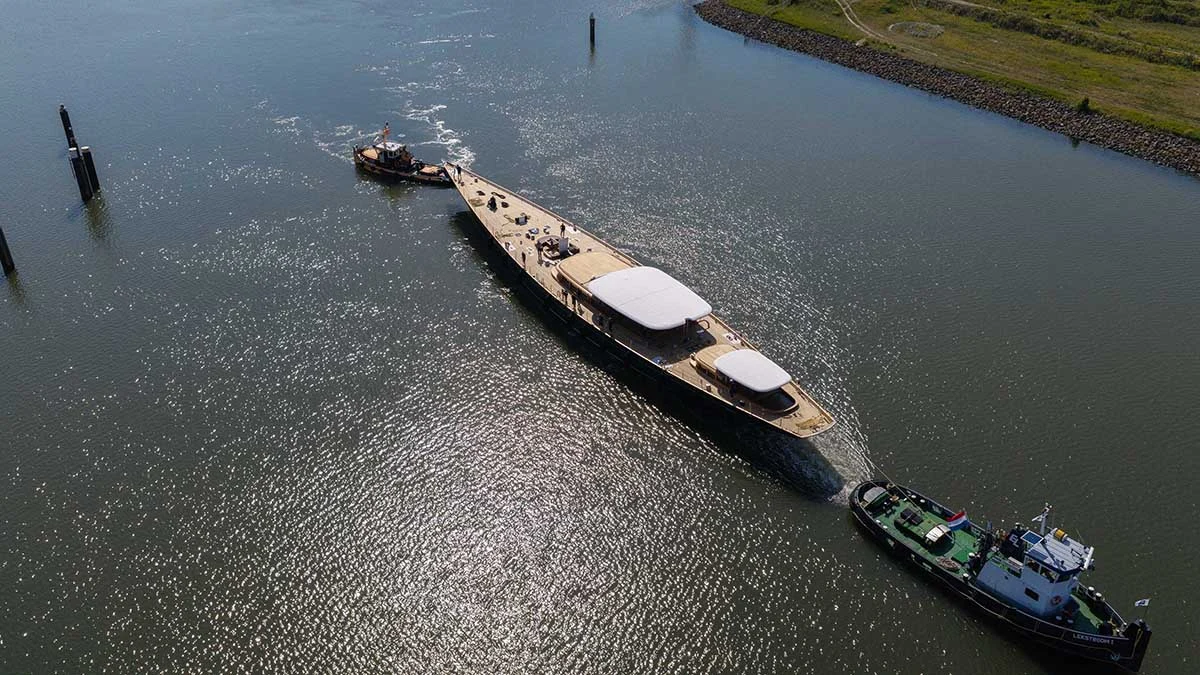
After seven years of rigorous engineering, computational modeling, and ambitious vision-casting, the maritime world has reached a defining moment. Zero, the 230-foot sailing yacht that has long existed as the industry’s "holy grail" of sustainable design, has finally touched the water. Launched in the Netherlands this past July, the vessel represents far more than a luxury plaything for the elite; it is a proof-of-concept for the future of clean propulsion. Awarded top honors in the Robb Report’s 2025 Best of the Best, Zero is poised to change the narrative surrounding high-end yachting, proving that opulence and environmental responsibility are no longer mutually exclusive.
A Symphony of Engineering: The Core Innovation
At the heart of Zero’s significance is her unprecedented energy architecture. While many modern yachts boast "hybrid" systems, Zero is the first vessel of her scale designed to operate entirely on renewable energy. The engineering team, led by the Dutch design studio Vripack in collaboration with Dykstra Naval Architects and Vitters Shipyard, has effectively created a self-sustaining power plant that doubles as a world-class superyacht.
The vessel utilizes a sophisticated, multi-layered energy harvesting system. Her primary power generation comes from a 250 kW hydrogeneration setup that captures energy from the water’s flow while the yacht is under sail. This is augmented by a sprawling 1,000-square-foot array of high-efficiency solar panels integrated into the yacht’s structure, alongside a wind-harvesting electrical system capable of pulling an additional 200 kW.

All this harvested energy is funneled into massive, state-of-the-art onboard battery banks. The system is governed by proprietary, high-tech software that manages energy distribution with surgical precision. According to the designers, this setup grants Zero roughly two weeks of total energy autonomy, offering the vessel a virtually unlimited range provided the elements cooperate. For the modern explorer, this means the ability to traverse the globe without the heavy carbon footprint traditionally associated with long-range luxury yachts.
The Seven-Year Odyssey: A Chronology of Development
The path to the water was neither short nor simple. Zero began as a conceptual sketch in 2019, a period when the marine industry was beginning to grapple with its role in the global climate crisis. What started as a series of theoretical "what-if" scenarios evolved into a gargantuan task requiring over 60,000 hours of research and development.
- 2019: The initial concept is unveiled, setting the ambitious goal of a zero-emission, large-scale sailing yacht.
- 2020–2022: The design phase. Vripack takes the lead on exterior and interior aesthetics, while Dykstra Naval Architects focuses on the complex physics of the hull, sailplan, and propulsion thrusters.
- 2023: Construction officially begins at Vitters Shipyard. The build is characterized by intense, iterative work, requiring constant collaboration between designers and shipbuilders to ensure the structural integrity of the energy-harvesting systems.
- July 6, 2026: Zero exits the construction hall. She is transported to Harlingen for the technical launch and the delicate process of stepping her masts.
- Late 2026: Final commissioning and sea trials commence, with delivery to the owner expected shortly thereafter.
"For years, Zero has existed as a vision, a series of calculations, design studies, and engineering hypotheses," says Mark Leslie-Miller, partner at Dykstra Naval Architects. "Seeing her afloat transforms all of that into a living experiment. It is the culmination of years of quiet, painstaking labor."

Aesthetics Meets Ethics: The Design Language
Despite her technological complexity, Zero is a masterclass in nautical elegance. Her exterior design pays homage to the golden age of sailing, featuring a striking Palma Blue hull that cuts a graceful silhouette. The superstructure utilizes FSC-certified Brazilian teak, emphasizing a commitment to sustainable sourcing without sacrificing the tactile luxury expected of a vessel in this class.
The interior continues the narrative of nature-inspired design. Vripack’s team utilized materials such as smoked European oak and "leathered" stone to create an atmosphere that feels organic and grounding. With accommodations for up to 12 guests and nine crew members, the yacht is designed for extended expeditions. Each of the four guest cabins is themed after the owner’s favorite global destinations, blending personal narrative with the yacht’s broader mission of environmental stewardship.
The Open-Source Revolution: A Gift to the Industry
Perhaps the most altruistic aspect of the project is its open-source nature. Recognizing that the climate challenge is too large for any single company to solve alone, the stakeholders behind Zero have committed to sharing their data. Through the non-profit Foundation Zero, the design, engineering, and performance metrics gathered during the yacht’s life will be made publicly available.

"We look forward to seeing Zero in her natural habitat," says Vitters CEO Louis Hamming, "and showing the world what can be achieved when creative minds embark together on a voyage to create a yacht that proves what can be done to make the world and the seas a little better."
This transparency is a radical departure from the typically secretive world of superyacht construction. By treating the yacht as a "science project," the team hopes to catalyze a wave of innovation across the wider maritime industry, effectively providing a blueprint for shipyards everywhere to follow.
Future Implications: The Road Ahead
As Zero prepares for her maiden voyage, she enters a period of intensive sea trials. These tests are not merely to ensure that the yacht sails well, but to validate the real-world performance of her green energy systems. The data collected will be instrumental in future iterations of zero-emission vessels.

Once delivered, the yacht will serve a triple purpose: private leisure, select chartering, and, crucially, scientific research. By facilitating oceanic study, the vessel will continue to give back to the environment even after she is fully operational.
The successful launch of Zero marks a pivot point. It proves that the "zero-emission" label is no longer a marketing buzzword or a futuristic dream—it is a current, tangible reality. For the billionaire adventurer, it offers a way to explore the most pristine corners of the earth without leaving a mark. For the maritime industry, it offers a standard to aim for. As Marnix Hoekstra of Vripack aptly put it, Zero was their "perfect storm"—a challenge that demanded everything, but ultimately delivered a landmark achievement in the history of naval architecture.
The world will be watching closely as Zero unfurls her sails. If she performs as designed, she will not just be a flagship for her owners, but a beacon for the entire yachting community, signaling that the future of the sea is, at long last, green.
 Evan Lee Salim
 Asep Darmawan
