

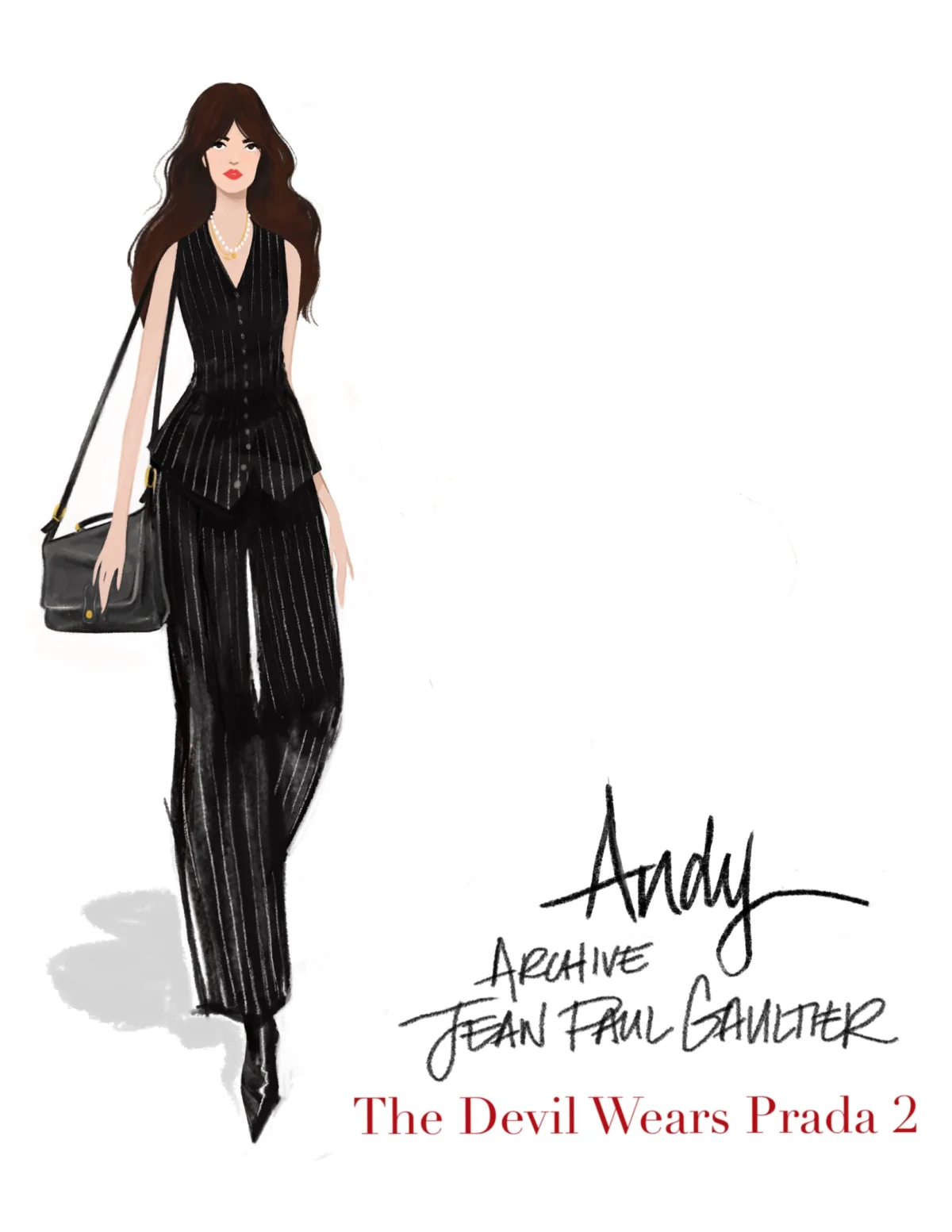
When the news first broke that a sequel to the seminal fashion film The Devil Wears Prada was officially in production, the immediate reaction from the global fanbase was a collective, breathless question: What will they be wearing?
Bringing back the legendary quartet of Meryl Streep, Anne Hathaway, Emily Blunt, and Stanley Tucci was a monumental achievement in casting, but for costume designer Molly Rogers, the task was far more daunting than simply dressing A-list talent. She was stepping into the shadow of the original film’s iconic costume designer, the legendary Patricia Field, tasked with capturing the essence of a world that has undergone a tectonic shift since 2006. As Field herself famously warned, "You’d better not screw it up."
In an exclusive interview with Gold Derby, Molly Rogers opens up about the Herculean effort required to evolve the aesthetic of Runway for a modern audience, the logistical nightmares of sourcing fashion in the digital age, and the collaborative process of aging characters who are now deeply embedded in the cultural zeitgeist.

The Evolution of Fashion: From Ladders to Algorithms
To understand the scale of the challenge, one must look at how the machinery of fashion has changed. In the first film, the aesthetic was defined by a specific, tactile approach to sourcing. It was an era of physical legwork and deep archival dives.
"I’ve got a good story to illustrate it," Rogers recalls. "On the first movie, Pat [Field] and I drove out to New Jersey in her car, went into a warehouse, and together, we got up on ladders and went through the Donna Karan archives for Miranda Priestley. Can you imagine if I asked one of my assistants to go to a warehouse and get up on a ladder and look for clothing today?"
The contrast is stark. In the mid-2000s, fashion discovery was a slow, deliberate process of personal connection and physical proximity. Today, the world of fashion is an "ocean" of infinite, instant access. Rogers notes that for the sequel, the challenge wasn’t finding clothes—it was the act of curation.

"I couldn’t get on an app and meet a designer in Nicaragua who was knitting some incredible sweater from a llama [during the first film]," she explains. "The access is just mind-boggling now. So, the biggest difference is that on the second movie, it was about being able to edit this vast ocean of clothing when you have access to everything."
Establishing the DNA: Character Continuity vs. Growth
One of the primary concerns for the design team was maintaining the "DNA" of the characters. Much like the iconic styling seen in Sex and the City, the characters in The Devil Wears Prada operate within very specific, well-defined stylistic lanes.
"Everyone is so familiar with each of those characters," Rogers says. "But that served me greatly, because Patricia, in the first movie, created such a powerful DNA for each of them. They have their own lane, and it’s so defined."

The Transformation of Andy Sachs
The most significant departure in the sequel involves Anne Hathaway’s Andy. In the original, she was the quintessential fish-out-of-water, struggling to reconcile her intellectual identity with the superficial demands of high fashion. By the end of the film, she had learned the language, but she hadn’t necessarily "drank the Kool-Aid."
In the sequel, the evolution of Andy’s wardrobe became the subject of intense, months-long debates between the creative team, including screenwriter Aline Brosh McKenna, director David Frankel, and Hathaway herself.
"When I told Annie she didn’t get access to the Runway closet to pilfer it with Nigel until the 26th outfit in the movie, she was like, ‘What? I can’t have anything?’" Rogers laughs. The goal was to depict an Andy who has grown, someone who knows the value of vintage Maison Margiela and carries herself with an air of "quiet luxury," yet still retains the soul of a journalist rather than a pure fashionista.

Timelessness in an Era of Trends
In a social media-driven world where "micro-trends" live and die in a matter of weeks, Rogers faced a difficult balancing act: how to make the film look current without making it look dated within a year of its release.
"It was really important to me, because when I watched the first movie, I can’t figure out what year it is," Rogers admits. "Those clothes look pretty timeless to me, even a Chanel thigh-high boot, which was very specific. I did not want the second movie to be an advertisement for anybody."
To achieve this, Rogers avoided the "it-bags" and hyper-trendy silhouettes that define modern Instagram fashion. Instead, she leaned into pieces that possess a historical weight. She cites a Paco Rabanne metallic chainmail dress as an example—a garment that references the 1960s, fits into the present, and will remain relevant in the future. "You can’t define that dress… you can’t pinpoint a year. I like that idea."

The Tassel Jacket: A Lesson in Instinct
Every fashion film needs a "hero" piece—an item that stops the audience in their tracks. In The Devil Wears Prada 2, that item is undoubtedly the now-famed tassel jacket worn by Miranda Priestley.
Rogers reveals that the garment was the very first thing she sourced for the production, despite having no idea where it would fit into the narrative. "I showed it to Meryl on the runway, and I said, ‘I don’t think this is going into production. It’s under the radar.’ And she was like, ‘We’ve got to get it in.’"
The jacket’s inclusion was not without its hurdles. "Higher-ups, when they don’t understand something, they’re afraid of it," Rogers explains. "Like it’s going to pull focus or something. But those of us in fashion know, no, it’s going to be the it thing."

When the scene was eventually written—a moment pitting art against commerce, and good against evil—the jacket became the focal point. The resulting "shimmy" that Meryl Streep performed in the elevator, while wearing the jacket, was entirely unscripted. "That’s why she’s who she is," Rogers notes.
The Implications of a Modern Sequel
The release of The Devil Wears Prada 2 marks a significant moment for film fashion. It bridges the gap between the traditional, high-gloss "magazine" era of fashion and the modern, digital-first landscape.
By prioritizing character identity over brand placement and timeless design over fleeting trends, Rogers has ensured that the sequel honors the legacy of the original. The film is not merely a visual feast; it is a commentary on how we consume fashion today. The reliance on digital archives, the shift toward vintage as a signifier of status, and the pressure to maintain one’s brand identity in a world of infinite choices—these are the themes that permeate every frame.

For the audience, the result is a film that feels both nostalgic and vital. The characters have grown, the industry has shifted, and the clothes remain the ultimate vehicle for storytelling.
The Devil Wears Prada 2 is currently available on digital platforms, inviting viewers to once again enter the high-stakes, impeccably dressed world of Runway. Whether you are watching for the plot or the couture, the film stands as a testament to the fact that while fashion changes, style—and the ability to curate it—is forever.
As Rogers puts it, the ultimate goal was never to replicate the past, but to ensure that when viewers look back at this film in another two decades, they, too, won’t be able to "figure out what year it is." In that, she has succeeded.
 Ammar Sabilarrohman
 Siti Muinah
 Iffa Jayyana
