

By Chris Guest
Published October 6, 2026
In the upper echelons of the Pokémon Trading Card Game collecting community, financial value and pure aesthetic aura do not always walk hand-in-hand. While the iconic Base Set Charizard and its myriad modern reprints remain the most recognizable cards in the hobby’s history, they rarely command the astronomical figures of a one-of-a-kind promotional piece—such as the stupendously rare Pokémon Art Academy Pikachu promo that fetched a mind-boggling $8.4 million at auction in late September 2026.
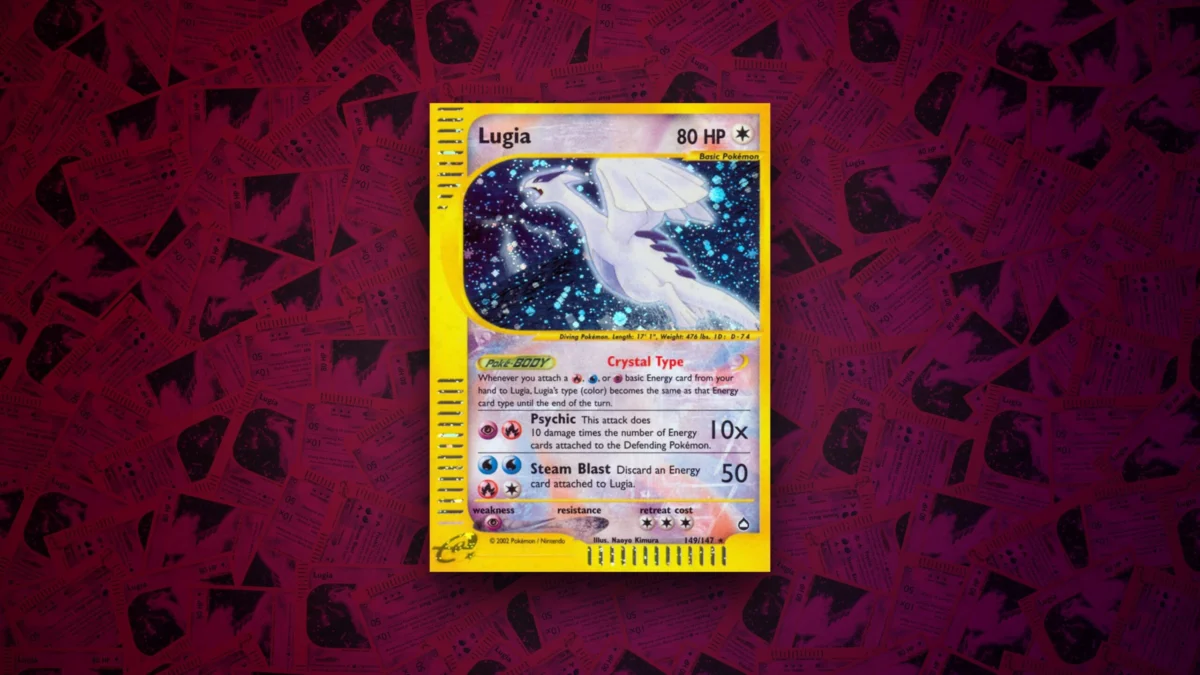
Yet, true reverence in the hobby is often reserved for pieces of unmatched artistic pedigree and severe historical scarcity. This sentiment was dramatically underscored when a pristine, professionally graded PSA 10 Holo Lugia from the 2003 Aquapolis expansion went under the hammer. The card shattered its previous high-water mark, selling for a staggering $360,000—obliterating the prior record of $148,511 by a massive 142%.
For collectors and investors alike, the sale marks a watershed moment for the e-Reader era of the Pokémon TCG, cementing the legendary "Crystal" Lugia as one of the most coveted and untouchable holy grails in the entire hobby.
Main Facts: Anatomy of a Record-Breaking Sale
The star of the historic auction is a certified PSA 10 Gem Mint copy of the Aquapolis Secret Rare "Crystal" Lugia (Card #149/147). Featuring a holographic finish and a designation that fundamentally altered how the card functioned within the tabletop game, this specific variant has long been recognized as a crown jewel of vintage collecting.
The transaction pushes the ceiling for vintage, non-promotional Pokémon cards into a new tax bracket, proving that collector demand for historically significant, low-population art pieces from the early 2000s is stronger than ever. Unlike modern chase cards manufactured with artificial scarcity in mind, the Aquapolis Lugia earned its legendary status through a combination of a depressed market during its initial release, a complex design architecture, and breathtaking artwork that has stood the test of time.
Chronology: The Rise and Fall (and Rise) of the e-Reader Era
To understand why the Aquapolis Lugia commands such ferocious bidding wars, one must look back at the tumultuous era in which it was born.
The e-Reader Experiment
The first three e-Reader-compatible Pokémon TCG sets—Expedition (released in September 2002), Aquapolis (January 2003), and Skyridge (May 2003)—arrived during a period when the initial, white-hot Pokémon mania of the late 1990s had begun to cool. Casual fans had largely moved on to other entertainment properties, and the general public had grown fatigued with the concept of "catching ’em all."

Capitalizing on this lull, Nintendo and Wizards of the Coast attempted to revitalize the physical card game by introducing the Nintendo e-Reader. By scanning the unique dot-matrix strips printed on the sides and bottoms of these cards, players could unlock mini-games, Pokédex data, and alternate card borders on their Game Boy Advances.
Wizards of the Coast Passes the Torch
Because the market appetite for Pokémon had dipped significantly, print runs for the e-Reader sets were comparatively low. The final set of the block, Skyridge, received only a single print run before Wizards of the Coast—the publisher that had successfully shepherded the game through its meteoric global rise—relinquished its publishing duties.
Following Skyridge, Pokémon USA (the direct predecessor to The Pokémon Company International) took over the English-language game, officially ushering in the Ruby & Sapphire era. Consequently, the e-Reader block represents the definitive end of an era for the TCG, locking the cards from Expedition, Aquapolis, and Skyridge into an era of natural scarcity.
Supporting Data: What Makes the Aquapolis Lugia So Special?
The defining characteristic of the chase cards from Aquapolis and Skyridge was the introduction of "Crystal" Pokémon. These cards retooled iconic species from the franchise into Colorless-type Pokémon featuring a unique, game-altering mechanic.
The Crystal Type Poké-Body
All Crystal cards shared a specialized Poké-Body known as "Crystal Type." This rule allowed the card’s elemental type to shift dynamically until the end of the turn based on whatever Basic Energy card was attached to it. While this mechanic was distributed across a fascinatingly eccentric roster of Pokémon—including Golem, Crobat, Kingdra, Celebi, and Ho-Oh—it was the Skyridge Crystal Charizard and the Aquapolis Crystal Lugia that captured the imagination of the player base.
Despite the immense mainstream popularity of Charizard, it is the Aquapolis Lugia that proudly retains the crown as the most expensive and revered piece of cardboard bearing the Crystal designation.
Built-In Scarcity and Secret Rarity
All Crystal Pokémon were classified as Secret Rares. This meant their collector card numbers exceeded the official set list printed on the packaging. For instance, Lugia was numbered 149/147 in a set that officially ended at 147. For children and collectors opening booster packs in 2003, pulling a card numbered beyond the set checklist felt like discovering a hidden easter egg, perfectly leaning into the exploratory ethos of the franchise.
Artistic Mastery: Naoyo Kimura’s Magnum Opus
While mechanics and scarcity dictate a card’s collectibility, art gives it an enduring soul. The visual presentation of the Aquapolis Crystal Lugia is widely considered a masterclass in miniature canvas design.

The Lattice Foil Pattern
All Crystal cards featured a distinct text box background adorned with a multifaceted, diamond-like lattice pattern. When viewed physically under light, the crystalline texture creates an almost prismatic effect that online digital scans frequently fail to capture.
The Dynamic Illustration
The card’s artwork was illustrated by Naoyo Kimura, a veteran artist who has contributed over 260 illustrations to the Pokémon TCG over her illustrious career. Kimura’s portfolio includes modern masterpieces like the infamous Pikachu with Grey Felt Hat promo from the Van Gogh Museum collaboration, as well as several gorgeous Southern Islands promotional cards.
However, many enthusiasts argue that the Aquapolis Lugia is her finest work. The illustration depicts Lugia violently breaching the ocean surface, roaring into a tempestuous, wind-whipped sky—a visual testament to the Legendary Pokémon’s titanic, storm-summoning power.
Deliberate Framing Choices
Kimura made the bold artistic decision to utilize a canted, slanted horizon line, forcing the viewer to tilt their head slightly to take in the full composition. Furthermore, because the physical card had to accommodate the chunky e-Reader tracking dot-matrix stripe along its bottom and left-side borders, the actual art box was remarkably compact. Rather than hindering the design, this limitation forced a tighter, more dramatic composition that makes Lugia’s explosive emergence pop with incredible intensity upon closer inspection.
Implications: A Lasting Legacy in the Modern TCG
The ripple effects of the Aquapolis Crystal Lugia extend far beyond a single high-rolling auction house. The card’s enduring cultural footprint has not gone unnoticed by The Pokémon Company itself.
The design and legacy of the Crystal Lugia recently made a triumphant return in the 30th Celebration expansion, where modern renditions of classic e-Reader cards immediately emerged as some of the most sought-after and valuable pulls in the set. This retrospective nod serves as a fitting tribute to an era that was once overlooked by the mainstream market.
More than two decades after Aquapolis first sat on dusty hobby shop shelves, the Crystal Lugia’s stature has only grown. It stands as a testament to a confluence of factors: unusual gameplay mechanics, breathtaking avant-garde artwork, organic low print runs, and an undeniable aesthetic aura.
While there may technically be other Pokémon cards that command higher price tags in the modern grading market, very few possess the singular, mythic gravity of the Aquapolis Crystal Lugia. As this record-breaking $360,000 sale proves, true grails only grow brighter with time.
 Laily UPN
 Siti Muinah
 Sagoh
Sagoh
