

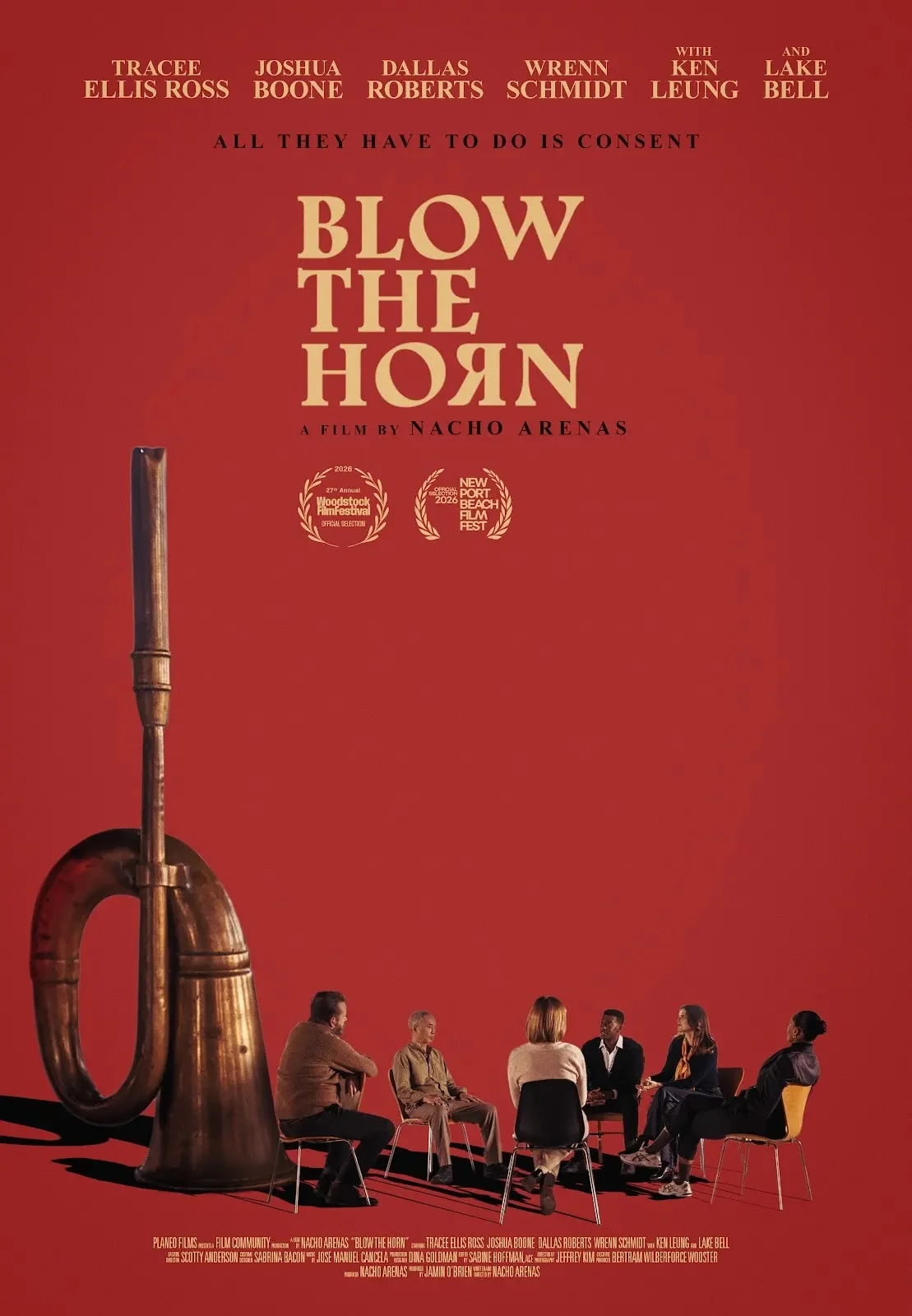
Little Boy Blue might have been tasked with keeping the cows out of the corn, but at the 2026 Woodstock Film Festival, the horn-blowing is reserved for a far more volatile purpose. As the festival prepares for its high-profile slate, one film has emerged as the definitive "must-watch" of the season: Blow the Horn, a claustrophobic, high-stakes chamber drama that promises to leave audiences breathless.
Directed by Nacho Arenas, the film marks a distinct shift in the landscape of psychological thrillers. Set in a desolate New York City loft, the story traps three couples in a crucible of their own making. What begins as a seemingly standard group therapy retreat quickly devolves into a harrowing, puzzle-box narrative that tests the limits of intimacy, honesty, and endurance. With a world premiere scheduled for October 17, the film is already generating significant buzz, not only for its premise but for the powerhouse performances of its leads, Tracee Ellis Ross and Ken Leung.
The Premise: Eight Envelopes, One Horn
The narrative hook of Blow the Horn is as simple as it is cruel. The three couples—portrayed by Ross and Leung, Lake Bell and Joshua Boone, and Dallas Roberts and Wrenn Schmidt—arrive at a remote location expecting a guided intervention. Instead, they are met with a series of eight sealed envelopes.
Each envelope contains a question specifically engineered to dismantle the defensive walls of the participants, exposing the fault lines that have been quietly eroding their relationships. However, there is a catch: before the contents of a new envelope can be revealed, one participant must blow a literal horn. It is a ritualistic, haunting requirement that punctuates the psychological warfare unfolding within the loft. The two-minute trailer, exclusively debuted by Gold Derby, offers a glimpse into the mounting tension as the couples struggle to maintain their composure under the weight of their own secrets.

Chronology of a Production
The journey of Blow the Horn from script to screen was marked by an intensity that mirrors the film’s narrative. Director Nacho Arenas utilized the concept of a "creative bubble" to push his actors into a state of heightened focus.
The production was defined by a sense of isolation that paralleled the characters’ entrapment. According to Tracee Ellis Ross, the choice to have the basecamp in the same space as the set—combined with the biting cold of the filming location—created an inescapable reality for the cast. "The fact that basecamp was in the same space we were shooting in and eating in—and that it was freezing cold outside—invited us all into an emotionally shared space that really supported the material," Ross explained.
For Ken Leung, the experience was a study in controlled pressure. Having recently come off an acclaimed run on HBO’s Industry, a show defined by its high-stress financial environments, Leung is no stranger to the demands of intense drama. However, he noted that the experience of filming this project was uniquely immersive. "Pressure informs focus," Leung remarked, "but quiet, wandering moments are also fun. You need both to build a character that feels human."
Supporting Data: Character Dynamics and Artistic Collaboration
The film’s power relies heavily on the chemistry between its ensemble cast. The collaboration between Ross and Leung was reportedly a highlight of the production, characterized by mutual respect and an almost obsessive attention to detail.

Leung, known for his methodical approach to character work, left a lasting impression on his co-star. Ross recounted a story about a small, seemingly insignificant object—a piece of plastic—that Leung discovered early in the shoot. He integrated the item into his performance, carrying it through scenes as a physical manifestation of his character’s internal state. "He had this incredible way of finding a piece of lint on the floor, a safety pin, a paperclip, a tiny piece of paper, and turning it into a character trait," Ross shared. Upon wrapping the film, Leung gifted the piece of plastic to Ross in a jewelry box—a gesture that underscores the deep, almost spiritual connection the actors formed while inhabiting their roles.
Beyond the acting, the technical structure of the film relies on a slow-burn buildup. The "eight envelopes" serve as a structural spine, dictating the pacing of the film. As the couples move through these questions, the narrative shifts from standard conversation to psychological excavation.
Official Perspectives: The Actors Speak
Both Ross and Leung have been vocal about the unique challenges of the script. Ross, who recently completed a critically acclaimed run in the one-person show Every Brilliant Thing on Broadway, noted the stark differences between the two experiences.
"In many ways, it felt like the complete opposite of live theater because the environment was so incredibly intimate and there wasn’t the same element of novelty, performance, or improvisation," Ross stated. Despite this, she found the process of discovery to be similar. "Working with Ken felt like a masterclass in discovery and trust."

Leung, meanwhile, emphasized the script’s ability to manipulate the audience’s expectations. He described the experience of reading the screenplay for the first time as a "violent" disruption of the reader’s relationship with the story. "You instantly want to start from the beginning again," Leung teased. "It’s also poignant in the sense that a contract is broken between reader and story—suddenly and violently—echoing what happens in certain relationships."
Implications: A New Benchmark for Chamber Dramas
As Blow the Horn prepares to make its debut, its implications for the thriller genre are significant. In an era dominated by high-budget spectacle and sprawling cinematic universes, the success of a tightly contained chamber drama like this could signal a return to character-driven storytelling.
The film challenges the audience to reconcile multiple "layers of truth." As Ross noted, the characters are often forced to inhabit contradictory realities simultaneously. "What was incredibly interesting about playing this role was that there were three different layers of truth, all of which were contradictions to the story we were telling, and all of it had to be true at the same time," she explained.
If the film manages to execute this level of narrative complexity, it will likely serve as a masterclass in how to maximize tension without the need for traditional action beats. The success of the film at the Woodstock Film Festival will be a bellwether for its wider release. With the backing of a strong cast and a director willing to experiment with the conventions of the "locked-room" trope, Blow the Horn is positioned to be one of the most discussed films of the year.

A Cultural Resonance
The film also taps into a broader cultural fascination with radical honesty and the breaking point of modern relationships. In an age where digital personas often mask deep-seated interpersonal failures, the premise of being forced to confront the "fault lines" in one’s life resonates with a contemporary audience.
Whether the film delivers on its promise of a revolutionary narrative shift remains to be seen, but the early indicators suggest that Blow the Horn will be a significant entry in the filmographies of both Ross and Leung. The "creative bubble" they inhabited has clearly produced something that is as intellectually challenging as it is emotionally raw.
As the October 17 premiere approaches, the industry and critics alike are watching with bated breath. Will the audience be able to handle the questions inside the envelopes? Will the horn-blowing provide the catharsis these characters—and the viewers—so desperately seek?
One thing is certain: when the horn sounds at the Woodstock Film Festival, the silence that follows will be heavy with the weight of the truths being unveiled. Blow the Horn is not just a film about couples in a room; it is an examination of the fragile, often invisible, threads that bind us to one another, and what happens when those threads are pulled until they finally snap.
 Jia Lissa
 Sagoh
Sagoh
