

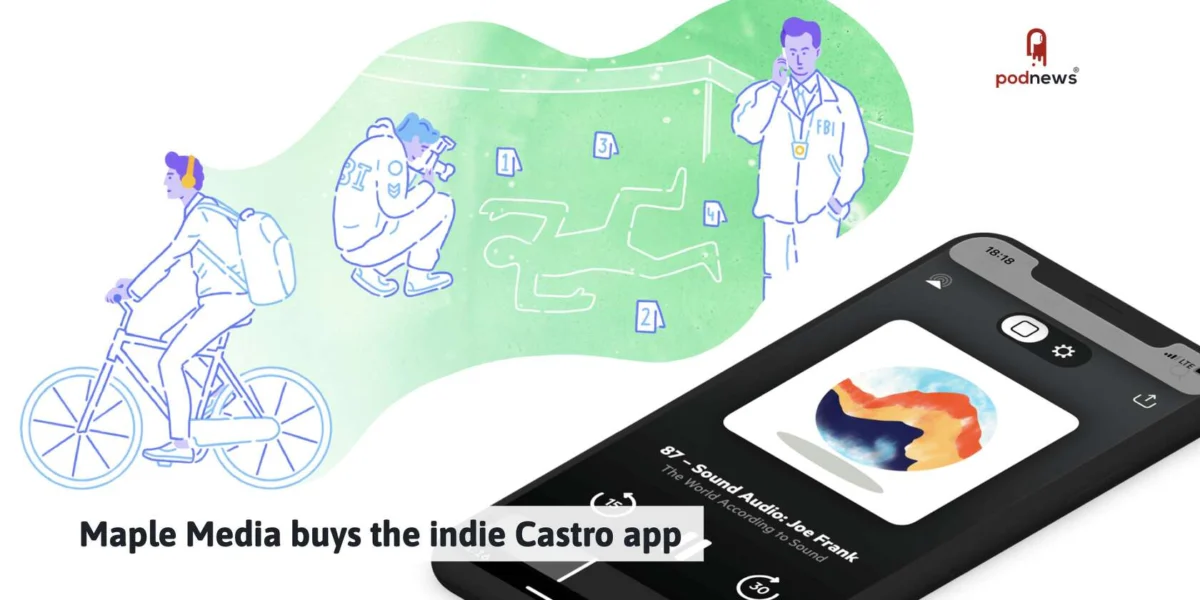
Main Facts: Maple Media Consolidates Its Position
In a significant move that has rippled through the independent software community, Maple Media has officially announced the acquisition of Castro, the long-standing, beloved independent podcast player for iOS. The news, confirmed on October 12, 2026, marks the end of an era for one of the most aesthetically distinctive and feature-rich podcasting applications in the market.
For years, Castro was the gold standard for power users who demanded high-level control over their listening queues. Known for its "triage" system—a workflow that allowed users to quickly sort new episodes into "queue" or "archive"—the app carved out a dedicated niche. Maple Media, a firm known for acquiring and maintaining legacy mobile applications, now assumes control of the platform, raising questions about the future of the app’s unique design language and its commitment to the independent podcast ecosystem.

The acquisition is part of a broader trend of consolidation in the "podcast utility" space. As podcasting has moved from a hobbyist pursuit to a multi-billion-dollar industry, the tools that facilitate discovery and consumption have become highly valuable assets. By folding Castro into its portfolio, Maple Media adds a premium brand to its roster, likely aiming to leverage the app’s loyal subscriber base while integrating its own proprietary monetization and management frameworks.
Chronology: The Evolution of Castro
To understand the gravity of this acquisition, one must look at the timeline of Castro’s development, which has been defined by radical design experiments and a dedicated, if small, user base.

- The Early Years (2014-2015): Castro launched with a minimalist design that stood in stark contrast to the bloated, menu-heavy podcast apps of the time. It was built on the philosophy that podcast listening should be focused and frictionless.
- The Shift to Triage (2016): With the release of Castro 2, the team introduced the "triage" interface. This was a revolutionary shift in podcast UX, forcing users to make an active decision about every new episode—an approach that resonated with "inbox zero" enthusiasts.
- Transition to Subscription (2018): Like many independent apps, Castro struggled to find a sustainable revenue model. It pivoted to a subscription-based "Castro Plus" model, which introduced advanced features like episode trimming and audio enhancement, securing its place as a premium product.
- Independent Struggles (2020-2025): Throughout the early 2020s, the app faced increasing competition from massive platforms like Spotify and Apple Podcasts, which began aggressively integrating features that were once unique to apps like Castro. Maintaining an independent team to handle API updates, Apple’s rigorous App Store guidelines, and user support became a daunting task.
- The Acquisition (October 2026): Maple Media formally acquires the app, bringing the independent era of Castro to a close.
Supporting Data: The Current Podcast Landscape
The podcasting landscape in late 2026 is vastly different from when Castro first hit the App Store. As of mid-October, the data reflects a market dominated by massive tech conglomerates, yet driven by diverse, niche content.
Current rankings indicate the strength of the status quo:

- Apple Podcasts: The Daily remains the undisputed leader in the United States, proving the enduring power of news-based daily podcasts. Meanwhile, The Power of Young People has seen a notable surge in the Australian non-profit category, signaling a growing appetite for purpose-driven content.
- Spotify: The Joe Rogan Experience continues to hold the top spot in the United States, while RedHanded dominates the True Crime charts in the United Kingdom.
The data suggests that while "super-shows" capture the most attention, there is significant movement in specialized categories. For example, La Revue Juridique recently entered the Irish charts as a high-performing new entry in the "Courses" category, demonstrating that educational and professional development podcasts are finding healthy audiences. This fragmentation is precisely why an app like Castro, which excels at managing large queues of diverse content, remains relevant even in an age of algorithm-driven discovery.
Official Responses and Industry Sentiment
While a formal press statement from Maple Media was sparse, the acquisition has been met with a mixture of relief and apprehension within the developer community. For the original team behind Castro, the sale represents a "soft landing"—a way to ensure the app continues to function and receive security updates without the constant threat of total abandonment.

Industry analysts note that Maple Media’s business model typically involves keeping apps functional and slowly optimizing them for ad revenue. "Maple Media isn’t in the business of destroying apps," one industry consultant noted. "They are in the business of maintaining them for a long-tail audience. The challenge for Castro users will be whether the ‘soul’ of the app—the design-first, user-centric triage workflow—remains intact under a company that prioritizes efficiency and scaling."
Many users took to social media to express their fears regarding the potential introduction of intrusive advertising or a shift toward a more generic user interface. The primary concern is that the "indie spirit" of the app will be sacrificed for the sake of quarterly growth targets.

Implications: What This Means for Podcast Listeners
The acquisition of Castro has several immediate and long-term implications for the podcasting ecosystem:
1. The Death of the "Indie" Utility
This sale signals that the "golden age" of independent, bootstrapped podcast players is effectively over. The costs associated with maintaining a high-quality app that works seamlessly with iOS updates are simply too high for small teams to shoulder alone. Users should expect that if they want a niche, premium experience, it will almost certainly be owned by a parent company that manages a suite of similar products.

2. UX vs. Monetization
The central tension in the coming months will be between the app’s refined user experience and the need for Maple Media to generate a return on investment. If the app remains a subscription-only, ad-free experience, it may thrive. However, if the new owners attempt to integrate heavy ad-tech or data-tracking modules to monetize the free-tier users, the very audience that made Castro famous may begin to migrate toward open-source alternatives like AntennaPod.
3. The Future of Podcast Management
Castro was more than just a player; it was a management tool. The fact that it is now under corporate ownership suggests that the "podcast manager" category is maturing. We are likely to see more focus on "audio productivity"—apps that allow listeners to transcribe, summarize, and organize their podcasts using AI. With the backing of a larger firm, Castro may actually receive the R&D budget it needs to implement these modern features, which would be a significant upgrade for its power-user base.

4. A Call for Open Standards
Ultimately, this move highlights the importance of open standards like RSS. Because podcasts are built on a decentralized protocol, users are not locked into any single ecosystem. If the new version of Castro fails to meet expectations, the community can—and will—vote with its feet. The podcasting industry remains one of the few corners of the internet that is not fully enclosed by a "walled garden," and the strength of the medium lies in that freedom.
Conclusion: Watching the Horizon
As the dust settles on this acquisition, the podcasting community will be watching closely. Will Castro remain the minimalist, triage-focused tool that changed how we listen to audio? Or will it become another legacy app lost to the pressures of corporate optimization?

For now, the app continues to function for existing users. The developers and stakeholders have signaled a commitment to stability, but the long-term roadmap remains unwritten. For the casual listener, this may be a non-event. But for the power users who treat their podcast queue like a digital garden, the coming months will determine whether their favorite tool survives the transition or fades into the history of the platform.
As we look toward the future of digital audio, the Castro acquisition serves as a poignant reminder: in the rapidly evolving landscape of 2026, even the most beloved tools are subject to the tides of industry consolidation. Whether this leads to a better, more robust product or a dilution of what made the app great is a question that only time—and the next few updates—will answer.
 Jia Lissa
 Laily UPN
 Lina Irawan
