

By Anna Lee
Published by Special Arrangement with Hyperallergic
Main Facts: A Grand Finale in the Lagune
As the curtains draw on a tumultuous and historic edition of the international contemporary art world’s most prestigious gathering, artist and educator Tammy Nguyen is set to deliver a breathtaking conceptual finale. On November 13 and 14, during the closing program of the 61st Venice Biennale, Nguyen will present the prologue and opening aria of her debut, still-unfinished opera, Timaeus and The Teacher.
Hosted as part of the biennale’s final series of performances, lectures, and roundtables, the presentation serves as a fittingly ambitious capstone to an event already marked by significant disruptions, labor tensions, and groundbreaking global discourse. The preview introduces audiences to an expansive, cross-disciplinary masterwork that bridges ancient Greek philosophy with the visceral, high-stakes geopolitical realities of the late 20th-century Vietnamese diaspora.
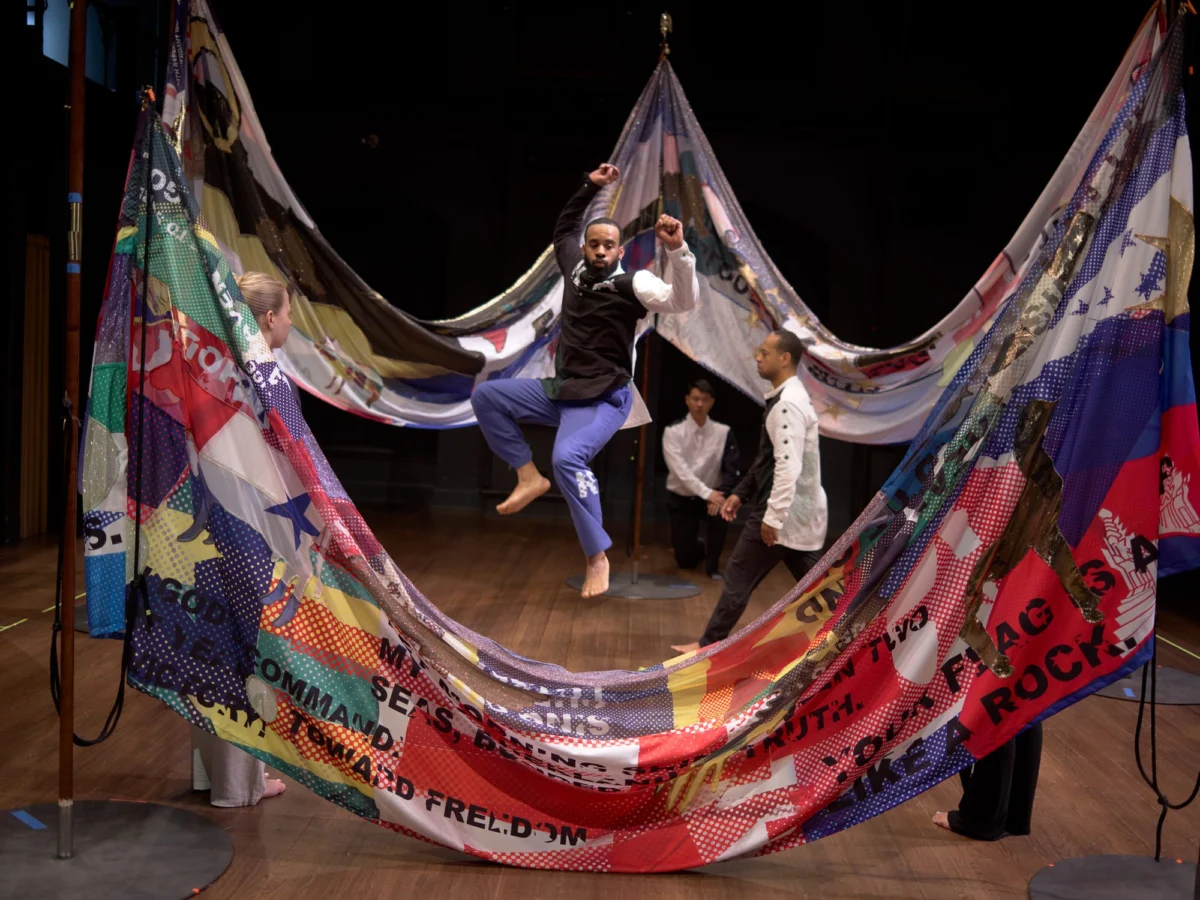
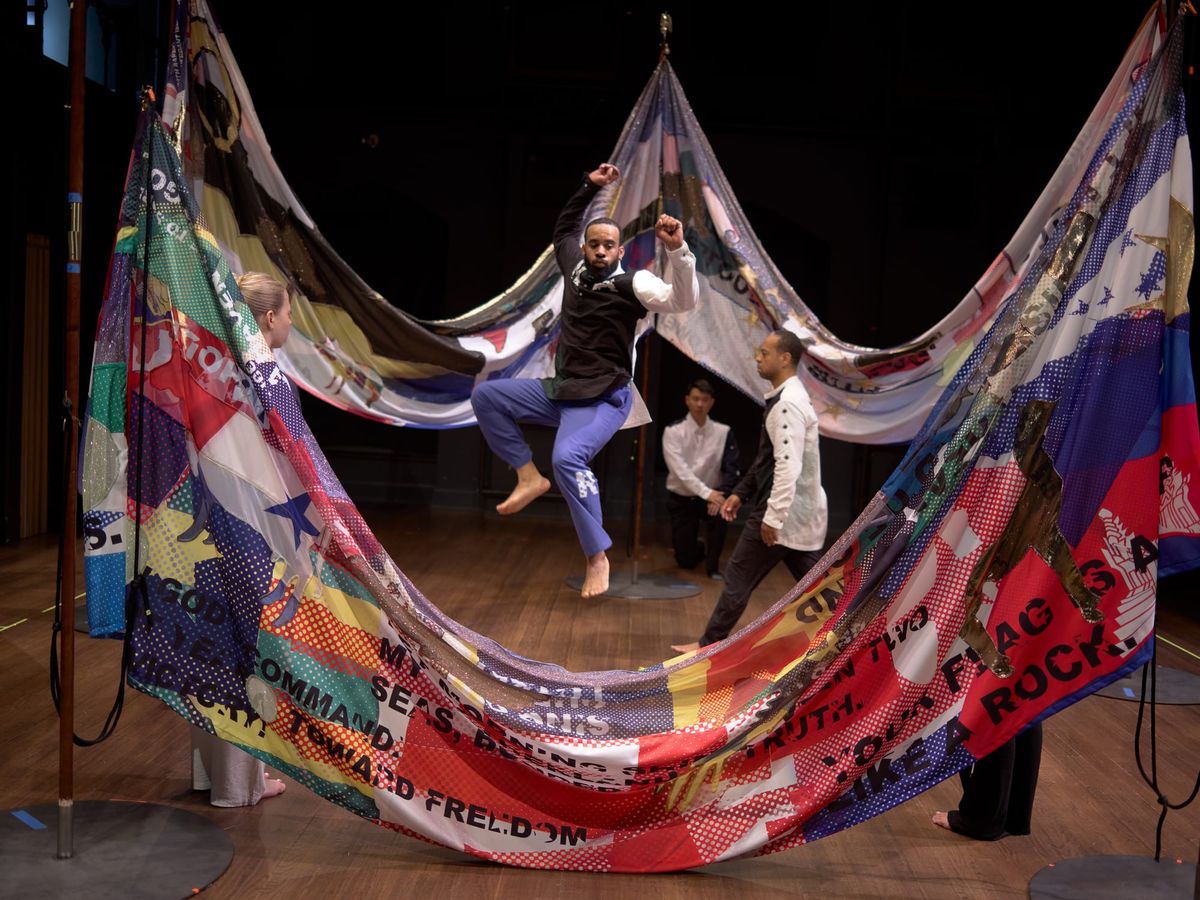
At the center of the performance is Grammy-nominated tenor Brian Vu, who will bring the opera’s libretto to life in the role of the titular Vietnamese English teacher. Surrounding him will be a troupe of contemporary dancers—choreographed by Jamal Jackson—whose movements dynamically manipulate a massive, symbolic tapestry composed of flags. This striking visual and aural presentation not only previews a major upcoming work of contemporary music theater but also encapsulates the thematic core of Nguyen’s broader artistic practice, which has steadily interrogated the intersections of cartography, geopolitical borders, imperial ambitions, and cosmic theory.
While the complete opera is a long-term undertaking with a targeted completion date in the fall of 2029, this Venetian preview offers the global art community a rare, early glimpse into a project years in the making. It underscores the Biennale’s closing days as a site not just of retrospection, but of forward-looking artistic ambition.
Chronology: From the South China Sea to the Venice Stage
The genesis of Timaeus and The Teacher spans decades of personal history, academic research, and multidisciplinary artistic output. Understanding the weight of the Venice Biennale performance requires tracing the trajectory of Nguyen’s life and career:
- Post-1975: The historical backdrop of the opera takes shape. Following the fall of Saigon in April 1975, Nguyen’s father—alongside hundreds of thousands of others—flees the newly renamed Ho Chi Minh City by boat, enduring the perilous journey across the South China Sea as a refugee. These foundational narratives of displacement and maritime transit plant the seeds for Nguyen’s lifelong artistic inquiry.
- Formative Years: Growing up, Nguyen develops a deep interest in music, learning to play and write compositions during her time in San Francisco. A recurring ambition takes root: to one day direct a fully realized opera.
- 2024: Nguyen deepens her exploration of global logistics and nationhood with her exhibition Timaeus and the Nations at the Sarasota Art Museum. For this project, she rearranges 46 "flags of convenience"—the contentious maritime practice wherein ship operators register vessels in foreign nations to bypass stringent domestic regulations and taxes.
- 2025–2026: Development accelerates on Timaeus and The Teacher, commissioned and produced by Wesleyan University, where Nguyen serves as an associate professor of art. She collaborates closely with composer Neely Bruce to build a sonic architecture that matches the scale of her conceptual framework.
- Spring–Autumn 2026: Nguyen’s multi-part engagement with the 61st Venice Biennale unfolds. In addition to the upcoming performance, a dedicated series of her paintings remains on view at the biennale’s Central Pavilion through November 22.
- November 13–14, 2026: The global debut of the opera’s foreword occurs during the closing program of the Venice Biennale, marking a major milestone in Nguyen’s career and providing a dramatic coda to the international exhibition.
- Fall 2029 (Projected): The anticipated completion date for the full opera, deliberately timed to coincide with composer Neely Bruce’s 85th birthday.
Supporting Data: The Architecture of an Opera
To fully appreciate the layers embedded within Timaeus and The Teacher, one must examine the complex web of data, historical references, and artistic methodologies that Nguyen and her collaborators have deployed.
The Musical and Linguistic Framework
- The Libretto: Eschewing traditional linear storytelling, Nguyen constructs her text by fracturing standard English language structures through a fractal sequence. Furthermore, she extracts lyrics from the national anthems of the nations represented by the "flags of convenience," hybridizing these patriotic verses into an arbitrary, poetic collage.
- The Score: Composer Neely Bruce takes these hybridized national anthems and remixes them into an avant-garde musical score that directly mirrors the literal and ideological journey of the refugee protagonist across treacherous waters.
- The Vocals: Tenor Brian Vu, celebrated for his dynamic vocal control and emotional depth, carries the weight of the narrative as the Vietnamese teacher fleeing Saigon two years after the 1975 transition of power.
The Visual and Choreographic Elements
- The Flag Tapestry: Expanding on the 46 flags utilized in her 2024 Sarasota Art Museum exhibition, the physical textile used in the Venice performance serves as a mutable sculptural prop. Choreographer Jamal Jackson directs the dancers to manipulate the cloth into various configurations, transforming it into representations of mountain ranges, an ocean vessel, the rolling sea itself, and the intricate cosmological diagrams found in Plato’s Timaeus.
- Platonic Cosmology: The dialogue Timaeus is one of Plato’s most famous works, outlining a theory of the creation of the universe by a benevolent demiurge who imposes mathematical order upon chaos. Nguyen superimposes this ancient Greek quest for cosmic harmony onto the brutal, chaotic realities of modern geopolitical displacement.
Official Responses and Artist Perspectives
Speaking to Hyperallergic in an exclusive phone interview, Tammy Nguyen illuminated the personal and philosophical motivations driving her monumental undertaking. The work, she explained, is an attempt to make sense of the micro-narratives swallowed up by grand historical movements.
"I was really fascinated by what happened at sea, as are many children of refugees from war-torn countries," Nguyen reflected. "The South China Sea is such a heavily trafficked area, and it created little stories where humans and the global economy collided."
By fusing the intimate tragedy of a single teacher fleeing his homeland with the abstract mathematical structures of Pythagorean and Platonic philosophy, Nguyen attempts to elevate the refugee narrative into the realm of classical epic.
Discussing the sheer scale of the production, Nguyen pointed to the unique capabilities of the opera medium:
"Opera has a gestalt of sorts, just this massive tapestry of coming together and telling a story. I took the anthems of all cemetery countries in the flags of convenience, extracted various lyrics, and hybridized them arbitrarily for the libretto."
Institutional backing has been crucial to bringing this vision to life. Wesleyan University has served as both incubator and producer for the project, supporting Nguyen not only as an associate professor of art but as a visionary interdisciplinary creator. The university’s investment in the production underscores the growing importance of academic institutions in funding high-risk, experimental contemporary art projects that might otherwise struggle to find commercial backing in the traditional opera world.
Implications: The Fluidity of Nationhood in Contemporary Art
The presentation of Timaeus and The Teacher at the closing of the 61st Venice Biennale arrives at a critical juncture in contemporary global politics. As migration crises escalate worldwide, national borders harden, and economic globalization faces severe populist pushback, Nguyen’s work offers a timely meditation on the artificiality and lethality of national boundaries.
By linking the concept of "flags of convenience"—a legalistic loophole used by multinational corporations to evade accountability—with the desperate voyages of refugees escaping state collapse, Nguyen draws a sharp, critical line between the free movement of capital and the heavily policed, perilous movement of human beings.
As Nguyen succinctly summarized in her remarks to the press:
"The idea of nationhood is so flexible. But people die over it and fight over it, questioning whether they belong. We grapple with these questions all the time, as people who are looking to feel at home or develop a sense of agency for ourselves."
A Broader Dialogue in Venice
The opera does not exist in a vacuum; it is part of a broader thematic choir echoing through the final days of the Biennale. Alongside Nguyen’s performance, the closing program features diverse, socially engaged works: Hagar Ophir’s communal gatherings around a Ouija board to probe historical ghosts; Ziad Antar, Hatem Imam, and Nayla Mabsout’s explorations of cultivation and exchange; and Nathalie Vairac’s minimalist meditations on salt as a fundamental driver of human civilization.
Yet, it is Nguyen’s operatic vision that promises to linger most hauntingly in the collective memory of the Biennale attendees. By marrying the ancient philosophical quest for universal order with the fractured modern identity of the Vietnamese diaspora, Timaeus and The Teacher challenges viewers to reconsider the structures of power, displacement, and belonging that define the 21st century.
As audiences file out of the Central Pavilion and look toward the three-year horizon leading up to the opera’s full 2029 premiere, Nguyen’s cosmic coda will undoubtedly resonate as one of the defining conceptual achievements of the 2026 art season.
 Nila Kartika Wati
 Laily UPN
 Muslim
