

The landscape of video game adaptations has undergone a radical metamorphosis over the past decade. For years, the "curse" of the genre—the tendency for high-budget Hollywood spectacles to strip away the soul of their source material—seemed insurmountable. Yet, as the industry has matured, two distinct, successful blueprints have emerged. On one side, we have the "Faithful Expansionists," exemplified by the meticulous world-building of The Last of Us or the vibrant, lore-accurate joy of Super Mario Galaxy. These films and series succeed by treating the game’s internal mythology with the reverence of a classic novel.
On the other side sits the "Vibe-Check" school of adaptation: projects that acknowledge the narrative thinness of their source material and instead focus on capturing the kinetic energy and aesthetic spirit of the gameplay, such as Zach Cregger’s recent, divisive Resident Evil.
Director Kitao Sakurai’s latest foray into the fighting game genre, Street Fighter, exists in a volatile, neon-soaked middle ground. It is neither a masterclass in narrative adaptation nor a purely abstract tone poem. Instead, it is a chaotic, unapologetically bizarre, and undeniably memorable cinematic experience that captures the specific, primal thrill of an arcade cabinet’s "Select Your Fighter" screen. While it struggles to reconcile its fractured script with its high-concept visual ambition, it remains an unforgettable time at the theater, destined to be analyzed for decades to come.
A Chronicle of Conflict: From Arcade to Screen
The narrative foundation of Street Fighter is deceptively simple. We follow the paths of Ryu (Andrew Koji) and Ken Masters (Noah Centineo), two martial artists bound by a brotherhood that is as much about mutual protection as it is about internal struggle. Their master’s warnings—to guard one another against their own darker impulses—serve as the film’s moral compass, though that compass is frequently shattered by the sheer absurdity of the unfolding events.
The film chronicles the brothers’ journey toward the "World Warrior Tournament," a high-stakes, Kumite-style bracket that serves as the centerpiece of the franchise’s lore. After a hard-fought victory in the initial tournament, a rift forms between the two. The fallout is compounded by an emerging threat: a demonic entity known as Akuna. As the brothers drift apart, Ken falls into a state of professional and personal stagnation, trading his discipline for cheap, surface-level celebrity endorsements. Six years later, the announcement of a second World Warrior Tournament forces a reunion, setting the stage for the film’s climax.
However, viewers expecting a traditional sports drama will be caught off-guard. Sakurai’s screenplay prioritizes the "arcade feel" over coherent character arcs. The film is less a linear story and more a succession of vignettes where, much like in the game, the primary goal is simply to select a character and watch them unleash chaos upon another.
The Ensemble: A "Choose Your Fighter" Cast
Perhaps the most fascinating aspect of the film is its sprawling, eclectic ensemble cast. The roster feels less like a traditional Hollywood production and more like a fever dream of pop culture figures. Jason Momoa is present, rendered in thick, almost aggressive green CGI, while 50 Cent portrays a boxer whose hairline defies the laws of physics and biology.

The inclusion of professional wrestling icons Cody Rhodes and Roman Reigns brings a performative physicality to the screen, while the presence of comedians like Eric Andre and Andrew Schulz adds a layer of surrealism to the dialogue. Add in the stylistic flair of Orville Peck—sporting iconic, Wolverine-esque claws—and cameos from character actors like David Dastmalchian and Kyle Mooney, and you have a recipe for total tonal instability. It is a cast designed to provoke a reaction, whether that be delight, confusion, or outright disbelief. It is an intentional, calculated move that ensures the audience is never quite sure what to expect from the next scene.
The Aesthetic of Excess: Visuals and Expressionism
By conventional narrative standards, Street Fighter is, in many ways, incoherent. Plot threads are abandoned, pacing is erratic, and the logic of the world is consistently bent to suit the next visual set-piece. Yet, to dismiss the film based on traditional storytelling metrics would be to miss the point entirely.
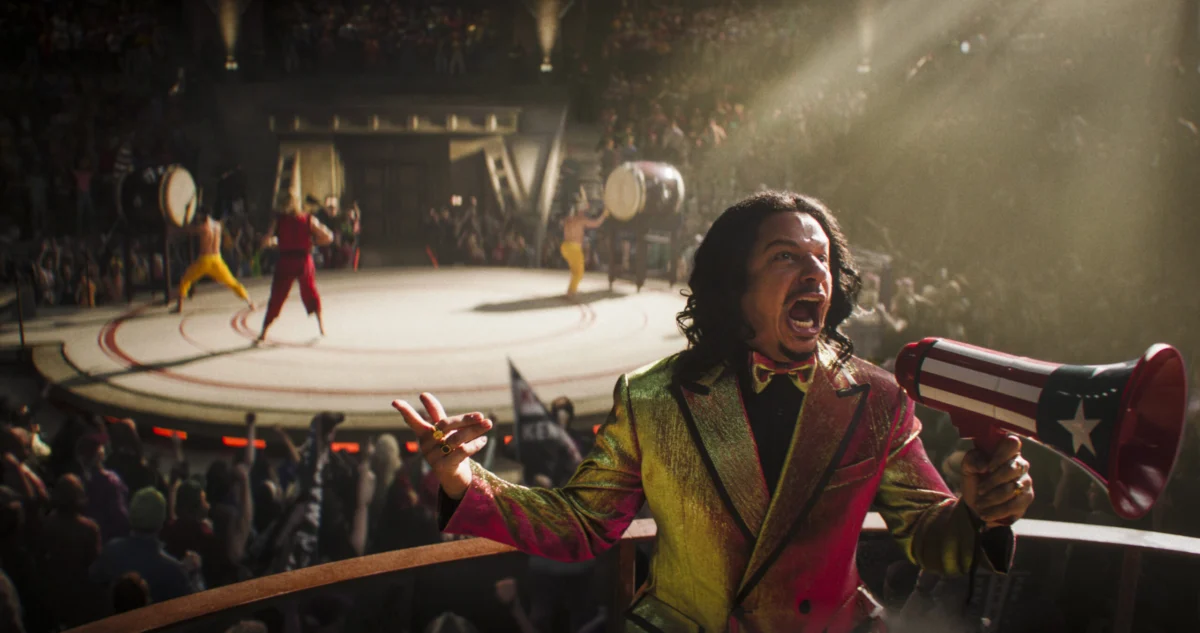
Sakurai bombards the audience with a relentless assault of high-contrast neon lighting, surrealistic humor, and classic rock needle drops. The costume design and hair styling are deeply committed to the two-dimensional, hyper-stylized aesthetic of the original arcade cabinets. In an age where digital cinematography often feels muted and utilitarian, Street Fighter swings for the fences with a palette that feels like a glitch in the best way possible.
Is it a film designed to be consumed in 30-second clips on social media? A cynic might argue that the film’s structure—chopped into aesthetic bursts—is better suited for the scrolling consumption of the digital age than for a two-hour theatrical experience. Conversely, one could view this as a form of misunderstood expressionism. Regardless of the label, the film is visually arresting, ensuring that even when the plot stumbles, the screen remains alive with color and movement.
Baffling Choices and Structural Anomalies
To discuss the plot of Street Fighter is, as one might say, to dance about architecture. It is a structural nightmare filled with decisions that feel both baffling and oddly brilliant. For instance, the decision to present all flashback sequences through traditional animation—while maintaining a stark, live-action aesthetic for the "present day"—creates a jarring, yet effective, psychological distance between the characters and their pasts.
Perhaps more controversial is the film’s treatment of its tournament bracket. While the tournament is the driving force of the film, over half of the promised marquee fights conclude in offscreen forfeits. The fighters spend an inordinate amount of time socializing in hotel bars or bickering in hallways rather than engaging in the fisticuffs the title promises.
Consider the performance of Cody Rhodes, who essentially plays the role of a provocateur. He spends his screen time not in the ring, but delivering vaguely homoerotic monologues, handing out beers with the labels facing the camera, and challenging his rivals to "suck on this." It is an bizarre, meta-commentary on product placement and hyper-masculinity, set in an oddly specific 1993 timeline that nonetheless feels obsessed with the consumerist absurdity of the present day, specifically in its fixation on Taco Bell endorsement deals.

Implications for the Future of IP Adaptations
The implications of Street Fighter for the broader film industry are significant. By prioritizing the feeling of the source material over the integrity of its narrative, the film challenges the prevailing wisdom that adaptations must be "grounded" to be successful.
While the film is almost certainly destined to underperform at the box office upon its October 16 release, it is equally certain that it will find a second life. In twenty-five years, it will likely be heralded as a cult classic—a bizarre, experimental artifact of a time when Hollywood was still trying to figure out how to translate the language of gaming into the language of cinema.
The film’s "sin," if it has one, is not boredom. It is, if anything, an overabundance of ambition. For fans of the franchise, the lore is merely a vessel—a way to project their own experiences onto a canvas of colorful, stylized martial artists. Sakurai has provided that canvas. Whether the audience chooses to appreciate the brushstrokes or get lost in the mess is entirely up to them.
Grade: B-
Ultimately, Street Fighter is a triumph of style over substance, and in this specific instance, that might just be enough. It is a film that refuses to be boring, refuses to be polite, and refuses to apologize for its own existence. While it may not satisfy those looking for a traditional narrative, it offers a visual experience that is, quite simply, cool as hell.
A Paramount release, "Street Fighter" opens in theaters on Friday, October 16.
 Asep Darmawan
 Azzam Bilal Chamdy
 Lina Irawan
