

Main Facts
Half a century after reshaping the landscape of modern rock and art-pop, Talking Heads are opening their private vaults. David Byrne, Tina Weymouth, Chris Frantz, and Jerry Harrison have officially announced New Feeling, the band’s first-ever authorized, fully collaborative coffee-table book. Set for publication on May 18, 2027, through Abrams Books, the 400-page tome arrives to coincide precisely with the 50th anniversary of the group’s landmark debut album, Talking Heads: 77.
Designed by Eric Skillman, New Feeling compiles hundreds of rare and previously unseen photographs, early album sketches, personal ephemera, and original essays written independently by all four band members. Crucially, the project marks the first time the complete quartet has authorized and contributed directly to a definitive print history of the band.
Fans eager to secure copies can choose from three distinct tiers. The standard hardcover edition will retail for $65. For dedicated collectors, a $150 collector’s edition and a $350 limited edition will also be available. Both of the deluxe versions feature a unique 19-piece wooden puzzle built directly into the cover of a custom box. Furthermore, the highest-tier limited edition includes a high-grade reproduction of an iconic Mick Rock photograph individually signed by Byrne, Weymouth, Frantz, and Harrison. Pre-orders for all editions are currently ongoing.
While the band has repeatedly dampened rumors of a formal musical reunion or a traditional concert tour, New Feeling represents a significant milestone in a steady wave of collaborative activity that has seen the quartet step back into the public eye together.
Chronology: From the RISD Lofts to Global Icons
To understand the weight of New Feeling, one must trace the timeline of Talking Heads—a journey that began not in a traditional music hub, but within the conceptual art circles of the Rhode Island School of Design (RISD) in the mid-1970s.
The Formative Years (1974–1977)
David Byrne, Chris Frantz, and Tina Weymouth initially coalesced in Providence, Rhode Island, before relocating to New York City in 1975. Operating as a trio under the moniker The Artistics, they soon solidified the core lineup and adopted the name Talking Heads. Their arrival in Manhattan coincided with the embryonic days of the legendary downtown punk and no-wave scene centered around CBGB. Alongside peers like Television, Patti Smith, and Ramones, Talking Heads injected an intellectual, jittery, and rhythmically complex sensibility into guitar-driven rock.
In 1977, the band signed with Sire Records and released their debut studio album, Talking Heads: 77. Propelled by the anxious, stuttering brilliance of "Psycho Killer," the record established them as critical darlings and innovators of the nascent "new wave" genre.
The Golden Era of Art-Funk (1978–1984)
Collaborating with visionary producer Brian Eno across albums like More Songs About Buildings and Food (1978), Fear of Music (1979), and Remain in Light (1980), Talking Heads expanded their sonic palette. They integrated polyrhythms, African funk influences, electronic textures, and avant-garde song structures. By the time they recruited a touring ensemble that included Adrian Belew, Bernie Worrell, and Steve Scales, they had evolved into one of the most formidable live acts on the planet.
This era culminated in the late 1983 performances at the Pantages Theatre in Hollywood, which were captured by director Jonathan Demme to create Stop Making Sense (1984). Widely regarded as the greatest concert film ever made, the movie cemented the band’s visual iconography—most notably Byrne’s oversized "Big Suit."
Hiatus, Dissolution, and Post-Band Realities (1988–2022)
Following their final studio album, Naked (1988), tensions mounted within the group. Byrne effectively signaled the end of the band in the early 1990s, leading to a prolonged estrangement and public friction between Byrne and his rhythm section, Weymouth and Frantz.
During the ensuing decades, the members pursued divergent paths. Byrne focused on solo records, film scores (winning an Oscar for The Last Emperor), theater, and writing books on design, bicycles, and human optimism. Harrison established a successful career as a producer while releasing solo material, and Weymouth and Frantz achieved further success with their side project, Tom Tom Club.
Despite a brief, one-off performance at their 2002 Rock and Roll Hall of Fame induction, a permanent reconciliation seemed unlikely for many years—until a cinematic milestone shifted the dynamic.
Supporting Data: Archival Treasures and Editions
New Feeling draws heavily from physical archives that have remained sealed away for decades. According to promotional materials released by Abrams Books, the volume features:
- Handwritten Lyrics: Original manuscript pages for foundational tracks, including "Psycho Killer" and the frantic, paranoid "Life During Wartime."
- Visual Ephemera: Early concert posters, flyer designs from the CBGB era, tour itineraries, and polaroids taken during studio sessions with Brian Eno.
- Literary Contributions: First-person essays penned individually by Byrne, Weymouth, Frantz, and Harrison, offering contrasting perspectives on shared historical moments.
Pricing and Packaging Breakdown
- Standard Hardcover Edition ($65): Features the complete 400-page historical retrospective, extensive photography, and standard binding.
- Collector’s Edition ($150): Housed in a custom deluxe box featuring an integrated 19-piece wooden puzzle on the cover.
- Limited Edition ($350): Includes the custom box and wooden puzzle, alongside an exclusive, archival-quality reproduction of a Mick Rock photograph hand-signed by all four members of the band.
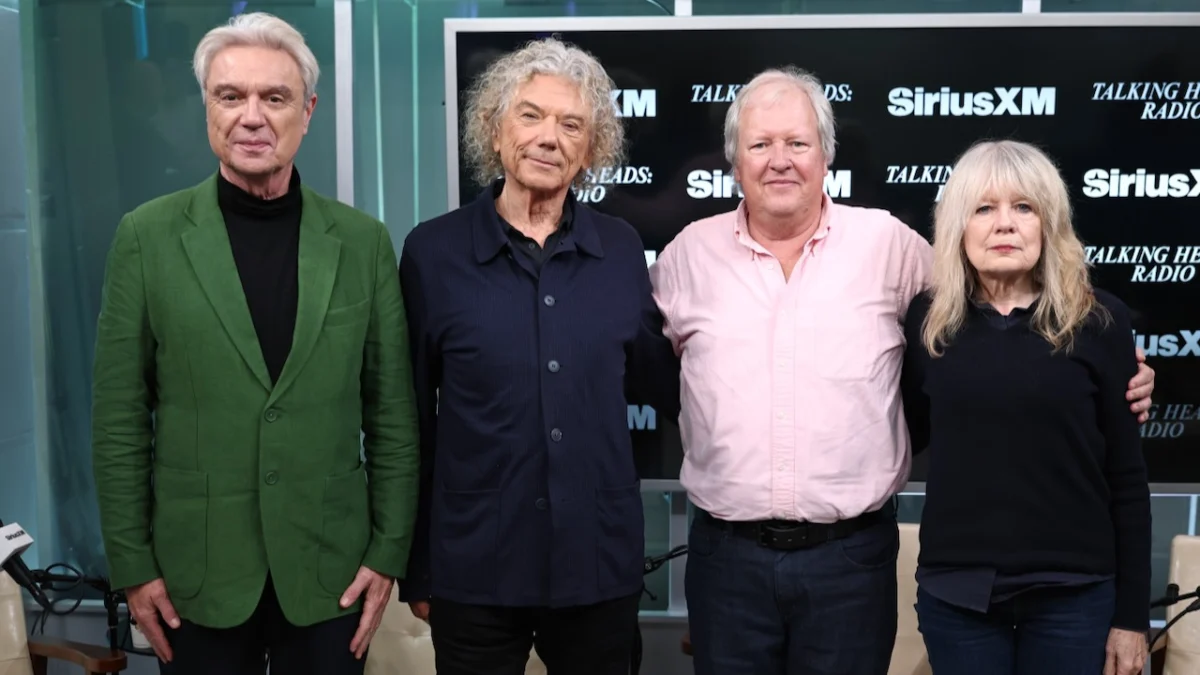
In tandem with the book’s announcement, the band’s commercial apparatus is operating at peak efficiency. November 13 brings a massive super deluxe edition of 1979’s Fear of Music, stuffed with unreleased studio outtakes and live recordings. Meanwhile, digital preservation continues via Talking Heads Radio, their dedicated SiriusXM channel launched in October following a high-profile promotional appearance moderated by Este Haim.
Official Responses and Public Statements
The announcement of New Feeling was accompanied by a rare joint video statement featuring all four members, underscoring a unified front that would have seemed improbable ten years ago.
Jerry Harrison elaborated on the depth of the archival material in a press statement accompanying the release:
"For this book, we pulled out handwritten lyrics, original album sketches, and private photos, some of which haven’t left our archive in over 40 years."
The collaboration on New Feeling follows a systematic thaw in band relations, catalyzed largely by the September 2023 world premiere of A24’s 4K restoration of Stop Making Sense. The subsequent promotional tour brought Byrne, Weymouth, Frantz, and Harrison together for a series of retrospective Q&A panels, red-carpet appearances, and joint interviews.
While questions regarding a musical reunion invariably surface during every press cycle, the members have consistently managed expectations. Rather than picking up their instruments to tour, the quartet has channeled its collective energy into archival curation—ensuring that their historical legacy is preserved on their own terms.
Implications: A Unified Legacy and Solo Endeavors
The arrival of New Feeling carries profound implications for how rock history remembers Talking Heads. For decades, the band’s narrative was often overshadowed by internal friction and the towering, eccentric persona of David Byrne. By presenting a project co-authored and authorized by all four founding members, New Feeling reasserts that Talking Heads was, above all, a deeply collaborative artistic organism whose collective chemistry was greater than the sum of its parts.
Furthermore, the timing of the book intersects with ongoing solo projects. David Byrne continues to push intellectual boundaries independently, evidenced by his early October book release, Sleeping Beauties: Why Good Ideas Go Dormant and How They Wake Up, published via Penguin Random House. That text explores the lifecycle of innovation and why groundbreaking concepts are frequently overlooked before finally gaining traction—a thematic parallel to how Talking Heads’ radical blend of punk, funk, and world music was initially met with bemusement before reshaping mainstream pop culture.
Ultimately, New Feeling serves as a capstone to a multi-year rediscovery of the band’s catalog. As the 50th anniversary of Talking Heads: 77 approaches in May 2027, fans are not merely being offered nostalgia; they are being granted an unprecedented, unfiltered portal into the minds of four artists who permanently altered the trajectory of modern music.
 Pevita Pearce
 Lina Irawan
 rifanmuazin
