

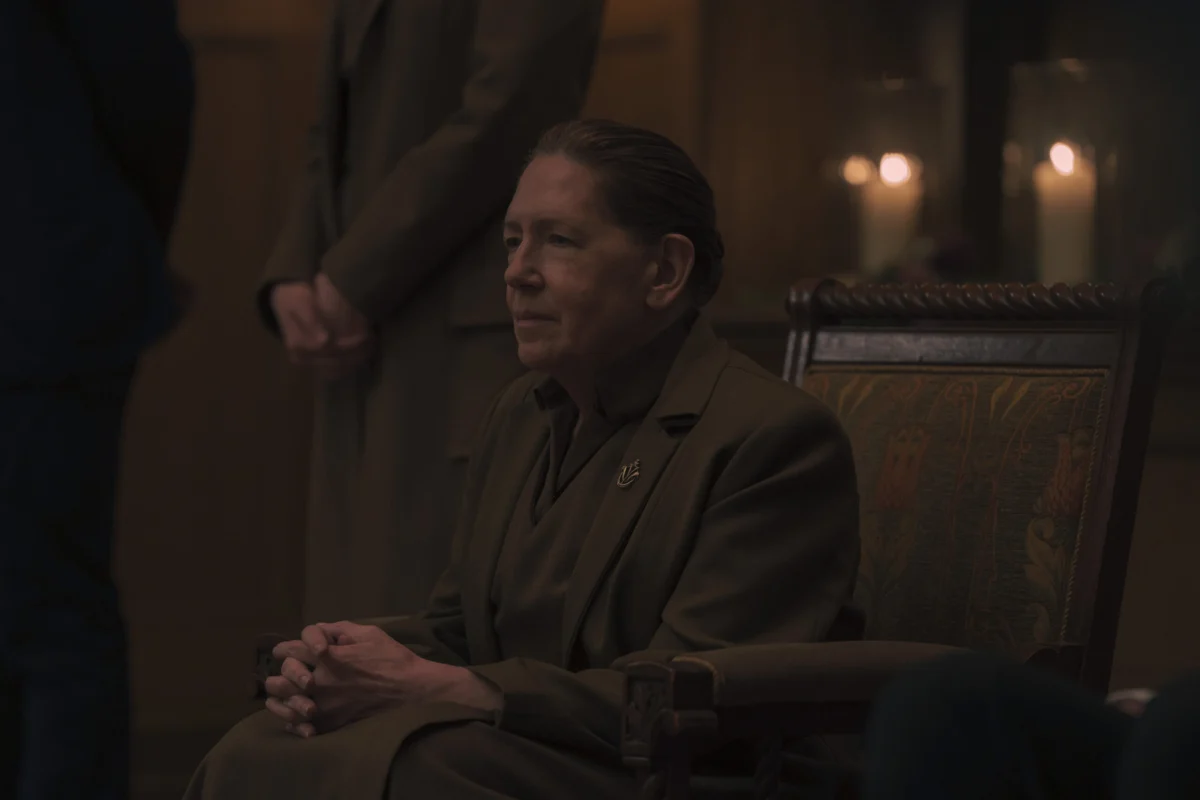
From the chilling, grief-stricken hallways of The Leftovers as Patti Levin to the iron-fisted, polarizing tyranny of Aunt Lydia in The Handmaid’s Tale, Ann Dowd has spent the better part of a decade cementing her status as television’s most formidable character actress. Now, as the spotlight shifts to The Testaments, Dowd continues to peel back the layers of one of modern fiction’s most debated figures. With a four-time Emmy nomination record—including a hard-won victory for her portrayal of the regime’s most infamous enforcer—Dowd’s work is characterized by a haunting stillness that suggests volumes are being spoken behind her eyes, even when her lips remain tight.
A Legacy of Divisive Brilliance
Ann Dowd does not play villains; she plays women in survival mode. Her portrayal of Aunt Lydia has become a masterclass in duality. In the expansive, harrowing universe of The Handmaid’s Tale and its successor, The Testaments, Dowd avoids the trap of caricature. Instead, she imbues every scene with a nuanced, often contradictory humanity.
As the narrative shifts into the events of The Testaments, the character of Aunt Lydia has entered a new phase of tactical complexity. She is no longer just the enforcer of the regime’s misogynistic laws; she is a woman playing a long game. The audience is privy to a version of Lydia who is simultaneously executing colleagues to maintain her standing in the upper echelons of Gilead and secretly documenting the atrocities of the regime. This internal conflict—the teacher who loves her students versus the survivalist who would burn the world to protect her position—is the cornerstone of Dowd’s current Emmy-eligible performance.
Chronology of a Survivalist
To understand the current iteration of Aunt Lydia, one must look at the crucible of her past. Throughout the first season of The Testaments, viewers were granted glimpses into the formative trauma that shaped the monster we recognize.
- The Origin of Authority: Before the rise of the Gilead regime, Lydia was a teacher—a profession she viewed with inherent duty and love.
- The Descent: As the world shifted, so did Lydia’s moral compass. Her journey involved grueling choices, including a pivotal, dark past involving an abortion that served to humanize her in ways audiences never expected.
- The Rise to Power: Having navigated the treacherous political landscape of the new regime, Lydia successfully talked her way into the good graces of the commanders.
- The Secret Resistance: By the time she is running the Plum school, she has evolved into an observer, keeping meticulous, hidden records of the regime’s secrets—a direct contrast to the blind zealot seen in early seasons of The Handmaid’s Tale.
Supporting Data: The Art of the Performance
Dowd’s approach to the character is deeply collaborative yet intensely private. In a recent interview, she revealed that the "surprises" the writers throw her way—such as the revelation of her backstory in Episode 6—are treated as "gifts." These narrative breadcrumbs allow her to keep the character’s inner life active and present.

When asked about the infamous scene where she is forced to execute a colleague, Dowd describes the experience as both grueling and enlightening. "If they weren’t challenging, what’s the point?" she notes. The physical and emotional exhaustion of shooting those sequences, paired with the subsequent off-screen friendship she formed with co-star Mabel Li (who plays Aunt Vidala), illustrates the professional intensity Dowd brings to the set. She does not just inhabit the role; she subjects herself to the psychological weight of the character’s reality.
Official Perspectives: The Mind of Aunt Lydia
In a candid discussion regarding the motivations of her character, Dowd provides a rare glimpse into the "why" behind Lydia’s actions.
On Trust and Ambiguity
When pushed on whether viewers can truly trust Aunt Lydia, Dowd offers a nuanced defense. "I think that at the root of it with the girls is that she loves them," she asserts. According to Dowd, Lydia’s devotion to the daughters of high commanders and the Pearl girls is genuine. While her political machinations remain opaque, her commitment to her charges is a point of consistency. "When it comes to her power in Gilead and the plans she has for the future, I think she keeps it much to herself."
The "Mayday" Connection
The burning question for fans—whether Lydia is working with the Mayday resistance or June Osborne—remains unanswered by showrunner Bruce Miller, even to Dowd herself. However, Dowd embraces the ambiguity. "I love it. I think that’s very exciting. Boy, I would love it if she was aware and part of it through the whole thing."
The Evolution of Teaching
Dowd contrasts the brutality of her former role with the current, more controlled environment of the school. Because the girls under her current care are products of the regime, her approach is necessarily more measured. "Being able to have a much, if you will, gentler approach, a kinder approach, I found that fascinating," she explains. Yet, she admits to the underlying horror of the situation: "Can you imagine teaching and yet not teaching them to read and write and do math? It’s absurd, isn’t it? It must, on some level, just appall her."

Implications for Season 2: The Fall of Gilead?
As The Testaments moves forward, the implications for Aunt Lydia’s arc are profound. Dowd is vocal about her hopes for the character: she wants to see the slow, calculated dismantling of Gilead.
"I would love it if her goal [is] taking down Gilead," Dowd says. "The slow process that it requires and the choices that it requires day to day and what she’s willing to risk."
The character has evolved into a woman who possesses a "built-in" ability to remain in charge. Having survived the initial purges of the regime, she has developed a level of situational awareness that makes her nearly untouchable. Her secret recordings and her careful manipulation of the girls under her charge suggest that she is playing a long-form game of chess against the very leaders she serves.
Conclusion: The Professionalism of Ann Dowd
What makes Ann Dowd’s portrayal of Aunt Lydia so essential to the current television landscape is her refusal to grant the audience the comfort of a simple judgment. Is she a victim, a survivor, or a perpetrator? Through Dowd’s performance, the answer is "all of the above."
As we look toward the next season, the mystery of Lydia’s endgame—and whether her affection for the next generation of women will eventually outweigh her desire for survival—remains the series’ most compelling hook. With Dowd at the helm, Aunt Lydia remains a terrifying, pitiable, and ultimately masterful figure of modern drama, proving once again that the most dangerous characters are those who are not only willing to do anything to survive but who have the patience to watch the world burn while they quietly take notes.
 Ammar Sabilarrohman
 Siti Muinah
 Iffa Jayyana
