

In the realm of modern science fiction, few filmmakers possess the singular vision of Steven Spielberg, a director who has spent decades defining the visual language of the extraterrestrial. With his latest conspiracy thriller, Disclosure Day, Spielberg returns to the genre, not with the wonderment of Close Encounters of the Third Kind, but with the cold, calculated precision of a deep-state surveillance apparatus. Central to the film’s narrative is the Wardex command center, a sprawling, high-tech hub that monitors classified intelligence on Unidentified Anomalous Phenomena (UAPs) across more than 300 synchronized screens.
The set, constructed at Steiner Studios in New York, has already drawn comparisons to the iconic, labyrinthine lairs of the James Bond franchise—specifically those crafted by the legendary Ken Adam. However, as production designer Adam Stockhausen reveals, the reality of Wardex is grounded in a much more tactile, architectural history.

The Architectural Genesis: From Brutalism to the "War Room"
To create a space that felt both expansive and suffocatingly clandestine, Stockhausen looked to the real-world precursors of institutional power. He moved away from the neon-soaked tropes of "cyberpunk" cinema, opting instead for a structural honesty rooted in Japanese Brutalism, the functional geometry of NASA’s mission control, and the imposing, monolithic aesthetic of mid-century corporate headquarters like the former AT&T building in New York.
"The initial discussions were just about the nature of the work that was going on there, and trying to make this exciting space for it," explains Stockhausen, an Oscar-winning production designer whose previous collaborations with Spielberg include Bridge of Spies, Ready Player One, and West Side Story. "We wanted to create a space that felt like a pressure cooker—a place where the weight of global secrets creates a palpable, physical tension."

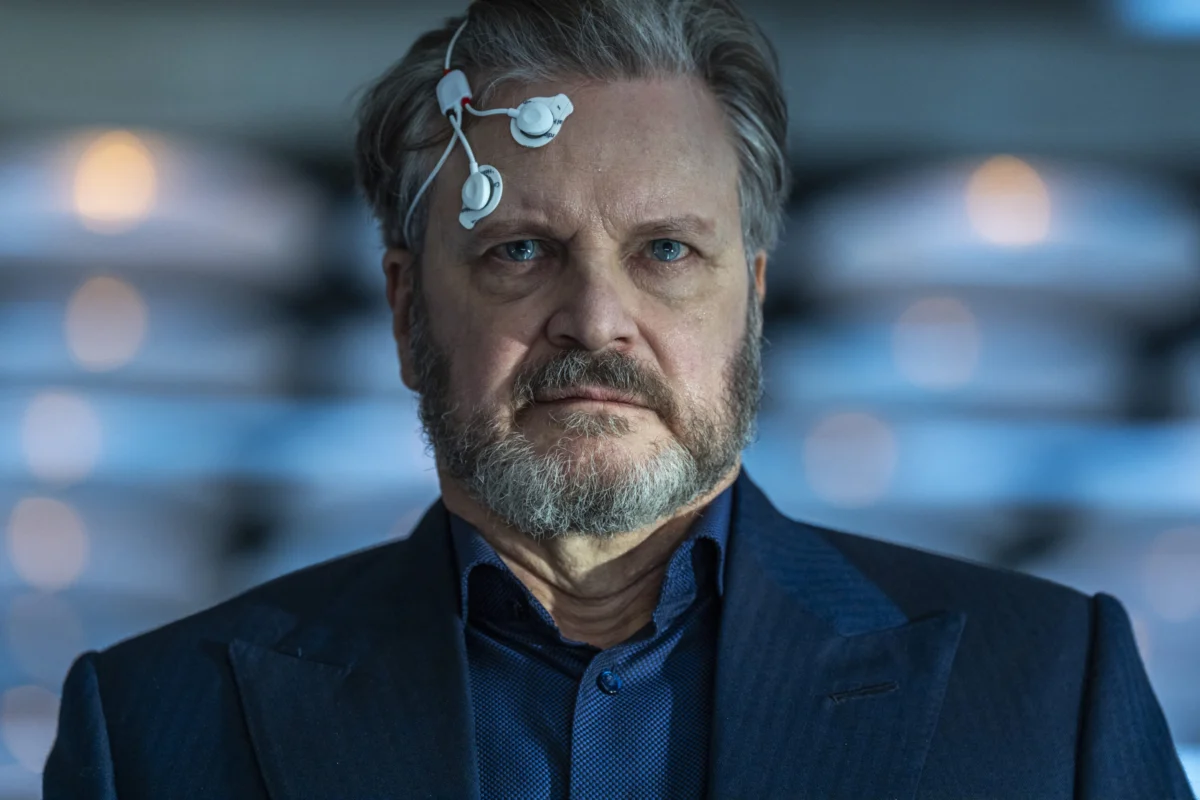
The resulting set is a marvel of multi-level, cantilevered engineering. By utilizing reflective glass surfaces, Stockhausen created a visual paradox: the room is transparent, yet the secrets it holds are impenetrable. This irony serves as a perfect backdrop for the character of Scanlon, played by Colin Firth, a power-hungry operative who has spent decades suppressing evidence of extraterrestrial contact.
Chronology of a Set: From Digital Model to Physical Reality
The creation of the Wardex set was a complex, iterative process that began long before ground was broken at Steiner Studios.

Phase 1: Conceptual Mapping
Stockhausen and his art department began by establishing the geography of the space. The script, penned by David Koepp, demanded two distinct areas: the main surveillance floor and the "cold room," where Scanlon performs his deep-dive analysis of alien technology. The challenge was to integrate these two zones into a single, cohesive narrative space.
Phase 2: The Digital Prototype
Using advanced 3D modeling, the team mapped the "vortex" situation room. They determined the optimal placement for the cold room window to allow for dramatic camera transitions—moving from a tight, claustrophobic close-up on Scanlon’s face to a sweeping, wide-angle shot of the entire 100×80-foot surveillance hub.

Phase 3: Construction and Texturing
Once the geometry was locked, the team began the physical build. To achieve the "clinical yet menacing" aesthetic, Stockhausen focused on the surface finish. Working with key scenic artist Elizabeth Lin, they rejected the idea of using raw steel, which could look too industrial or aged. Instead, they opted for a custom multi-step lacquer process applied over medium-density fiberboard. Each panel was sprayed repeatedly with metal-flake-infused paint, creating a finish that allowed light to float in a semi-transparent way over the base color, giving the walls a sense of depth and, ironically, "life."
Supporting Data: The Anatomy of the Wardex Hub
The functionality of the set was as important as its aesthetic. The "vortex" layout was designed in a stadium-like configuration, with bays and spokes radiating from a central core. This layout was specifically engineered to force the energy of the room back toward the center—the point where Scanlon exerts his control.

- The Alien Device: Prop master Joel Weaver was tasked with creating an artifact that felt "otherworldly" yet grounded. After testing various materials, the team settled on Damascus steel. The resulting six-inch hexagonal object features complex contours that seem to shift under different lighting conditions.
- The Lighting Grid: Cinematographer Janusz Kamiński worked closely with Stockhausen to manage the set’s lighting. The "cold" look of the surveillance floor was achieved through hundreds of synchronized LED strips, while the ceiling featured recessed incandescent lamps to provide a subtle, humanizing warmth.
- Real-Time Integration: To ensure authentic actor reactions, VFX studios Framestore and Territory delivered all screen graphics five months prior to filming. These were controlled in real-time by 4Wall Entertainment, allowing the cast to interact with the data during the filming of the sequences.
Official Perspectives: The Director’s Vision
Steven Spielberg’s approach to Disclosure Day necessitated a set that could act as a "character" in its own right. According to Stockhausen, the director was heavily involved in the spatial logistics, ensuring that the camera could move through the environment in a way that mirrored the film’s frantic, paranoid pace.
"I come from a theater background originally," says Stockhausen. "I knew we had to live in this space. It’s so much more rich if the actors have a real, tactile world to respond to. We didn’t want a green screen; we wanted the actors to feel the hum of the computers, the coldness of the metal, and the weight of the architecture."

For the actors, including Firth, Eve Hewson, and Josh O’Connor, the set provided a grounding reality. The scene in which Scanlon uses the alien device to manipulate Jane (Hewson) while she hides in a remote safe house was filmed with the physical geography of the "cold room" in mind. The window into the main hub was precisely calibrated so that the camera could capture both the isolation of the laboratory and the intimidating scale of the operation Scanlon oversees.
Implications for Future Sci-Fi Production
The production design of Disclosure Day signals a potential shift in how big-budget sci-fi films handle internal environments. By prioritizing physical, high-fidelity set construction over reliance on post-production visual effects, the team has created a sense of permanence and gravitas that is often missing from contemporary genre films.

The decision to lean into "real-world" architectural influences—such as the 45-degree angle gusseted corners that evoke a bunker-like intensity—proves that the most effective way to communicate "alien technology" is to frame it within a human space that feels corrupted by the weight of the unknown.
As the film prepares for its release, the Wardex command center is already being hailed as a masterclass in production design. It serves as a reminder that even in a story about extraterrestrial anomalies, the most compelling elements are often the ones built by hand, designed with intent, and captured with the singular, patient vision of a master filmmaker.

Whether the audience is drawn in by the mystery of the UAPs or the performance of the cast, the "vortex" of the Wardex center will undoubtedly linger in the minds of viewers, a cold, metallic monument to the secrets we keep from ourselves.
 Ammar Sabilarrohman
 Siti Muinah
 Iffa Jayyana
