

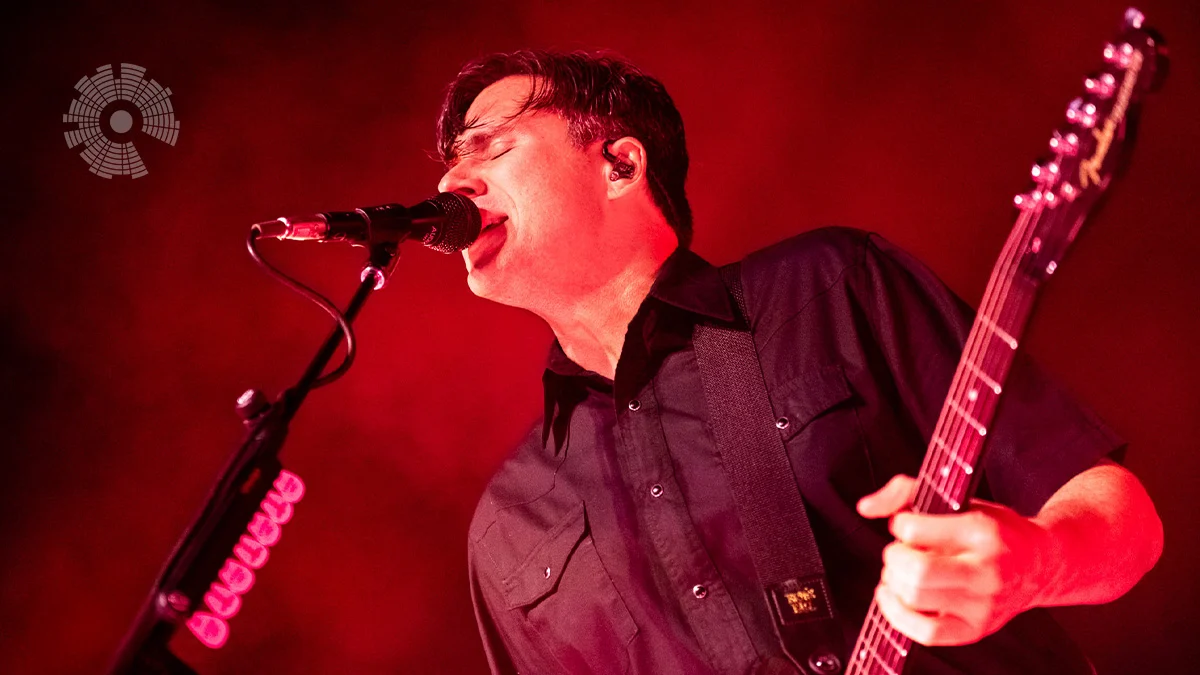
There is a unique, almost sacred contract between a band and their audience when a full-album playthrough is announced. Unlike a standard headline show, where the setlist remains a guessing game of hits and rarities, an anniversary tour—specifically one honoring a seminal work like Jimmy Eat World’s Bleed American—is built on the promise of total immersion. It is a shared journey through a specific time, place, and emotional landscape.
On Tuesday, June 16th, at the historic Brooklyn Paramount, Jimmy Eat World proved that their 25th-anniversary celebration is less of a dusty trip down memory lane and more of a vital, pulse-pounding affirmation of the band’s enduring relevance.
The Landmark Record: Why 2001 Still Matters
To contextualize the night, one must understand the gravity of the album in question. Released in the summer of 2001, Bleed American was the record that catapulted Jimmy Eat World from cult-favorite emo pioneers into the stratosphere of alternative rock. It is a masterpiece of balance—part raw, cathartic energy, part polished power-pop perfection. For thousands of fans, it served as a sonic companion through the complexities of adolescence and early adulthood.
Twenty-five years later, the record remains a definitive touchstone. Its presence on the Bleed American tour is not just an excuse for a reunion; it is a celebration of a band that defied industry rejection—having been dropped by their label shortly before the album’s recording—to create a cultural phenomenon.
Chronology of a High-Voltage Evening
The evening began with a masterclass in pacing. Recognizing that Bleed American clocks in at a lean 46 minutes and 38 seconds, the band opted to prime the audience with a selection of tracks from their 1999 landmark record, Clarity.
The Prelude: A Nod to ‘Clarity’
Performing against a minimalist backdrop—a simple black curtain and a singular row of lights—the band delivered razor-sharp renditions of "Clarity," "Believe in What You Want," "Your New Aesthetic," and "Lucky Denver Mint." These tracks served as the perfect warm-up, establishing a kinetic rapport with the capacity crowd. By the time the curtain fell, the atmosphere in the Brooklyn Paramount had reached a fever pitch.
The Main Event: ‘Bleed American’ from Start to Finish
The reveal was dramatic: a full lighting rig and grated risers emerged, with drummer Zach Lind ascending to a higher kit and touring member Robin Vining joining on keyboards. As the title track’s opening chords shattered the silence, the crowd transitioned into a singular organism of energy.
The sequence of the album highlights the band’s mastery of dynamics. Frontman Jim Adkins, ever the thoughtful curator, had previously noted that the album features a complex structure of peaks and valleys. The live experience mirrored this; the aggressive, high-octane "Sweetness" and "A Praise Chorus" provided an immediate adrenaline surge, while the power-pop structural shifts in "The Authority Song" and "If You Don’t, Don’t" kept the momentum fluid.
Perhaps most surprising was the performance of "The Middle." Adkins shared a candid moment with the crowd, admitting, "None of us really knew what to do with this song. We didn’t expect much from track three because it came together really easy." The song, while being the band’s most ubiquitous hit, was met with a grounded, appreciative response—a testament to the fact that the fans in attendance were there for the entirety of the work, not just the radio single.
The Gut-Punch Interludes
The show truly excelled during the more vulnerable tracks. "Your House" saw the most significant live re-interpretation, with subtle tempo adjustments and shifts in the chorus that only added to its haunting, sweet beauty. Similarly, "Hear You Me" and "Cautioners" provided the night’s emotional anchors. Adkins introduced "Cautioners" with a cryptic remark regarding Live Nation’s request not to play it, leaving fans to wonder if it was a nod to the band’s past industry struggles or simply an acknowledgment of the song’s downbeat nature. Regardless, the execution was impeccable.
Supporting Data and Technical Nuance
The production value of the tour reflects the band’s commitment to honoring the record while acknowledging their current status as veteran performers. The integration of keyboards by Robin Vining added a layer of sonic depth that allowed the live renditions to feel fuller than the original studio recordings.
Despite the technical rigor, there were human moments that reminded the audience of the band’s genuine joy. During "A Praise Chorus," bassist Rick Burch had to swap out his instrument mid-song. Rather than a source of tension, it became a moment of levity; the band and the crowd shared in the spontaneity, with Burch unable to stop grinning. It was a clear indicator that after 25 years, the act of playing these songs remains a source of genuine fulfillment for the members of Jimmy Eat World.
Official Responses and Perspectives
In discussions leading up to the tour, Jim Adkins emphasized that this anniversary is not merely about the commercial success of 2001. "The album is a starting point," he suggested. His interaction with the audience at the Paramount reinforced this; he spoke not as a rock star on a pedestal, but as a peer sharing a long-standing dialogue with the fans.
By closing the set with "My Sundown" and returning for a five-song encore that included "Pain," "For Me This is Heaven," and the fan-favorite "23," the band bridged the gap between their history and their longevity. This "mini-set" was a critical component of the tour’s success, rewarding those who have remained loyal through every era of the band’s career.
Implications: A Band in Their Prime
The implications of this tour are clear: Jimmy Eat World is not a nostalgia act. While they are celebrating a specific milestone, the energy they bring to the stage—and the intensity with which their fans receive it—suggests a band that is still very much in their prime.
For the attendees at the Brooklyn Paramount, the night was a reminder of why they fell in love with music in the first place. It was a validation of the "emo" label’s capacity for complexity and the power of power-pop to communicate profound human experience.
Key Takeaways for Future Dates:
- The Setlist: Expect a deep dive into the band’s history beyond Bleed American.
- The Vibe: The tour is an inclusive, communal experience rather than a cold, corporate retrospective.
- The Legacy: The band is successfully transitioning from "classic act" to "legacy icons" by maintaining a high standard of performance that honors both their past and their present.
As the final notes of "23" rang out, it was evident that the connection between the band and their audience has only deepened over the last two and a half decades. The Bleed American tour is a testament to the idea that some records don’t just age—they evolve, gathering new meaning with every passing year. Jimmy Eat World remains, as they have always been, a band that means a whole lot to a whole lot of people.
 Asro
Asro
 Lina Irawan
