

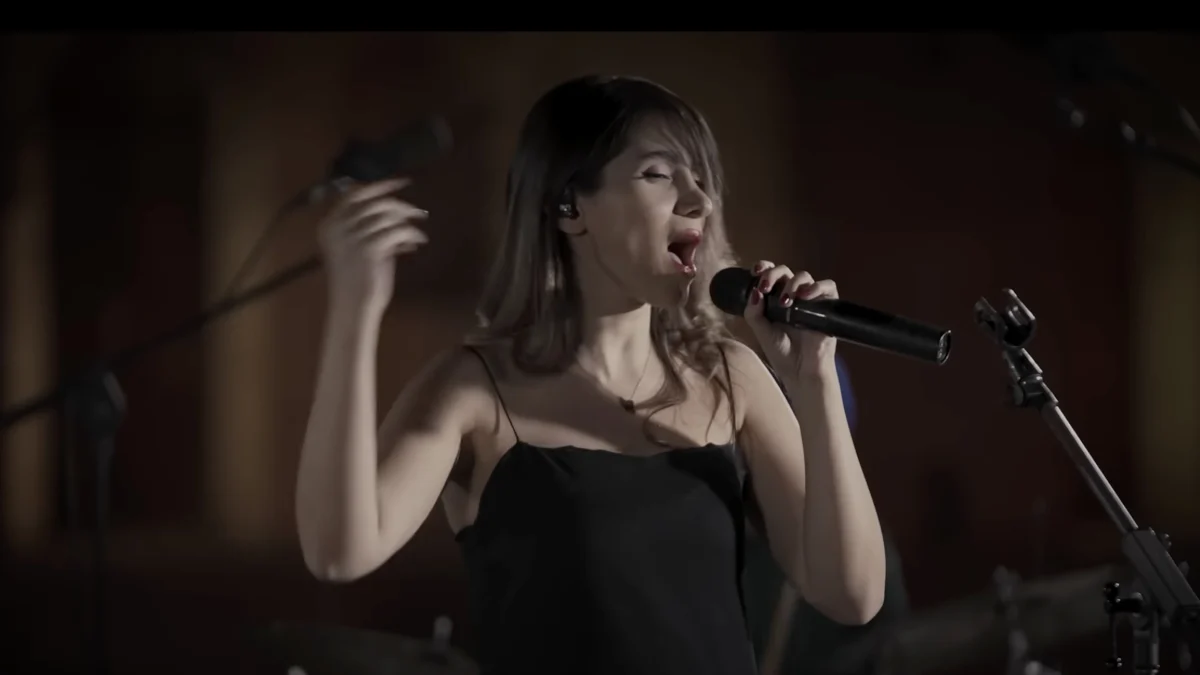
In a chilling reminder of the intensifying conflict between Iran’s cultural underground and the state’s restrictive moral codes, Iranian singer Parastoo Ahmadi has been sentenced to 74 lashes by a criminal court. The sentence, which stems from a December 2024 concert in which the 29-year-old performer appeared without a hijab, marks a significant escalation in the regime’s efforts to suppress artistic expression that challenges the state’s interpretation of public decency.
The repercussions of the verdict extend beyond the singer herself. According to legal documents reviewed by The Guardian, Ahmadi’s male band members and the entire production team involved in the concert have also been sentenced to flogging. Beyond the physical punishment, the court has imposed a two-year ban on all artistic activities for those involved, as well as a prohibition on leaving the country.
The incident, which saw a viral performance of a classic patriotic anthem transformed into a legal battleground, underscores the perilous climate for artists operating within the borders of the Islamic Republic.
The Chronology of a Viral Act of Defiance
The legal firestorm centers on a performance that took place in late 2024. During a concert that was subsequently uploaded and streamed on YouTube, Parastoo Ahmadi performed the iconic patriotic song "Az Khoone Javanane Vatan" ("From the Blood of the Youth of the Homeland").
The song, a deeply ingrained piece of Iranian culture that serves as a lament for the sacrifice of young revolutionaries, took on a poignant new meaning when performed by Ahmadi. Dressed in a simple black dress and appearing without the mandatory Islamic headscarf, Ahmadi was backed by a three-piece band. The performance was characterized by its simplicity and the emotional resonance of the lyrics, which call upon the collective memory of the nation’s struggle.
The video, which captured a moment of quiet, defiant beauty, resonated with millions. Within months of its upload, the video garnered over three million views, turning it into a symbol of cultural resistance. For the Iranian authorities, however, the video served as a repository of evidence.
By early 2025, reports began circulating that authorities had initiated a criminal investigation into the production. The court’s eventual ruling deemed the concert "vulgar and immoral content," specifically citing the violation of the hijab mandate and the "corruption" spread by the musicians’ public performance. The sentencing, handed down in mid-2026, serves as a punitive measure not only for the violation of dress codes but for the act of bypassing state-sanctioned channels of performance.
Legal and Ethical Framework: The State’s Justification
The verdict against Ahmadi and her team is rooted in the Iranian penal code, which grants the judiciary broad powers to interpret "public decency" and "morality." Under Article 638 of the Islamic Penal Code of Iran, the appearance of a woman in public without a "religious hijab" is a punishable offense. However, the court’s decision to apply corporal punishment—flogging—to the entire production team, including men who did not violate the dress code themselves, reflects an expansive application of the law regarding "aiding and abetting" in moral crimes.
Defining "Vulgarity"
The court’s characterization of the concert as "vulgar" highlights the regime’s ongoing struggle to maintain control over the arts. In the eyes of the Iranian judiciary, any unsanctioned public performance, particularly one involving female soloists or non-traditional attire, is inherently political. By labeling the performance as an offense to "public decency," the court effectively criminalizes the aesthetic choices of the performers.
The Scope of the Penalty
The 74 lashes represent a severe form of corporal punishment that has drawn condemnation from international human rights organizations. When combined with the two-year ban on artistic work, the sentence functions as a "professional death penalty." For a musician like Ahmadi, the inability to perform, record, or collaborate for two years is intended to isolate her from her audience and strip her of her livelihood, effectively silencing her voice within the domestic sphere.
Supporting Data: The Systematic Suppression of Dissent
The sentencing of Parastoo Ahmadi is not an isolated incident; it is a symptom of a broader, systemic campaign against cultural figures in Iran. Since the widespread civil unrest of 2022, which was triggered by the death of Mahsa Amini while in the custody of the "morality police," the regime has intensified its focus on the creative class.
Data from human rights monitors, including Amnesty International and Human Rights Watch, indicates a sharp uptick in the arrests of musicians, actors, and filmmakers since the beginning of 2023. This crackdown is often justified under the guise of "national security" or "preserving Islamic values."
- Cultural Blacklisting: Over the past three years, dozens of artists have been summoned by intelligence services, forced to sign "confessions," or had their passports confiscated to prevent them from performing abroad.
- The Gendered Component: Women in the arts face a disproportionate amount of state scrutiny. The mandatory hijab remains the primary tool for policing women’s presence in public spaces, and the criminalization of female singing—which is often restricted or heavily regulated in Iran—serves as a secondary barrier to entry.
- The YouTube Factor: The digital age has complicated the state’s control over culture. Platforms like YouTube and Instagram allow artists to bypass the Ministry of Culture and Islamic Guidance, which must approve all lyrics, performances, and public appearances. The sentencing of Ahmadi is, in part, an attempt to reassert control over the digital landscape by proving that even online actions have physical consequences.
Official Responses and International Outcry
The international community has reacted with alarm to the news of the sentencing. While the Iranian government rarely comments on specific judicial verdicts to foreign press, their official stance remains consistent: they maintain that their laws are sovereign, based on religious tenets, and are essential for maintaining the stability of the state.
Human rights advocacy groups, however, have been vocal. In a joint statement, several organizations argued that the use of corporal punishment for artistic performance is a violation of international human rights conventions, specifically the International Covenant on Civil and Political Rights (ICCPR), to which Iran is a signatory.
"The sentencing of Parastoo Ahmadi and her team is an act of state-sponsored intimidation," said a spokesperson for an international free-speech advocacy group. "By using the whip against musicians, the regime is signaling that it views the arts as a direct threat to its authority. This is not about ‘morality’; it is about the total suppression of the individual."
Domestically, the reaction has been one of quiet, cautious support for the artists. Because of the risk of surveillance and arrest, many of Ahmadi’s peers have expressed their solidarity through coded social media posts or by sharing her music, effectively turning her into a martyr for the cultural cause.
Implications: The Future of Iranian Cultural Expression
The sentencing of Ahmadi carries profound implications for the future of Iranian music and art.
The Erosion of the Middle Ground
For years, many Iranian artists attempted to navigate the "gray zone"—performing in private venues or strictly adhering to government regulations to keep their work alive. The sentencing of an entire production team suggests that this gray zone is shrinking. When even a collaborative project involving men and women is treated as a criminal conspiracy, the risks of domestic production become untenable for many.
The "Brain Drain" of Talent
The travel ban imposed on the team is a tactical move to prevent these artists from leaving the country to continue their careers in exile. By keeping them within the country’s borders, the regime intends to ensure that they are silenced. However, historical patterns suggest that such repression often drives artists to find increasingly innovative, albeit clandestine, ways to record and share their work.
A Test of Resilience
The question remains: will this punishment serve as a deterrent, or will it galvanize further dissent?
History in Iran suggests that harsh crackdowns often lead to a "Streisand Effect." The more the regime tries to erase a performance, the more legendary it becomes. The fact that the video has already been viewed millions of times means that the state has already lost the battle to suppress the content itself. The sentencing is now an attempt to impose a cost on the act of creation, hoping to make the price of fame too high for the next generation of artists to pay.
As Parastoo Ahmadi faces her sentence, she stands at the center of a larger, ongoing struggle for the identity of Iran. Her story reflects the tension between a populace that increasingly looks toward global standards of personal freedom and a regime that remains committed to maintaining its power through the rigid enforcement of its moral ideology.
Whether this incident marks the end of a career or the beginning of a larger cultural movement remains to be seen. What is clear, however, is that for the Iranian state, the song of a young woman has become a threat that can only be countered with the most archaic of punishments. The world will be watching to see how the Iranian judiciary proceeds, and whether the fear it aims to instill will ultimately succeed in silencing a generation that has already found its voice.
 Asro
Asro
 Lina Irawan
 rifanmuazin
