

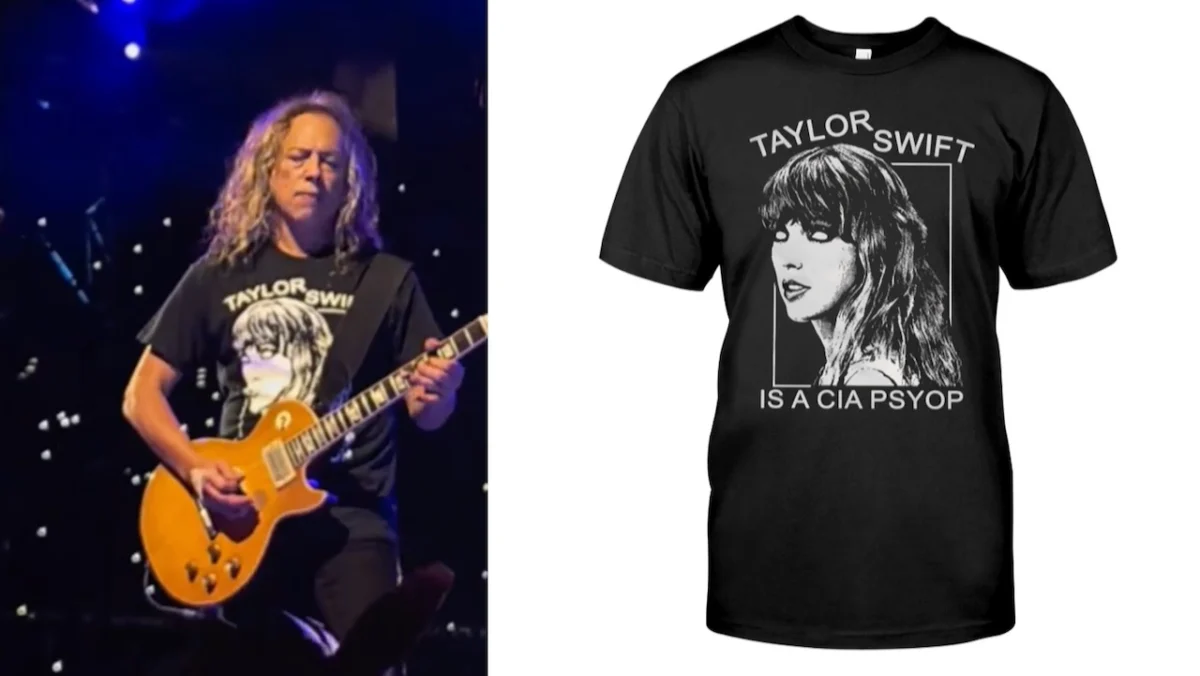
The worlds of heavy metal and global pop stardom rarely collide, but when they do, they rarely do so with the nuance one might hope for. This week, the metal community and the vast, digital-native army of Taylor Swift fans—known as the “Swifties”—found themselves embroiled in a peculiar cross-genre spat dubbed by social media users as “Shirtgate 2026.”
At the center of the storm is Metallica lead guitarist Kirk Hammett, whose sartorial choice during a June 13th performance at the Puskás Aréna in Budapest has ignited a firestorm of online outrage, conspiracy-laden commentary, and a broader discussion on the nature of celebrity marketing in the digital age.
The Budapest Incident: A Fashion Statement or a Provocation?
On June 13, 2026, during the European leg of their current tour, Metallica took the stage in Budapest. As Hammett shredded through the band’s iconic discography, observant fans in the front row and those watching clips on social media quickly noticed something unusual about the guitarist’s attire. Hammett was sporting a graphic T-shirt that featured a stylized, blank-eyed illustration of Taylor Swift, emblazoned with the provocative text: “Taylor Swift is a CIA Psyop.”
The shirt, which appears to be a satirical nod to the increasingly common (and increasingly absurd) internet discourse surrounding “industry plants” and psychological operations, did not go unnoticed for long. Within days, the image had circulated across X (formerly Twitter) and TikTok, reaching the outer orbits of the Swiftie fan base, which is famously protective of the pop icon.
The reaction was immediate and, in many ways, predictable. By June 19, the “Taylor Swift Fan Archive” account on X had shared the image with a pointed caption: “Kirk Hammett from the has-been band Metallica was wearing a ‘Taylor Swift Is a CIA Psyop’ shirt on stage.” The post served as the primary catalyst for a wave of digital retaliation, forcing a clash between two of the most dedicated fan bases in music history.
Chronology of the Controversy
- June 13, 2026: Metallica performs at the Puskás Aréna in Budapest. Kirk Hammett wears the “CIA Psyop” shirt on stage.
- June 14–17, 2026: The image begins to circulate in niche music forums and on Reddit, initially gaining traction among fans of indie rock and metal.
- June 18, 2026: The controversy reaches the mainstream Swiftie community. A surge of negative comments targets Hammett’s social media accounts.
- June 19, 2026: The “Taylor Swift Fan Archive” account posts the photo, amplifying the backlash and labeling Metallica a “has-been band.”
- June 20, 2026: Media outlets begin covering the story as “Shirtgate 2026,” highlighting the intersection of conspiracy theories and pop culture.
The Context: Where Do “Psyop” Theories Come From?
To understand why a shirt would cause such a stir, one must look at the peculiar state of modern digital discourse. The term “psyop” (psychological operation) has migrated from military and intelligence parlance into the vernacular of chronically online music fans.
Earlier in 2026, the indie-rock band Geese found themselves at the center of a bizarre marketing controversy. Their unconventional promotional tactics were labeled a “psyop” by detractors, leading to a wave of online psychosis—a phenomenon where fans begin to believe that every element of a star’s career is a manufactured, state-sanctioned, or corporate-engineered deception.
Hammett’s shirt is almost certainly a satirical commentary on this trend. By wearing the shirt, the guitarist was likely mocking the absurdity of the conspiracy theories that plague modern artists. However, in the high-stakes world of online fandom, nuance is often lost. To many Taylor Swift fans, the shirt was not a meta-commentary on the state of the music industry; it was a direct, derogatory attack on an artist who has become a cultural institution.
Supporting Data: The Two Titans of Touring
While the fan bases trade barbs, the financial reality for both acts remains unbothered. Taylor Swift continues to dominate the Billboard charts with “I Knew It, I Knew You,” a standout track from the Toy Story 5 soundtrack, which currently holds the number one spot on the Hot 100. Her recent appearance at New York’s Electric Lady Studios, where she reportedly spent an overnight session, suggests she is already deep into her next creative project, completely insulated from the minor tremors caused by a metal guitarist’s fashion choice.
Metallica, meanwhile, is maintaining a grueling pace. Following their European tour, the band is set to transition into a massive, multi-month residency at the Las Vegas Sphere, scheduled from October 2026 to March 2027. The demand for tickets remains at an all-time high, suggesting that the “has-been” label applied by social media critics holds little weight in the actual marketplace.
The Dynamics of Digital Outrage
The controversy highlights a shift in how fan bases interact with the icons they support. In the age of parasocial relationships, fans often view any critique—or even vague, potentially ironic jabs—at their preferred artist as a personal affront.
When Metallica’s legacy is compared to Swift’s current ubiquity, it creates a generational divide. The “Swifties” operate with a level of coordination and defensive fervor that most 80s-era metal bands never had to contend with. Conversely, the Metallica fan base, built on decades of “us vs. them” mentality, is likely to double down on their support of Hammett precisely because he has drawn the ire of a group they perceive as “outsiders.”
Implications: A Marketing Win in Disguise?
From a cynical public relations perspective, Shirtgate 2026 is a masterclass in unintentional marketing. By engaging in this “controversy,” both parties remain firmly in the headlines. Metallica’s ticket sales for their Sphere residency are unlikely to suffer, and Swift’s streams will remain in the billions. If anything, the friction between these two demographics has exposed more Metallica fans to Swift’s recent work, and vice-versa.
Industry insiders note that such spats often serve to keep older acts relevant in the eyes of younger listeners, while keeping younger stars in the conversation with veteran music fans. While Hammett has remained silent regarding the backlash, it is highly probable that if the two were to cross paths in the future, the interaction would be marked by professional mutual respect and perhaps a private, ironic laugh over the absurdity of the internet age.
The Intersection of Metal and Pop
The controversy also forces a reflection on how we consume music in 2026. With the barrier to entry for content creation lower than ever, the distinction between a “real” artist and a “manufactured” one is increasingly blurred. Theories about “industry plants” and “psyops” are, in many ways, the modern fan’s way of grappling with the lack of transparency in music marketing.
Hammett, a veteran of the industry who rose to fame long before the advent of the viral social media post, represents an older guard. His humor, if that is indeed what it is, is grounded in the irony of the rock-and-roll tradition. Swift represents the new guard—a hyper-connected, meticulously managed, and incredibly successful juggernaut that operates with a precision that makes the old-school metal world look chaotic.
Conclusion: The Unforgiven vs. The Global Icon
Ultimately, Shirtgate 2026 is a footnote in the history of both Metallica and Taylor Swift. It serves as a reminder that in an age of constant connectivity, even a simple garment can trigger a global chain reaction of commentary and conflict.
As Metallica prepares to bring their heavy sound to the high-tech confines of the Las Vegas Sphere and Swift continues to craft the soundtrack for the next generation of cinema and radio, this incident will likely fade as quickly as it emerged. Yet, it leaves behind a lingering question about the state of our discourse: are we becoming so obsessed with looking for conspiracies and hidden agendas that we have lost the ability to distinguish between genuine malice and a simple, off-color joke?
For Kirk Hammett, the lesson is clear: in the era of the Swiftie, every T-shirt is a manifesto, and every stage is a courtroom. Whether he intended to be the “unforgiven” or just a guy wearing a funny shirt, he has inadvertently become a central player in one of the summer’s most peculiar cultural conversations. For the rest of us, it serves as a chaotic, albeit entertaining, look into the intersection of two very different musical worlds.
 Asro
Asro
 Lina Irawan
 rifanmuazin
