

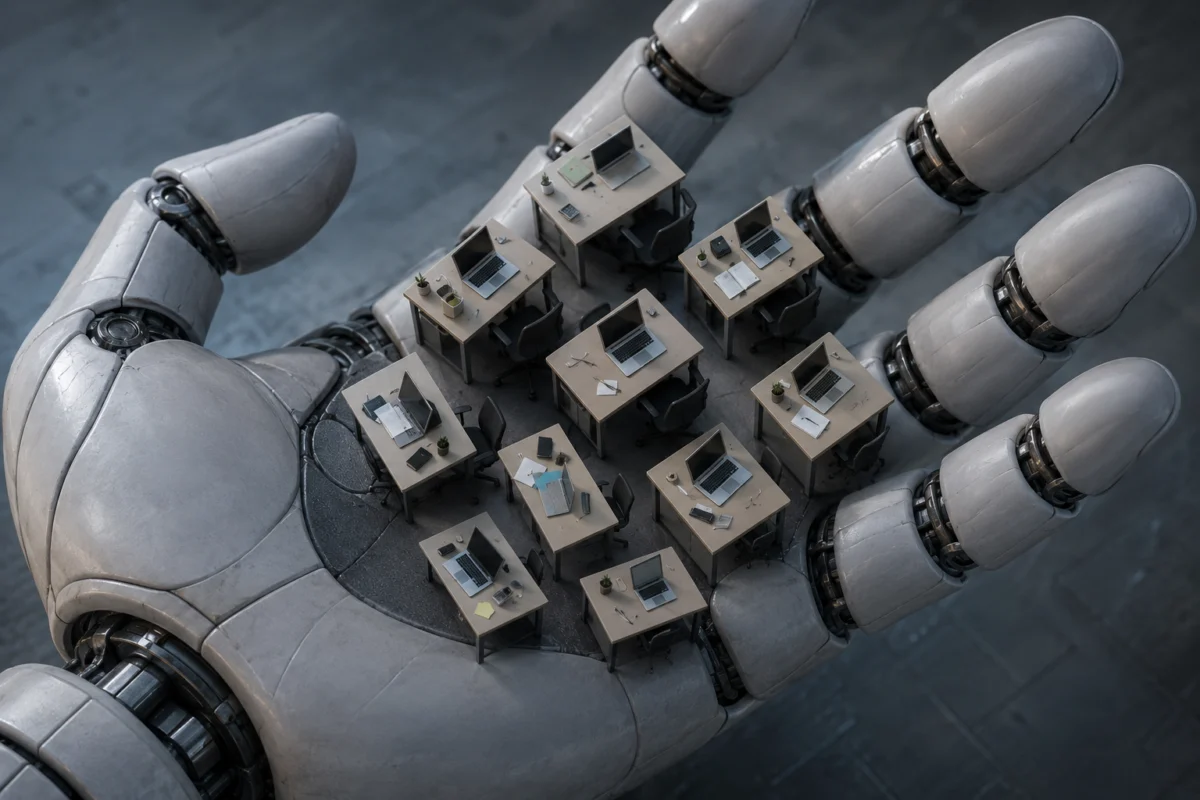
The technology sector is currently navigating a profound and often painful transformation. While Wall Street celebrates the unprecedented financial growth driven by generative AI, the human cost of this transition has reached a fever pitch. In a sobering disclosure this week, Oracle revealed that its workforce has shrunk by 21,000 employees over the past 12 months—a 13% reduction that far exceeds previous industry estimates.
This revelation is not an isolated incident; it is a defining characteristic of the 2026 labor market. As companies report record-breaking revenues and soaring stock valuations, they are simultaneously executing massive layoffs, explicitly citing the deployment of AI as the primary catalyst. This "AI Efficiency Paradox" has sparked a fierce debate: Are these cuts a necessary evolution to remain competitive, or is the industry sacrificing its long-term human capital for short-term operational gains?
The Oracle Disclosures and the New Normal
In its latest annual financial regulatory filing, Oracle laid bare the cold reality of its restructuring. "The adoption and deployment of AI technologies across our operations have resulted, and may continue to result, in reductions to our workforce," the company stated.
This admission confirms what many analysts have suspected: the "AI wave" is not just creating new job categories; it is aggressively cannibalizing existing ones. For the broader tech industry, May 2026 proved to be the most severe month for layoffs in years, with artificial intelligence cited as the leading factor by outplacement firm Challenger, Gray & Christmas. The trend suggests that for C-suite executives, AI is being positioned as the ultimate tool for "simplification"—a corporate euphemism for reducing headcount to increase margins.
A Chronology of the AI-Driven Downsizing
The scope of these layoffs is expansive, touching every corner of the tech ecosystem, from infrastructure providers to consumer-facing platforms. Below is a detailed look at the major players who have restructured their workforces in 2026 with AI as a central justification.
Infrastructure and Enterprise Shifts
- GitLab (June 2026): In a bid to scale its platform for AI workloads, GitLab cut 14% of its staff (approx. 350 people). CEO Bill Staples described the move as a "generational rebuild" of infrastructure, noting that agentic AI is forcing competitors to the brink.
- Cisco (May 2026): Despite a record-breaking quarter, Cisco slashed 4,000 jobs. CFO Mark Patterson characterized the move not as a cost-cutting exercise, but as a strategic reallocation of resources toward silicon, optics, and AI capabilities.
- Dell (March 2026): Dell’s fiscal 2026 filing revealed a 10% workforce reduction—roughly 11,000 positions—as the company pivoted its focus toward the high-growth sector of AI-optimized servers.
The "Efficiency" Drive at Tech Giants
- Google (Ongoing, May 2026): Google has utilized a "quiet" approach to layoffs. Through rolling performance reviews and voluntary buyouts, the company has shed thousands of engineers and managers, particularly in its Cloud division, despite Cloud revenue surging 63% to over $20 billion.
- Meta (May 2026): Meta laid off 8,000 employees while simultaneously shifting 7,000 others into new, AI-focused units—a move that has reportedly led to significant internal morale issues.
- Amazon (January 2026): Following a trend of "anti-bureaucracy," Amazon cut 16,000 corporate jobs. CEO Andy Jassy had previously signaled that generative AI would naturally reduce the need for certain roles, framing the cuts as an inevitable consequence of increased efficiency.
Startups and Agile Restructuring
- Block (February 2026): Jack Dorsey’s firm cut 4,000 jobs—nearly half its staff. Dorsey argued that AI-enabled tools allow for smaller, flatter teams, signaling a shift that he believes most companies will eventually be forced to emulate.
- Coinbase (May 2026): The exchange cut 14% of its staff, with CEO Brian Armstrong noting that AI has allowed engineers to ship in days what previously took weeks, necessitating a leaner organizational structure.
- Atlassian (March 2026): While cutting 1,600 jobs, CEO Mike Cannon-Brookes was transparent about the shift: "It would be disingenuous to pretend AI doesn’t change the mix of skills we need… it does."
The Logic of "Simplification"
A common thread across these announcements is the desire to reduce "complexity." Companies like Intuit (3,000 cuts) and PayPal (4,500 cuts) have cited organizational simplification as a pillar of their AI strategy. By flattening management layers and automating routine tasks, these firms aim to increase the "velocity" of their product cycles.
However, critics argue that this rationale often masks a deeper systemic issue. Many of the roles now being eliminated were hired during the pandemic-era growth surge. By blaming AI, these companies can reframe a necessary correction of past hiring mistakes as a forward-looking technological pivot, effectively insulating themselves from the stigma of over-hiring.
The Human Cost and Corporate Culture
The impact on corporate culture is palpable. In cases like Meta, where employees were forced into AI roles they were not trained for or interested in, the "AI transition" is being described by insiders as a "soul-crushing" experience. Furthermore, the reliance on AI agents to replace human functions—such as Salesforce replacing support staff with its Agentforce unit—raises existential questions about the future of entry-level roles.
When companies like IBM replace hundreds of HR positions with AI agents while simultaneously hiring for AI-specific roles, they are effectively shifting the skill requirements of the labor market faster than the workforce can adapt. This creates a "skills gap" that leaves thousands of displaced workers stranded while the companies struggle to find the specialized AI talent they claim to need.
Implications for the Future
The long-term implications of this widespread downsizing are profound:
- The Erosion of Institutional Knowledge: As middle management—the "measurers," as Cloudflare CEO Matthew Prince called them—is gutted in favor of AI, companies risk losing the connective tissue that holds complex organizations together.
- The Junior Talent Vacuum: If entry-level support, coding, and HR roles are the first to be automated, the industry faces a future where there is no clear pipeline to train the next generation of senior engineers and leaders.
- Market Volatility: The market has largely reacted positively to these layoffs, with stock prices often rising upon the announcement of staff cuts. This creates a perverse incentive for CEOs to continue cutting to appease shareholders, regardless of whether the organization actually requires the reduction.
Conclusion: A Turning Point
The wave of AI-driven layoffs is not merely a temporary adjustment; it is a structural realignment of the global economy. As Oracle and others have demonstrated, the integration of AI is not just an additive process—it is a subtractive one.
While the promise of AI lies in its ability to increase productivity and drive innovation, the current trajectory suggests that the "efficiency" gained comes at a significant cost to the social contract between employer and employee. As we move further into 2026, the tech industry must reckon with whether it is building a more efficient future or simply dismantling the human foundations of its own success. For now, the "powder keg" of AI-driven layoffs continues to smolder, leaving a generation of tech workers to wonder if they are part of the future of the industry, or merely an obstacle to its profit margins.
 Asep Darmawan
 Siti Muinah
 Ali Ikhwan
