

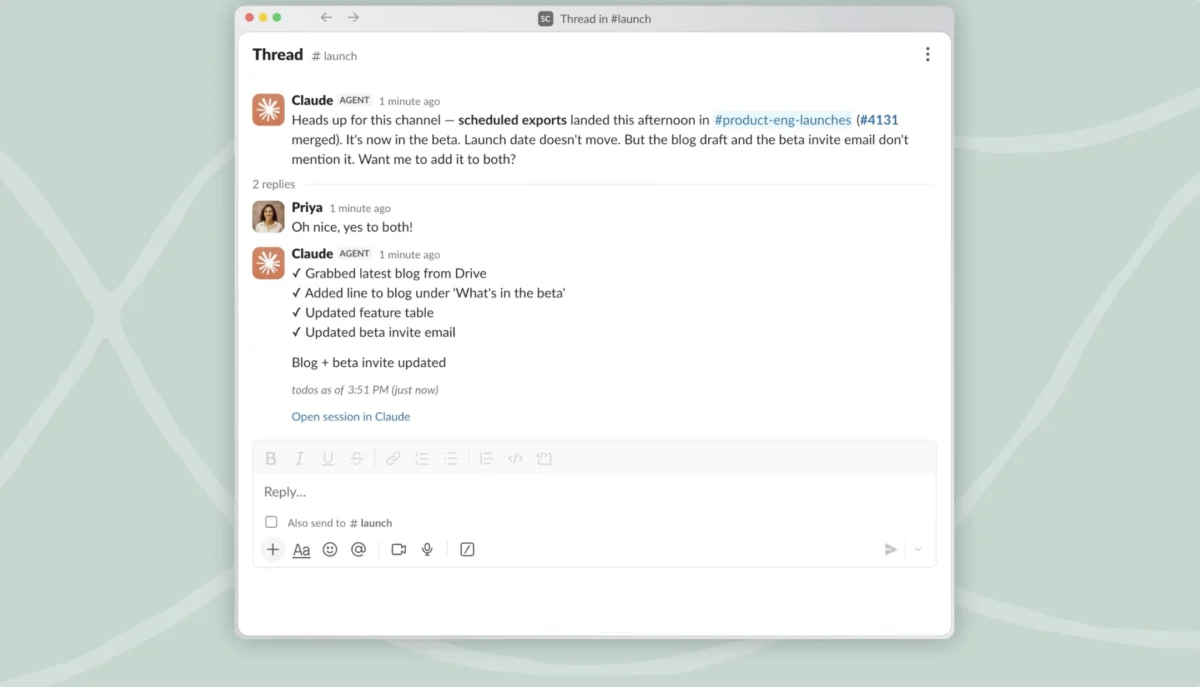
In the rapidly evolving landscape of enterprise artificial intelligence, the gap between "chatbot" and "colleague" is closing. Anthropic, the San Francisco-based AI research company, has announced a significant expansion of its enterprise capabilities with the launch of "Claude Tag." Currently in research preview, this new feature shifts the paradigm of AI interaction from sporadic, on-demand querying to a persistent, ambient, and collaborative experience embedded directly within Slack.
For businesses utilizing Claude Enterprise and Claude Team, Claude Tag is designed to function not merely as a tool, but as a digital teammate that "lives" in Slack channels, follows ongoing projects, and maintains institutional memory. This move represents a strategic push by Anthropic to move beyond the limitations of single-session interactions, positioning their AI as a foundational layer of the modern digital workplace.
The Evolution of the AI Teammate: From Query to Colleague
To understand the significance of Claude Tag, one must look at the trajectory of Anthropic’s integration strategy. Previously, interacting with Claude in Slack was a transactional affair. Whether a user sent a direct message to @Claude or tagged it in a channel for a quick summary or a burst of code, the AI’s presence was ephemeral. It operated within the silo of a single prompt-response cycle, requiring the user to constantly provide context and restate goals.
Recent innovations, such as the introduction of "Claude Code," allowed for more sophisticated workflows, where coding tasks were routed from Slack to the web and back again. However, these tools remained task-specific. Claude Tag, by contrast, introduces "persistent context." As Claude follows a channel, it builds a historical understanding of the work being done. It learns the nuances of a project, recognizes the recurring needs of the team, and can autonomously pull information from other authorized channels.
How Claude Tag Functions
The technical architecture of Claude Tag is built on the premise of "shared identity." In a given Slack channel, everyone has access to the same instance of Claude. This means that if an engineer leaves a thread unfinished, a product manager can tag @Claude to pick up exactly where the conversation left off. The AI remembers the context, the constraints, and the previous suggestions, effectively acting as a living record of the project’s evolution.
Administrators maintain granular control over this "teammate." They define which tools, data repositories, and channels the AI can access. This scoping is vital; it ensures that a Claude instance assigned to a legal review team does not inadvertently access or leak sensitive data into an engineering channel, maintaining strict internal data governance.
Chronology: Building Toward Ambient Intelligence
The release of Claude Tag is the culmination of a multi-year effort to integrate large language models into the daily flow of professional work.
- Phase 1: The Transactional Era (2024): AI integrations were limited to simple DMs or mentions. Users relied on AI to draft emails or summarize long threads on an ad-hoc basis.
- Phase 2: The Agentic Pivot (2025): The launch of Claude Code marked a shift toward action-oriented AI. The model began moving beyond text generation to executing technical tasks and reporting results back to the team.
- Phase 3: The Persistent Teammate (2026 and beyond): With the introduction of Claude Tag, Anthropic is moving toward "ambient intelligence." The AI no longer waits to be spoken to; it is designed to monitor threads, flag potential bottlenecks, and proactively suggest follow-ups, effectively mirroring the behavior of a human project coordinator.
Implications: The Battle for the Enterprise Context Layer
The introduction of Claude Tag places Anthropic at the center of an intense industry struggle: the battle for the "context layer." As companies struggle with data fragmentation, the AI that best understands the "tacit knowledge" of an organization—the unwritten rules, the project history, and the team dynamics—becomes the most valuable.
The Competitive Landscape
Anthropic is not alone in this endeavor. The race to become the "OS for the Enterprise" is crowded with heavyweights:
- Microsoft’s Ecosystem: Through Microsoft 365 Copilot and the underlying Microsoft Graph, the software giant has a distinct advantage. It controls the suite where work happens (Word, Excel, Teams), allowing its AI to tap into a massive, unified repository of enterprise data.
- The Infrastructure Play (Snowflake and Databricks): These data giants are shifting from being mere "storage" providers to "intelligence" providers. By positioning their platforms as the back-end support containing the raw data that AI agents need to function, they are trying to ensure that no matter which front-end agent a company chooses, it is running on their foundation.
- The Intelligence Layer (Glean): Companies like Glean are carving out a niche as the "connective tissue." They sit between the AI model and the enterprise data, providing a unified search and context engine that allows AI to navigate an organization’s disparate SaaS tools with ease.
Anthropic’s strategy with Claude Tag is to provide a user interface that is so frictionless—living exactly where the team already communicates—that the "context layer" feels like a natural part of the conversation rather than a separate database or application.
Official Perspectives: The "Human-in-the-Loop" Philosophy
Anthropic’s framing of this feature is distinctly focused on the "teammate" experience. In a statement regarding the launch, the company emphasized that the goal is to make the AI feel like a "real colleague."
"Claude can automatically gather facts from elsewhere in the organization, if it’s granted permission," the company noted. This suggests that Anthropic is betting on transparency and "public work." By forcing the AI to show its work in a public Slack thread, team members can verify, edit, and collaborate on the AI’s output in real-time. This reduces the "black box" concern that often plagues enterprise AI adoption, as the AI’s reasoning becomes visible and subject to peer review.
However, this also introduces new challenges for human management. If an AI is "proactively jumping into the chat," how do companies prevent notification fatigue? Anthropic argues that the AI’s ability to "flag things from across the organization" will actually reduce noise by summarizing fragmented information, but the burden of managing an AI coworker will ultimately fall on the human team leads.
Supporting Data: Why Context is King
The shift toward persistent AI is driven by a clear economic imperative: the high cost of context switching. Research suggests that the average knowledge worker spends a significant portion of their day toggling between apps to find information.
- Context Retention: In traditional LLM usage, the "context window" is the limit of what the AI can remember in one session. Claude Tag effectively extends this to the lifespan of a project.
- Reduced Friction: By keeping the AI within Slack, organizations reduce the need for workers to copy-paste data between their messaging platform and a separate AI dashboard, minimizing the risk of data leakage and human error.
- Governance at Scale: The administrative controls embedded in the Claude Tag preview reflect a maturing enterprise market that prioritizes security. By allowing admins to scope the AI’s memory to specific channels, Anthropic is addressing the primary barrier to AI adoption in regulated industries like finance and healthcare.
Future Outlook: What’s Next for the AI Teammate?
As the research preview for Claude Tag continues, the tech industry will be watching closely to see how effectively the model manages "memory drift." Can an AI remain useful over a six-month project, or will its memory become cluttered with irrelevant information?
Anthropic’s success will likely depend on its ability to refine the "ambient mode." If the AI becomes too intrusive, it will be muted. If it is too passive, it will be ignored. Finding the "Goldilocks zone" of proactive assistance will be the defining challenge for the next generation of enterprise AI.
Ultimately, Claude Tag signifies that the era of AI as a "tool" is fading, and the era of AI as a "team member" has arrived. Whether this leads to a massive boost in productivity or a fundamental change in how we structure work remains to be seen. For now, the integration of memory and context into the chat interface is a clear sign that the future of work is not just about faster computing—it is about smarter, more persistent collaboration.
Disclaimer: Some of the links in this article may be affiliate links. This does not influence the independence of our editorial reporting.
 Asep Darmawan
 Siti Muinah
 Ali Ikhwan
