

By Laura Quiñones
27 June 2026
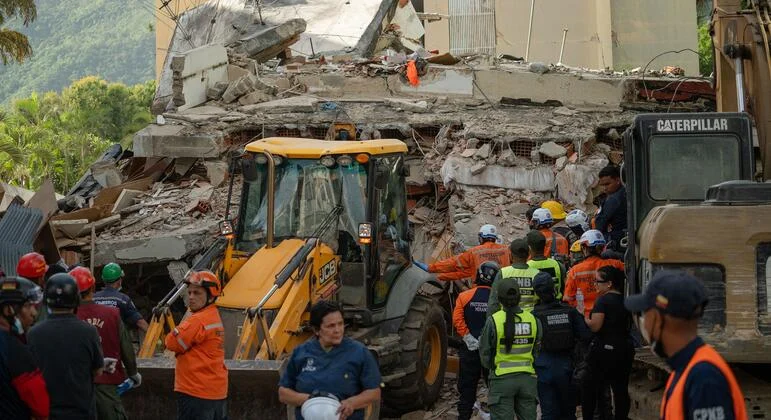
In an unprecedented humanitarian mobilization, more than 2,000 elite rescue specialists from 27 nations have converged on northern Venezuela. Their arrival marks a critical juncture in the race against time to locate survivors trapped beneath the ruins of cities devastated by powerful twin earthquakes that struck the region on Wednesday, June 24. As the death toll continues to climb, the international community has rallied under the coordination of the United Nations to address what is quickly becoming one of the most significant natural disasters in the nation’s modern history.
The scale of the devastation is staggering. As of Saturday, 27 June, official government figures confirm that at least 1,430 people have perished, with another 3,238 individuals sustaining injuries. With countless more reported missing, the United Nations Office for the Coordination of Humanitarian Affairs (OCHA) has warned that these figures are likely to increase as search-and-rescue teams penetrate deeper into the most heavily damaged urban sectors.
The Anatomy of the Disaster: A Chronology
The crisis began on the morning of June 24, when the northern coast of Venezuela was rocked by two seismic events of extraordinary intensity. According to geological data, the initial tremors—registering magnitudes of 7.2 and 7.5—sent shockwaves through densely populated regions, including the capital city of Caracas and the states of La Guaira, Carabobo, Miranda, Yaracuy, and Aragua.
The dual nature of the seismic activity—occurring in rapid succession—multiplied the structural failure of thousands of buildings that might have otherwise withstood a single, shorter-duration event. The primary tremors were followed by a series of aftershocks that further destabilized already compromised infrastructure, hampering initial domestic rescue attempts and forcing the Venezuelan government to issue an urgent international appeal for specialized assistance.
By June 25, the Venezuelan authorities had officially requested support from the UN, triggering the activation of the International Search and Rescue Advisory Group (INSARAG) network. Within 48 hours, a logistical bridge was established, facilitating the rapid deployment of 44 Urban Search and Rescue (USAR) teams. These teams, accompanied by 140 highly trained search-and-rescue dogs, represent a global coalition spanning the Americas, Europe, and the Middle East.
Global Solidarity in Action
The international response has been swift and geographically diverse. The rescue contingent currently operating on the ground includes specialists from Argentina, Brazil, Canada, Chile, Colombia, Ecuador, El Salvador, Guatemala, Mexico, Panama, Peru, and the Dominican Republic. Furthermore, significant technical and medical teams have arrived from Germany, Czechia, Spain, the United States, France, Italy, Jordan, Lithuania, the Netherlands, Qatar, the United Kingdom, Serbia, Syria, Switzerland, and Türkiye.
These teams are currently working in rotating shifts, utilizing advanced acoustic listening devices, thermal imaging cameras, and heavy-duty extraction machinery to navigate the labyrinthine debris fields. Their mission, coordinated by OCHA, is twofold: to identify "live" voids within collapsed structures and to provide immediate field-level medical stabilization for those pulled from the rubble.
Economic and Structural Impact: The $6.7 Billion Toll
Beyond the tragic loss of life, the economic implications of the twin earthquakes are profound. A preliminary satellite-based assessment conducted by the United Nations Development Programme (UNDP) estimates that the direct physical damage to infrastructure, housing, and economic assets stands at approximately $6.7 billion.
This figure, which represents roughly six percent of Venezuela’s annual Gross Domestic Product (GDP), was calculated using the UNDP’s "Rapid Digital Analysis" (RAPIDA) tool. The analysis suggests that the true cost of the disaster could range anywhere from $4.7 billion to $8.7 billion. It is vital to note that these figures represent only the immediate, tangible physical destruction; they do not encompass the long-term economic contraction, the massive costs associated with national reconstruction, or the total collapse of local supply chains.
The UNDP report highlights the sheer scale of the exposure: approximately 8.6 million people—nearly a third of the national population—were subjected to moderate to severe shaking. Of these, 2.1 million individuals were located in the epicenter zones, where they experienced the most violent tremors. Satellite analysis of the affected regions indicates that approximately 1.7 million structures were located within the impact radius, with tens of thousands of these buildings suffering catastrophic structural failure.
Infrastructure and Essential Services
The earthquakes have severed critical lifelines across the northern corridor. Satellite data provided by the UNDP has identified a significant reduction in nighttime lighting in the states of Carabobo, La Guaira, Caracas, and Aragua, serving as a grim indicator of widespread power grid failure.
The loss of electricity has created a cascading series of complications. Without power, water pumping stations have ceased to function, and the cold-chain requirements for essential medical supplies—such as vaccines and insulin—are currently under severe threat. Local hospitals, many of which were already strained, are now operating under emergency power, struggling to manage the influx of thousands of trauma patients while simultaneously dealing with their own structural damage.
"The speed and accuracy of initial assessments are essential for an effective response," stated Luis Francisco Thais, the UNDP Resident Representative in Venezuela. "Tools like RAPIDA help us make faster, evidence-based decisions to support affected communities. We are not just looking at numbers; we are identifying where the most vulnerable populations are clustered so that aid can be directed with surgical precision."
Official Response and Future Coordination
The Venezuelan government has established a central command center in Caracas to liaise with the UN and the various international contingents. The priority remains the "Golden Window"—the first 72 to 96 hours following a collapse, during which the probability of finding survivors is highest.
As the rescue phase continues, the UN has signaled its intention to transition toward early recovery efforts. This will involve the deployment of experts to evaluate the safety of remaining buildings and the establishment of temporary shelter complexes for the hundreds of thousands of people displaced by the destruction. The UNDP has committed to continued high-resolution satellite imagery analysis, which will provide the longitudinal data necessary to map out a phased recovery plan that includes the reconstruction of housing, schools, and health facilities.
The international community’s presence is not merely a logistical asset; it is a psychological lifeline for a population currently enduring a period of intense trauma. However, the path to recovery will be arduous. The combination of the immediate humanitarian crisis and the long-term economic impact requires a sustained, multi-year commitment from both the Venezuelan state and the international donor community.
A Nation at a Crossroads
As of late Saturday, the focus remains firmly on the ruins. The sound of heavy machinery and the barking of search dogs continue to echo through the streets of the capital and the surrounding affected states. For the families of those still missing, every passing hour is a testament to the resilience of the human spirit.
For the international teams, the challenges are immense: unstable debris, the risk of further seismic activity, and the logistical difficulty of navigating streets blocked by twisted metal and concrete. Yet, the coordination between the UN and the local authorities has so far proven effective in maintaining a steady flow of resources and personnel to the hardest-hit areas.
As the sun sets on the third day since the disaster, the international community stands in solidarity with Venezuela. The road ahead will require significant investment, technical expertise, and, most importantly, the continued global attention necessary to ensure that the recovery phase is as robust and well-coordinated as the emergency rescue operation currently underway.
For ongoing updates regarding the relief efforts or to learn how to support international humanitarian initiatives, please visit the official UN News portal. Readers are encouraged to subscribe to the UN daily newsletter to receive real-time updates on this developing situation.
 Lina Hope
 Asro
Asro
 Layla Zulfa
