

For decades, the global elite—those whose faces define pop culture and whose movements are tracked by a thousand lenses—have sought a sanctuary where anonymity is the only currency that matters. When legends like Tom Cruise, Jackie Kennedy Onassis, and Brigitte Bardot needed to vanish, they did not retreat to a hotel suite or a gated estate; they retreated to a 75-acre, verdant speck of land off the coast of Rio de Janeiro.
Owned by the late Dr. Ivo Pitanguy, the man widely regarded as the "Michelangelo of the scalpel," this private island has long been one of the world’s most guarded secrets. Today, that secret is finally being shared with the market. Listed for a staggering £76 million (approximately $100 million) with Beauchamp Estates, the island, formerly known as Ilha dos Porcos Grande, stands as a monument to mid-century architectural ambition, medical prestige, and the kind of ultra-private luxury that is becoming increasingly rare in the digital age.
Main Facts: A Sanctuary of Curvaceous Architecture
The island is more than just a piece of real estate; it is an architectural manifesto. Purchased by Dr. Pitanguy in 1973, the property underwent a decades-long transformation led by the visionary architect Paulo Coelho. Their objective was not to conquer the landscape but to harmonize with it.
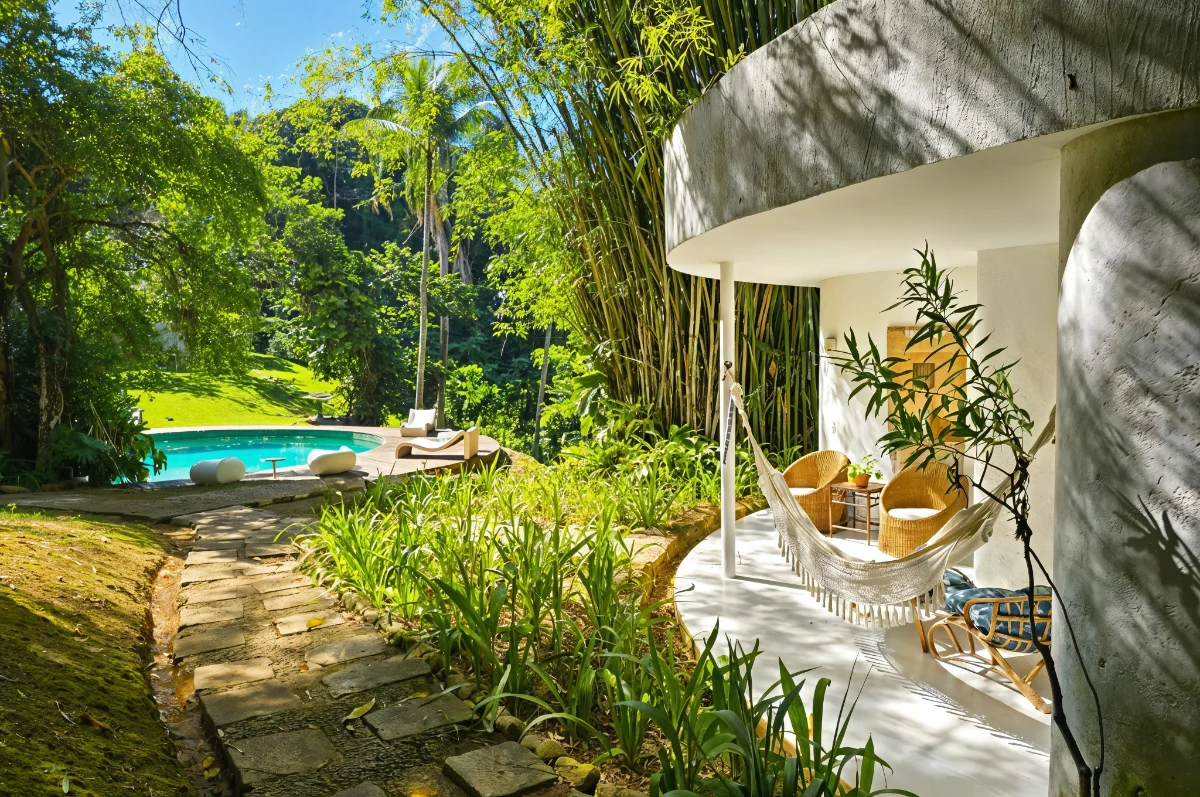
The island currently hosts six futuristic, whitewashed bungalows. These structures are defined by their organic, sweeping curves, which were intentionally designed to mirror the contours of the human body—a subtle nod to the profession of their owner. The interior living spaces, totaling approximately 15,000 square feet, are complemented by a sprawling communal pavilion that serves as the heart of the estate. This hub features a fireside lounge, a private cinema, a dedicated game room, and a beachfront kitchen designed for effortless, high-end entertaining.

The island’s topography is equally impressive, offering three private white-sand beaches, lush forest trails, a tennis court, and even a natural aquarium. Five freshwater springs sustain the island’s greenery, ensuring it remains an emerald jewel against the brilliant blue of the Atlantic.
Chronology: From "Big Pig" to A-List Oasis
The history of the island is inextricably linked to the trajectory of Dr. Ivo Pitanguy, a pioneer who transformed the landscape of aesthetic medicine.
- 1973: Dr. Pitanguy acquires the property, then known as Ilha dos Porcos Grande (Big Pig’s Island) due to its boar-like silhouette. He begins an exhaustive development project to turn the wild terrain into a refined refuge.
- 1960s–1980s: Pitanguy rises to international fame for pioneering the "Brazilian Butt Lift" and other revolutionary plastic surgery techniques. His reputation as a humanitarian—providing reconstructive surgery for burn victims at no cost—earns him the respect of the global elite.
- 1974: The aesthetic of the island is heavily influenced by the release of the James Bond film The Man with the Golden Gun. Pitanguy, a fan of the film’s iconic, glass-walled villain lair, incorporates elements of that mid-century, high-tech aesthetic into his bungalow designs.
- 1980s–2000s: The island becomes the ultimate "black book" destination. Roger Moore (who played 007) and Michael Caine (who co-starred in the Bond film) are among the luminaries who frequent the island, enjoying the seclusion that only a private Atlantic retreat could provide.
- 2016: Dr. Pitanguy passes away at the age of 93, just one day after carrying the Olympic torch through Rio.
- 2026: After a decade of maintenance and stewardship by the Pitanguy family, the decision is made to bring the property to the global market, citing the immense logistical and financial demands of managing a private island of this caliber.
Supporting Data: Infrastructure and Accessibility
While the island is designed for isolation, it is by no means inaccessible. The property’s infrastructure is engineered for the convenience of the world’s ultra-high-net-worth individuals (UHNWIs).
- Arrival and Departure: The island features a dedicated deep-water pier capable of accommodating a 50-meter superyacht. For those traveling by air, a private helipad and a 400-meter private airstrip allow for a seamless 40-minute transit from Rio de Janeiro.
- Current Capacity: Nine luxurious suites provide accommodation, with the potential for massive expansion. Current zoning permits the vertical expansion of existing structures into two-story villas, which would effectively double the living space to 30,000 square feet.
- Geopolitical Jurisdiction: As is the case with all private islands in Brazil, the land falls under the strict purview of federal maritime jurisdiction. Any significant new construction—such as the potential development of a brand-new mansion on the eastern side of the island—requires explicit approval from the Brazilian Navy.
Official Responses and Market Context
The listing agent, Beauchamp Estates, has positioned the island not just as a residence, but as a "legacy acquisition." In an era where privacy is the ultimate luxury, the island offers a level of seclusion that few other properties can match.

"The island is a rare intersection of history, medical legend, and extreme exclusivity," a spokesperson for the brokerage noted. "While the maintenance costs are significant, the value proposition lies in the fact that there is no other location in the region that provides such a perfect blend of accessibility to Rio and total, absolute solitude."
The market for private islands has seen a surge in interest as high-net-worth buyers look to secure "safe havens" in the wake of global volatility. Comparable listings, such as the recent $28 million sale of a Swarovski heir’s island near Venice, demonstrate that while the $100 million price tag is steep, it aligns with the scarcity of prime, privately owned islands with established infrastructure.
Implications: The Future of the Pitanguy Estate
The sale of the Pitanguy island marks the end of an era. For over 40 years, it was the private laboratory and playground of one of the 20th century’s most influential surgeons. Its future now hangs in a delicate balance.
A New Chapter for the Elite
There are two primary pathways for the property’s future. The first is as a private family compound for an ultra-wealthy buyer, continuing the legacy of the island as a secluded fortress of privacy. The second path is commercial—a transformation into a high-end, Necker Island-style luxury resort.

Given the existing infrastructure—the airstrip, the pier, and the proximity to the cultural vibrancy of Rio de Janeiro—the island is perfectly positioned for conversion into a boutique hospitality venture. Such a project would require significant capital expenditure, but it would arguably create the most exclusive resort in South America.
The Mystique Remains
Regardless of the buyer, the "Pitanguy" brand remains a powerful intangible asset. The island is not merely a collection of bungalows and beaches; it is a repository of stories. It is where, in the silence of the Atlantic, the world’s most famous faces found the freedom to be themselves.
As the property moves toward a sale, the global real estate market is watching closely. The transaction will serve as a bellwether for the ultra-luxury segment in Brazil. For now, the island waits, the whitewashed curves of its bungalows still catching the Brazilian sun, holding onto the secrets of the past while preparing to welcome its next chapter.
The listing is a reminder that while empires rise and fall, and legends like Dr. Ivo Pitanguy eventually depart the stage, the places they create—the sanctuaries they carve out of the earth—remain as enduring monuments to their influence. Whether the next owner chooses to expand the villa, renovate the airstrip, or simply enjoy the quiet of the freshwater springs, they will be stepping into a rarefied world that, until now, was reserved for the icons of history.

For the prospective buyer, this is not just a real estate investment; it is the acquisition of an legend.
 Evan Lee Salim
 Asep Darmawan
 Laily UPN
