

To contemporary horological enthusiasts, the name Hublot is synonymous with unbridled audacity, avant-garde materials, and the “Art of Fusion.” It conjures images of the monumental Big Bang line—the commercial titan that propelled the brand into mainstream global consciousness following its explosive debut in 2005 under the visionary leadership of industry marketing maestro Jean-Claude Biver.
Yet, for seasoned horophiles and collectors with a penchant for late-20th-century design disruption, "Hublot" represents something far more foundational. It harks back to a singular, revolutionary timepiece launched in 1980 by Italian watchmaking entrepreneur Carlo Crocco under his MDM (Manufacture Horlogère de Montres) brand. That original creation was every bit as radical as Biver’s later masterpieces, though it arrived via an entirely different philosophy: a sophisticated, minimalist, yet profoundly defiant blend of precious gold and humble rubber.
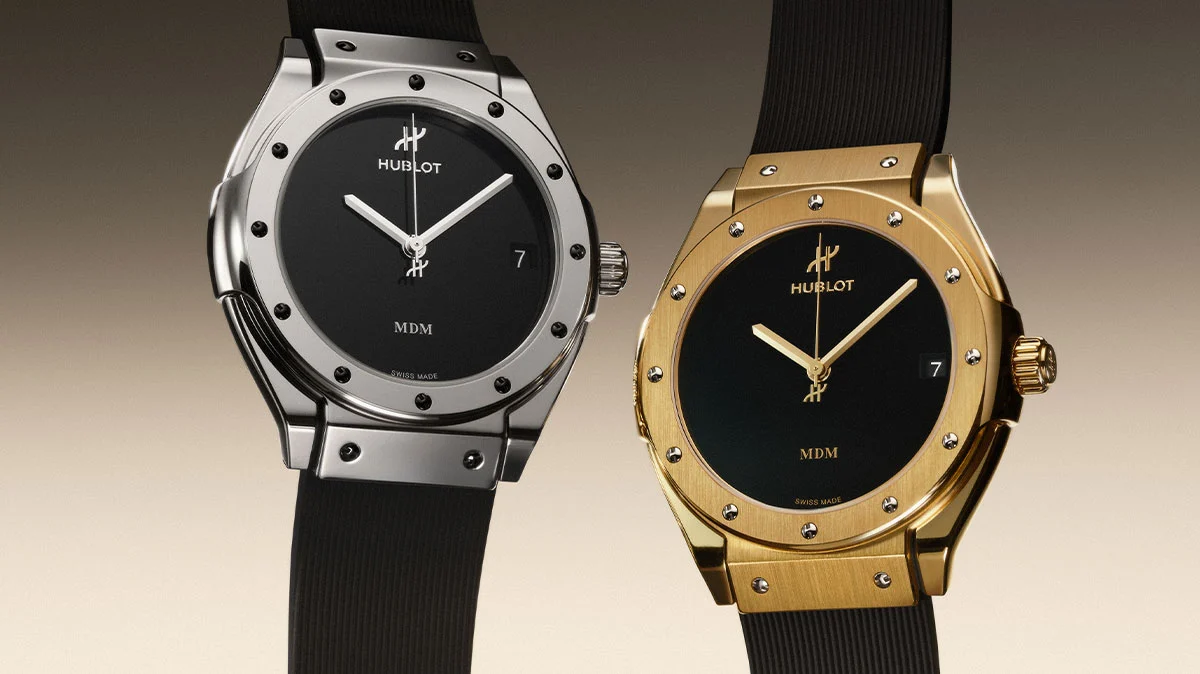
Now, more than four decades after it first stunned the conservative Swiss establishment, Hublot is reaching back into its archives to recapture the understated verve of that 1980 genesis. Enter the Classic Fusion Tributo, a meticulously crafted homage designed to honor Crocco’s original masterpiece while integrating modern watchmaking mechanics and material science. Limited initially to just 400 pieces globally, this release bridges two distinct eras of a brand that forever altered the landscape of luxury sports watch design.
Main Facts: The Anatomy of the Classic Fusion Tributo
The newly minted Classic Fusion Tributo is far more than a simple aesthetic re-edition; it is an exercise in faithful proportion and contemporary technical refinement. While it follows in the footsteps of the 2023 Classic Fusion Original, the Tributo steps closer to the soul and silhouette of Crocco’s 1980 blueprint while adapting to modern luxury expectations.
- Case Dimensions: The watch features a 38mm, seven-part case, measuring 2mm larger than the original 36mm 1980 model and boasting a slightly increased thickness. This extra depth accommodates a mechanical heart rather than the ultra-slim quartz movement of its predecessor.
- Movements and Materials: The Tributo is driven by Hublot’s in-house HUB 1711 automatic movement. It is divided into two distinct, highly limited initial series of 200 pieces each:
- White Gold Edition: Paired with a pristine, deep black onyx dial.
- Yellow Gold Edition: Paired with a classic matte black dial.
- Strap Technology: One of the most famous historical traits of the original Hublot was its natural rubber strap, famously infused with a vanilla scent to mask the unpleasant odor typical of early rubber compounds. The Tributo modernizes this feature by utilizing FKM (fluorocarbon rubber)—a high-performance synthetic elastomer that retains the exact visual texture of the original while offering vastly superior strength, resilience, and longevity.
- Pricing and Charity: Each model in the initial 400-piece run is priced at $30,900. Demonstrating a commitment to philanthropic legacy, Hublot has pledged CHF 100,000 from the proceeds of the Tributo sales to "Main dans le Main" (Hand in Hand), the humanitarian foundation established by Carlo Crocco in 1998. The historical MDM logo makes a triumphant return on the dial, now proudly representing Crocco’s charity.
Chronology: A Timeline of Disruption
To understand the weight of the Classic Fusion Tributo, one must trace the timeline of Hublot from a daring upstart to a global powerhouse.
1980: The Baselworld Earthquake
Carlo Crocco, scion of the Italian Binda group (known for making Breil watches), left the family business to forge his own path. He envisioned a watch that broke every established rule of Swiss watchmaking: a solid gold case married directly to a rubber strap. Unveiled at the Basel Watch Fair with no prior market research and a high price tag, the watch initially shocked the industry. The design was inspired by a ship’s porthole (hublot in French), complete with a jet-black dial and 12 functional bezel screws serving as hour markers instead of conventional batons or numerals.

The 1980s: The VIP Floodgates
For its first few years, commercial success was far from guaranteed. However, fate intervened when yachting enthusiast King Constantine of Greece spotted an advertisement in Time magazine. The ad featured a Hublot watch set against a backdrop of a raging sea with the faint silhouette of a sailboat in the corner. Impressed, the monarch purchased two—one for himself and one for his brother-in-law, King Juan Carlos of Spain.
This royal endorsement opened the floodgates for elite adoption. Soon, Hublots were found gracing the wrists of an extraordinarily eclectic VIP guest list: fashion mogul Giorgio Armani, Queen Noor of Jordan, Formula 1 driver Jacques Lafitte, rock legend Elton John, pop-art icon Andy Warhol, and actor Eddie Murphy. Exponential growth defined the brand’s first half-decade.
1998: The Birth of "Main dans le Main"
Having cemented his legacy in horology, Carlo Crocco shifted his focus toward philanthropy, establishing the "Main dans le Main" foundation to support children in need around the world—a legacy deeply intertwined with the brand’s identity today.
2005: The Biver Revolution and the Big Bang
Following years of steady growth that eventually plateaued due to market saturation and rampant counterfeiting, the brand entered a new epoch. Industry titan Jean-Claude Biver took the helm as CEO, introducing the Big Bang chronograph. Utilizing the concept of the "Art of Fusion" (combining ceramic, rubber, gold, and carbon fiber in unprecedented ways), the Big Bang became a global smash hit, transforming Hublot into a loud, proud, and unavoidable powerhouse in modern haute horlogerie.
2023–2026: The Archival Return
While the Big Bang remains the brand’s financial and cultural engine, Hublot began looking backward to honor its roots. Following the 2023 release of the Classic Fusion Original, the unveiling of the Classic Fusion Tributo marks the most faithful, refined homage to Crocco’s original vision to date.
Supporting Data & Design Engineering
Recreating an icon while making it viable for the 21st-century collector requires extraordinary engineering feats. According to Hublot’s creative director, Alessandro Camilli, placing the original and the new Tributo side-by-side from a distance of just a couple of feet makes them virtually indistinguishable. However, up close, the subtle modernizations reveal themselves.

Solving the Proportional Challenge
To house the robust HUB 1711 automatic movement, the watch required a larger 38mm case and increased thickness compared to the ultra-slim 1980 quartz original. To counteract any visual bulkiness, Hublot’s designers utilized clever geometric adjustments:
- The slope of the case where it meets the strap at the top and bottom was made significantly steeper, drawing the eye inward and minimizing the perceived footprint.
- A sophisticated combination of satin-brushed and polished finishing techniques breaks up the case geometry, preserving the slender elegance of its ancestor.
The Evolution of the Strap
The original watch required customers to undergo an elaborate in-store ritual: selecting the precise strap size from a luxury presentation box (coffret) containing five different options, all redolent of the famous vanilla scent used to neutralize natural rubber odors.
The Tributo streamlines this client experience entirely. It drops the natural rubber in favor of high-performance FKM fluorocarbon rubber—retaining the sensory comfort and look of the original while dramatically increasing durability. Furthermore, it abandons the fixed-size cutting ritual in favor of a modern, highly practical titanium deployant buckle, offering micro-adjustments and ease of wear for contemporary wrists.
Official Responses: Reflections from the Creator
The launch event in Milan brought together the past and present of the brand, culminating in a poignant moment for Carlo Crocco. Now 82 years old, the founder expressed profound appreciation for the homage paid to his life’s work. Reflecting on the tumultuous and exhilarating days of 1980, Crocco recalled the sheer risk involved in bringing the design to life.
"Nobody knew about us when we went to the Basel watch show in 1980," Crocco recalls. "The price was high, the watch was unlike anything else, and we had done no market research, so it could have been a flop. But we wanted to appeal to the higher end [of buyers], and we did. The Hublot was chosen by many important people and production went, roughly, 50 percent to men and 50 percent to women—and we never once gave a watch away."
Crocco noted that while growth was exponential during the first five years, success ultimately bred imitation.

"Then so many copies and fakes began to be made that soon everyone had a watch like ours," he laments. "But, in my time, I could still recognize a true Hublot from 10 metres away."
Creative director Alessandro Camilli noted that subsequent production numbers for the Tributo line beyond the initial 400-piece release will be strictly governed by market demand, ensuring exclusivity is maintained without completely shutting out ardent collectors.
Implications: What the Tributo Means for Hublot’s Future
The introduction of the Classic Fusion Tributo carries profound strategic and cultural implications for Hublot as it navigates the modern luxury landscape.
- Bridging the Generational Divide: For younger collectors who associate Hublot exclusively with the oversized, aggressive architecture of the Big Bang, the Tributo serves as an eye-opening history lesson. It proves that the brand’s DNA is deeply rooted in sophisticated elegance and minimalist design innovation long before it embraced the "loud and proud" ethos of the 2000s.
- Elevating Heritage Value: By limiting the initial run to 400 pieces (split evenly between white gold/onyx and yellow gold/matte black) and pricing them at $30,900, Hublot is signaling that its historical archive commands serious collector attention. It elevates the Classic Fusion line from an entry-level offering into a legitimate collector’s piece with archival weight.
- Philanthropic Continuity: Tying the release directly to Carlo Crocco’s Main dans le Main foundation reinforces a sense of corporate conscience and continuity. It proves that even as corporate entities evolve under massive luxury conglomerates (LVMH), honoring the personal legacy and humanitarian values of a founder remains a powerful narrative anchor.
Ultimately, the Classic Fusion Tributo is a masterclass in horological time-travel. It successfully resurrects the audacity of 1980 while equipping it with the mechanical pedigree and material resilience demanded by the modern connoisseur. For Carlo Crocco and the legions of watch lovers who fell in love with that original porthole-shaped golden marvel, the sea has never looked clearer.
 Evan Lee Salim
 Laily UPN
