

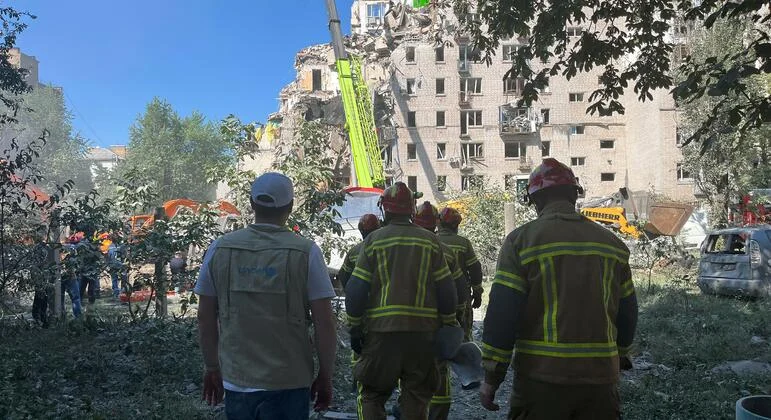
KYIV — The dawn that broke over the Ukrainian capital this week brought with it a landscape of smoldering steel and shattered concrete. In what city officials are describing as the "most massive" coordinated assault on Kyiv since the conflict’s inception, waves of Russian missiles and drones tore through densely populated residential districts, leaving a trail of devastation that has pushed the city’s emergency services to their absolute limit.
As rescue crews scramble through the debris of apartment blocks and hotels, the human cost is mounting. At least 18 people have been confirmed dead in the capital alone, with nearly 90 others sustaining injuries—many of them children. Beyond the physical toll, the psychological weight of a war that shows no sign of abating has reached a new, agonizing nadir for the millions who call Kyiv home.
The Anatomy of the Attack: A Night of Terror
For the three million residents of Kyiv, the night began not with sleep, but with the familiar, bone-chilling wail of air raid sirens. What followed was a harrowing 11-hour ordeal. Families huddled in cramped, cold basements, subway tunnels, and designated bomb shelters, listening to the thunderous, rhythmic explosions of incoming munitions.
"To the terrifying sounds of war," as Matthias Schmale, the UN’s top aid official in Ukraine, described it, families spent the night in a state of suspended animation, waiting for the strikes to cease. By morning, the city’s geography had been irrevocably altered. Apartment complexes, once hubs of domestic life, were reduced to skeletal shells. A local hotel, a bustling market, and vital civilian infrastructure were either leveled or severely damaged.
In the aftermath, the focus shifted to the desperate search for survivors. Heavy machinery and search-and-rescue teams are currently working around the clock to reach those pinned beneath the wreckage. Among the most harrowing reports is the ongoing effort to locate a 15-year-old girl and her family, who were trapped when their residential building collapsed.
A Direct Assault on Healthcare
The scale of the destruction extended to the very services tasked with saving lives. In a direct strike on a medical facility, an ambulance station was decimated, resulting in injuries to multiple health workers and emergency responders. Several ambulances—lifelines for a city under fire—were shredded by shrapnel, compounding the difficulty for first responders to reach the wounded.
"Medics are targets," a local official noted, highlighting the increasing frequency with which civilian infrastructure, including hospitals and emergency depots, has come under fire. The loss of these assets not only hampers the immediate response to the current crisis but diminishes the city’s long-term resilience against future strikes.
Chronology of a Deadly Pattern
This latest assault is not an isolated incident; it is part of a calculated, "deadly pattern" of escalation that has defined the conflict over the past year.
- December 2025 – May 2026: According to the UN Human Rights Monitoring Mission in Ukraine, civilian casualties have surged by 40% compared to the same period in the previous year. This rise is attributed to the systematic targeting of energy facilities and urban centers.
- The February 2022 Catalyst: The full-scale invasion, which began on February 24, 2022, fundamentally shifted the nature of modern urban warfare, turning residential neighborhoods into frontline zones.
- The Current Wave: The latest strikes represent a tactical shift, combining high-intensity missile barrages with drone swarms. While Russia continues its campaign, reports have also surfaced of Ukrainian forces utilizing long-range drone swarms against Russian oil facilities and transportation hubs, further signaling a widening of the conflict’s geographical reach.
Supporting Data: The Rising Toll
The statistical reality behind the headlines is stark. The UN Human Rights Monitoring Mission has documented a consistent increase in civilian deaths, largely driven by strikes on infrastructure that serves no military purpose.
Beyond the capital, the violence has claimed victims across the country. In the Dnipro region, the loss of a seven-year-old girl served as a grim reminder that no region in Ukraine is shielded from the reach of the conflict.
Aid organizations, including the UN and its various agencies, are currently struggling to provide emergency support to nearly one million people who have been directly affected by the latest wave of strikes. This relief, while vital, is merely a bandage on a hemorrhaging wound. It includes cash assistance, mental health support, and the provision of temporary shelter, yet it cannot replace the homes and lives lost in a single night of bombardment.
Official Responses and International Condemnation
The international community has responded with familiar, yet urgent, appeals. UN Secretary-General António Guterres issued a blistering condemnation of the attacks, stating, "Any attacks against civilians and civilian infrastructure, wherever they occur, are a clear violation of international humanitarian law and must stop immediately." Guterres reiterated his call for an urgent de-escalation, aiming for a full, immediate, and unconditional ceasefire.
Matthias Schmale was equally pointed in his assessment. "Civilians in Kyiv and across the country should not be bracing for yet another attack," he said. "They are protected under international humanitarian law."
The UNICEF perspective, provided by Chief of Communications and Advocacy Toby Fricker, emphasizes the generational damage being done. Having visited the sites of the recent strikes, Fricker noted the destruction of a nearby kindergarten—a symbol of the innocence caught in the crossfire. "Spending nights in shelters during the war in Ukraine is having a serious impact on children’s well-being," Fricker explained. "It has become a normalized, but entirely abnormal, part of life."
The Invisible Scars: A Psychological Crisis
While the physical ruins of Kyiv will eventually be cleared, the psychological landscape of the nation is suffering a more permanent form of damage. Mental health professionals working on the ground warn of a looming crisis of trauma that will persist for generations.
"The loss and fear caused by this and every other attack intensify the psychological trauma countless people have to bear," Schmale remarked. "The longer the war goes on, the deeper these invisible scars become."
For the children of Kyiv, the subway station has replaced the playground. For the parents, the sound of a closing door or a low-flying plane now triggers a physiological stress response. The trauma of the "night of horror" experienced this week is not just a memory; it is a cumulative weight that is breaking the spirit of a resilient, yet exhausted, population.
Implications: A Conflict Without Resolution
The implications of the current trajectory are grim. The increased frequency of systematic strikes suggests that the conflict is entering a phase of total attrition. As Russia targets the energy and housing sectors, the objective appears to be the erosion of the civilian population’s ability to survive the coming seasons.
Conversely, the reported increase in drone attacks on Russian soil—disrupting Moscow airports and oil infrastructure—suggests that Ukraine is increasingly capable of retaliatory strikes. This tit-for-tat escalation, however, only ensures that the "deadly pattern" identified by the UN will continue to widen.
As the smoke clears over Kyiv, the residents remain in a state of high alert. The international call for a ceasefire, while morally imperative, currently lacks the political momentum required to force a halt to the hostilities. Until such a shift occurs, the people of Kyiv remain in a precarious limbo—waiting for the next siren, searching for the next safe space, and burying their dead in a war that continues to redefine the limits of human suffering.
For the international community, the question remains: how much more destruction can the civilian population endure before the diplomatic efforts to force an end to this violence finally bear fruit? As the rescue operations conclude, the city begins the process of mourning, fully aware that the calm is only temporary.
 Azzam Bilal Chamdy
 Pevita Pearce
 Iffa Jayyana
