

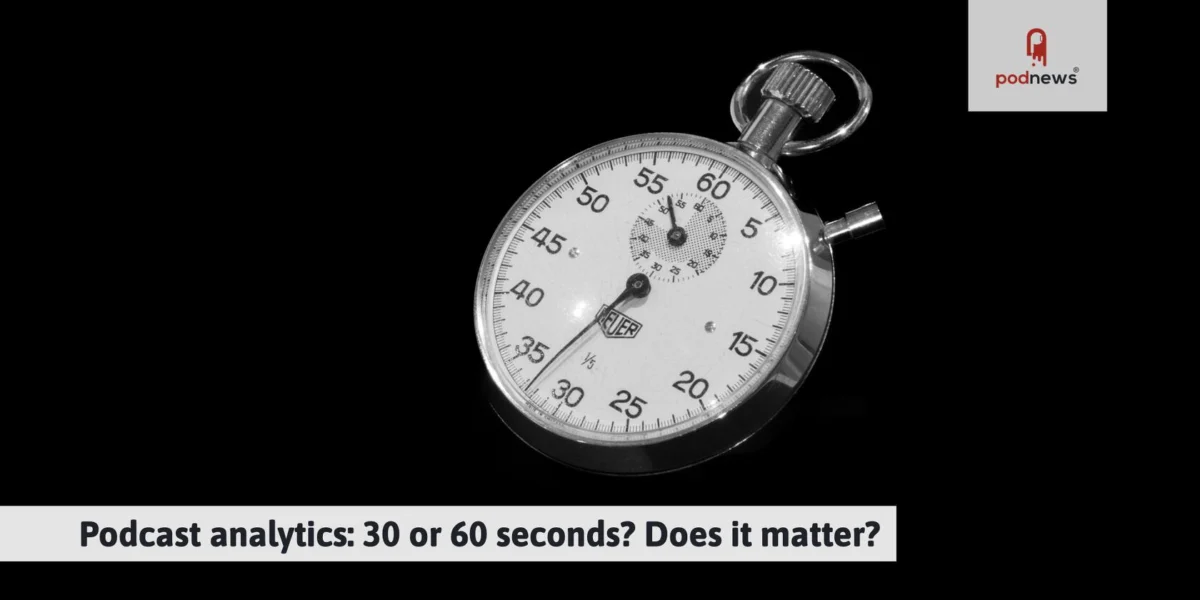
The podcasting industry stands at a technical crossroads. For years, the Interactive Advertising Bureau (IAB) has served as the gold standard for measurement, defining a "download" as the acquisition of at least 60 seconds of audio content. However, as the ecosystem shifts toward streaming-first consumption, a new movement is gaining momentum. The Alliance for Measurement in Podcasting (AMP) is pushing for a standardized definition of a "play" set at just 30 seconds—a threshold already adopted by streaming giants like Spotify.
This discrepancy between the 60-second "download" and the 30-second "play" creates a fragmented landscape for creators, advertisers, and networks. As we navigate this shift, the industry is forced to ask a fundamental question: Does the duration threshold truly matter for the bottom line, or is it merely an academic exercise in digital accounting?
The Core Conflict: 30 Seconds vs. 60 Seconds
The IAB Tech Lab’s Podcast Measurement Guidelines are the bedrock of the current ad-supported podcast economy. By requiring 60 seconds of content to be downloaded before a unit is counted, the industry has historically prioritized high-intent consumption. The logic is simple: a user who listens for a minute is more likely to be an active, engaged consumer of the content than one who clicks play and immediately exits.
However, the rapid growth of platforms like Spotify and, potentially, YouTube, has introduced a different metric: the 30-second play. This shorter duration aligns more closely with the metrics used in video and music streaming, where "skip" rates are high and attention spans are volatile.

The tension arises because a "download" and a "play" are not the same thing. A download is a technical transaction between a server and a device, whereas a play is a human interaction. Harmonizing these metrics could theoretically simplify the workflow for cross-platform advertisers who want to compare podcast performance against other digital media. But is the transition feasible, and what would it actually do to the numbers?
Empirical Analysis: The RSS.com Case Study
To understand the practical implications of moving from a 60-second to a 30-second threshold, industry observers turned to concrete data. In collaboration with the podcast hosting platform RSS.com, we analyzed a week’s worth of raw download data to compare the two standards.

The findings were revealing. When recalculating total downloads based on a 30-second threshold instead of the industry-standard 60 seconds, the variance was remarkably slim. Across the seven-day sample, the increase in total counted downloads ranged from just +0.90% to +1.06%.
In real-world terms, this means that for every 100,000 downloads currently reported, shifting the metric to 30 seconds would only yield an additional 1,000 downloads. The statistical impact is negligible—a rounding error in the grand scheme of massive podcast campaigns. This suggests that the vast majority of listeners who reach the 30-second mark continue on to hit the 60-second mark, rendering the argument over the threshold a battle of philosophy rather than a battle of volume.

Chronology of the Metric Shift
The evolution of podcast measurement has been a slow crawl toward maturity.
- The Early Era: Before formal standards, "downloads" were often inflated by bots, pre-fetches, and automated scrapers.
- The IAB Standards: The introduction of IAB guidelines brought sanity to the market, filtering out non-human traffic and establishing the 60-second download as the "valid" unit.
- The Streaming Explosion: As listeners migrated from RSS-based podcast apps to platforms like Spotify, the definition of a "play" became the dominant currency.
- The Current Debate: AMP’s advocacy for a 30-second standard signals the final stage of transitioning from a "download-based" industry to an "engagement-based" industry.
The Implications for Advertisers and Networks
If the difference between 30 and 60 seconds is only about 1%, why does the debate persist? The implications go beyond raw numbers; they touch upon monetization, reporting, and industry power dynamics.

1. Simplification of Cross-Media Reporting
Advertisers who buy cross-platform campaigns (e.g., ads on both YouTube and podcast feeds) prefer uniformity. If every medium reports success at the 30-second mark, the reporting process becomes automated and frictionless. For media buyers, that 1% difference in data is a small price to pay for the efficiency of a unified dashboard.
2. The Power of "Play" vs. "Download"
The shift away from "downloads" is also a shift away from the open RSS ecosystem. Downloads represent an decentralized, open-internet philosophy, whereas "plays" represent a platform-centric, walled-garden approach. By pushing for a 30-second play, platforms are asserting that their internal metrics—not the raw file transfers monitored by hosting companies—are the true measure of a podcast’s value.

3. Monetization Concerns
The most vocal critics of the 30-second threshold argue that it lowers the barrier for what constitutes a "success." If a podcast network can claim a "play" after only 30 seconds, does this allow them to inflate their reach? The data from RSS.com suggests this concern is overblown; the audience isn’t significantly larger at 30 seconds than it is at 60. However, the optics of the metric are important for smaller, independent creators who may feel that the industry is bowing to the demands of tech giants.
Voices from the Industry: The "PodBiz" Perspective
The debate is currently echoing through industry discussions, including recent insights from platforms like PodBiz. CEOs in the space, such as N’Jeri Eaton of Type C Studios, have pointed out that the financial realities of podcasting are often more pressing than the minutiae of measurement. Eaton recently highlighted that some networks are providing only 25% of the funding required for high-quality narrative productions, betting that creators are "desperate enough to say yes."

This highlights a broader industry problem: when we focus entirely on "how we count," we sometimes lose sight of "what we are counting." Whether a show has 10,000 or 10,100 downloads due to a threshold change matters less than the sustainability of the business model supporting that content.
Future Outlook: What Happens Next?
As the industry moves toward 2026, it is highly likely that a 30-second standard will become the de facto baseline, especially as YouTube continues to integrate podcasts into its primary video ecosystem. The IAB will likely face pressure to either update its guidelines to mirror this shift or risk becoming an obsolete authority in a streaming-first world.

The "1% difference" finding from our RSS.com data should provide some comfort to those worried about a massive devaluation of their catalog. A change in definition does not erase the actual listening behavior of the audience. The listeners who value the content will stay past the 60-second mark regardless of what the metric says.
Ultimately, the goal of measurement should be to provide a reliable proxy for human attention. While the industry debates the technicalities of the 30-second vs. 60-second threshold, the most successful creators will continue to focus on the one metric that no standard can artificially inflate: long-term listener retention.

Summary of Key Data Points
- Standard Definition: Current IAB guidelines require 60 seconds of downloaded content.
- Proposed Shift: AMP is advocating for a 30-second "play" threshold.
- Actual Impact: Analysis of 7 days of data shows that moving to a 30-second threshold increases reported numbers by only 0.90% to 1.06%.
- Conclusion: The shift is largely technical and aesthetic, with minimal impact on total reported listener volume.
As the industry continues to evolve, the focus must remain on transparency and the quality of the audience, rather than just the mechanics of the click. Whether it’s a 30-second play or a 60-second download, the value of the connection between the host and the listener remains the cornerstone of the medium.
 Nila Kartika Wati
 Nana Wu
 Basiran
