

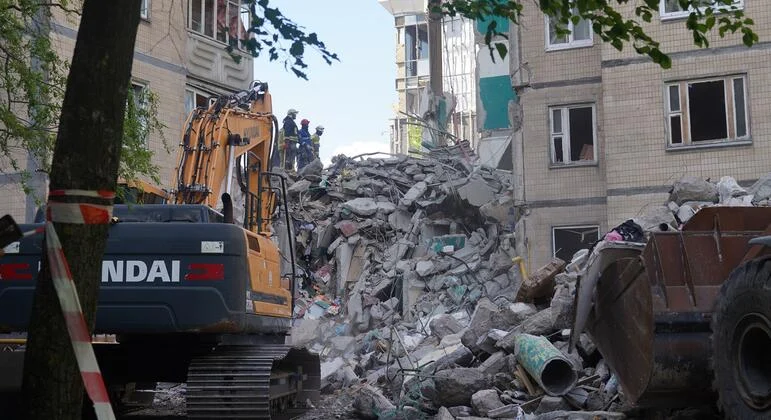
The war in Ukraine has entered a grim new chapter, characterized not by the static, trench-bound attrition that defined the conflict’s early days, but by a pervasive, high-tech lethality that has erased the traditional boundaries between the frontline and the home front. As drones become the primary arbiters of movement and violence, the fundamental calculus of combat—and the risks faced by millions of civilians—has shifted in ways that experts warn will have profound, long-term consequences for global humanitarian efforts.
Paul Heslop, Chief Mine Action Adviser at the UN Development Programme (UNDP) in Ukraine, describes this shift with stark clarity. "The battlespace has become a lot deeper, a lot wider, and a lot more lethal," Heslop told UN News. In a theater where the sky is constantly monitored by ubiquitous eyes, movement is no longer a tactical choice; it is an invitation to be targeted.
A Fundamental Shift in Combat Lethality
The most chilling indicator of this transformation lies in the casualty ratios. Historically, military doctrine has operated on a rough heuristic: for every four casualties, one would be killed and three would be wounded. This ratio was supported by the availability of rapid medical evacuation and the nature of traditional artillery and small-arms fire.
In Ukraine today, that ratio has been inverted. According to data and field observations shared by Heslop, the lethality of modern drone warfare is so absolute that three out of four personnel engaged in combat are being killed.
This, he explains, is the result of a "deep" battlespace. Drones no longer merely monitor; they coordinate artillery strikes with unprecedented precision and, increasingly, function as autonomous or pilot-operated explosive delivery systems. Because drones can hover, track, and strike with high-accuracy payloads, the window for survival after an injury has shrunk dramatically. When a drone delivers a mortar round or a grenade directly onto a target, the probability of reaching a trauma unit is significantly lower than in an environment where fire is indirect or inaccurate.
Chronology of a Transforming Conflict
To understand the current crisis, one must look at the evolution of weaponization since February 2022:
- Phase I (The Invasion): The initial months were dominated by large-scale mechanized maneuvers and relatively fixed frontlines. Explosive remnants of war (ERW) were largely comprised of unexploded artillery shells and cluster munitions—the "classic" hazards of conventional ground warfare.
- Phase II (The Drone Proliferation): As the conflict stabilized into a war of attrition, both sides began integrating commercial and modified military-grade drones. Initially used for reconnaissance, drones evolved into "loitering munitions," capable of identifying targets and adjusting fire in real-time.
- Phase III (The Precision Era): Today, drones are the primary delivery vehicles for a wide array of munitions. The sophistication of these systems has led to a "democratization" of precision strikes. Mortar rounds, grenades, and anti-tank weapons are now delivered with a level of accuracy that makes traditional cover and concealment largely obsolete.
- Phase IV (The Humanitarian Crisis): As the drone war expands, the debris—drones that fail to detonate, drones that malfunction, and the varied, highly sensitive submunitions they carry—has turned residential areas into minefields. This is the current reality: a landscape where the weapon is not just in the trench, but in the backyard.
The New Face of Contamination
The threat to civilians is no longer confined to "legacy" explosives left by retreating armies. Drones are delivering a diverse, dangerous array of modern weaponry that behaves in unpredictable ways.
"The person who goes into the area, if they’re walking a dog or going to school, steps on a mine and it blows their leg off," Heslop says. The danger is compounded by the nature of the payloads. Some drones scatter submunitions that trigger on impact; others leave behind sophisticated, delayed-fuse devices that are designed to remain hidden until a civilian inadvertently triggers them.
This has created a "dynamic contamination" environment. Unlike landmines, which are typically buried in static patterns, drone-delivered hazards can be anywhere. A neighborhood that was safe yesterday may be contaminated today by a drone that malfunctioned or was shot down. This forces emergency responders and humanitarian demining teams to adopt a strategy of constant adaptation, as they are now confronting weapon systems that were never designed for the civilian-populated environments they are ending up in.
Life Under the Constant Buzz
For millions of Ukrainians, the drone has become an unwelcome companion. In cities far from the physical frontlines, the sound of a buzzing motor or the wail of an air raid siren acts as a psychological and physical disruptor of daily life.
The UNDP highlights a "matter-of-fact" resilience among the population that is both impressive and tragic. Cafes remain open, schools operate with air-raid protocols, and parents continue their routines, even as the risk of a drone strike remains a statistical reality.
Heslop recounts an incident involving a drone strike on an apartment block in the dead of night. The device failed to explode, embedding itself in the structure. Within two hours, local emergency responders had evacuated the building, defused the explosive, and returned the residents to their homes. This ability to handle high-risk, high-tech threats as a mundane part of existence is what Heslop describes as "incredible" human resilience. Yet, he warns, this resilience should not be mistaken for normalcy. The constant state of alert is a cumulative trauma that will affect the civilian population for generations.
Institutional and Official Responses
International organizations, including the UNDP and various mine-action NGOs, are currently engaged in a massive, collaborative effort with Ukrainian authorities. The goal is two-fold: immediate clearance and long-term capacity building.
The challenges are immense. The sheer variety of explosive hazards means that bomb disposal teams must be trained on a rapidly changing catalog of weaponry. The UNDP is currently focusing on:
- Data-Driven Clearance: Using GIS mapping and AI to track drone activity and suspected impact zones to prioritize clearance efforts.
- Advanced Detection: Integrating robotic systems and sensors to identify unexploded drone payloads that are often smaller and harder to detect than traditional mines.
- Capacity Building: Training Ukrainian responders to manage these new threats locally, ensuring that the expertise remains in the country as the war progresses.
The Future: AI and Global Humanitarianism
Perhaps the most significant development in this grim landscape is the unintended benefit of the research being conducted in Ukraine. The pressure to survive and clear these hazards is accelerating the development of humanitarian demining technologies that could be exported globally.
"We need to be aware this is a battle that we can win," Heslop asserts. The integration of artificial intelligence for debris identification, the use of autonomous robotics to clear high-risk areas, and the deployment of advanced sensor arrays to scan for explosive components are all being field-tested in Ukraine.
Once the conflict ends, the lessons learned here will likely form the blueprint for the next generation of global mine action. The ability to process vast amounts of data to clear hazards faster, more efficiently, and with less risk to personnel, represents a silver lining in an otherwise devastating narrative.
Implications for Global Security
The war in Ukraine serves as a grim laboratory for the future of warfare. The implications are clear: the barrier to entry for precise, lethal, and pervasive aerial warfare has collapsed. As drone technology becomes cheaper and more autonomous, the humanitarian community must prepare for a future where the "frontline" is a fluid, global concept.
The international community’s response to the Ukrainian crisis—focusing on civilian protection, rapid debris removal, and the psychological support of displaced and besieged populations—must now become the standard model for post-conflict recovery. As drones continue to transform the battlefield, the mandate for humanitarian organizations must likewise transform to address a world where, increasingly, the sky is not a source of safety, but a primary source of danger.
The task ahead is not merely to clear the ground of explosives, but to rebuild the concept of safety in an age where the battlefield has no walls.
 Azzam Bilal Chamdy
 Pevita Pearce
 Iffa Jayyana
