

The humanitarian landscape across the Occupied Palestinian Territory (OPT) continues to deteriorate with alarming velocity, as United Nations agencies report a dual crisis of systematic aid strangulation in Gaza and a spiraling cycle of violence against children in the West Bank. From the shuttered crossings of the Gaza Strip to the blocked village gates of the Ramallah governorate, the civilian population faces an existential threat defined by restricted movement, acute medical deprivation, and the erosion of basic human rights.
The Bottleneck: Humanitarian Access and the Failure of Aid Logistics
At the heart of the crisis in Gaza lies a logistical paralysis. UN Spokesperson Stéphane Dujarric confirmed that while aid teams have managed to maintain a presence at the Kerem Shalom crossing, the volume of essential supplies—food, fuel, and medicine—is failing to meet even the most basic requirements of a population facing near-famine conditions.
The crux of the problem is twofold: the closure of critical transit arteries and the stringent, often arbitrary, restrictions placed on specific cargo types. Despite the existence of the UN 2720 Mechanism—an initiative authorized by Security Council Resolution 2720 (2023) specifically designed to accelerate and monitor the flow of aid—the data paints a grim picture of regression.
A Decline in Deliveries
Recent statistics from the UN 2720 Mechanism reveal a tangible contraction in aid reaching the enclave. In June, the total volume of supplies delivered fell to fewer than 42,000 pallets, a significant drop from the 46,600 pallets recorded in May. This downward trend is not for a lack of available supplies in the pipeline; rather, it is a consequence of administrative and physical barriers.
Last week, efficiency plummeted as only 42 percent of humanitarian supplies originating from Egypt and 65 percent of those coming via the Ashdod port could be offloaded at Kerem Shalom. These consignments had already been approved in principle by relevant authorities, yet they remained trapped in a bureaucratic limbo, unable to bridge the final few kilometers to the civilians who desperately need them. The continued closure of all other major crossings for commercial and humanitarian cargo exacerbates this isolation, effectively turning the aid pipeline into a narrow, unstable straw.
The Stolen Childhood: Gaza’s Generation Under Siege
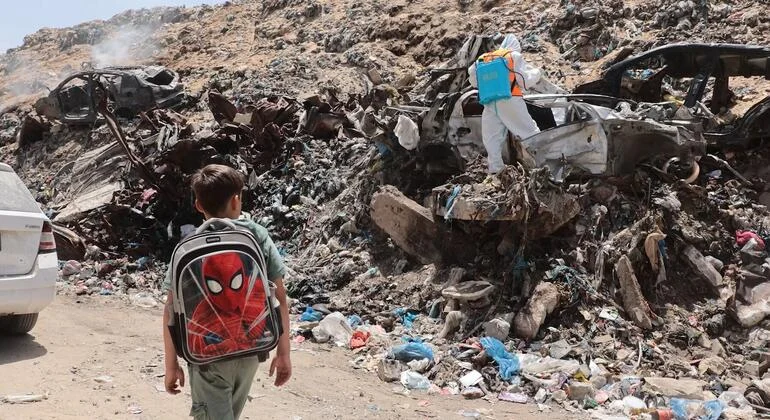
Beyond the logistics of aid, the human cost is most visible in the children of Gaza. For over 1,000 days of conflict, an entire generation has been stripped of the fundamental pillars of human development: nutrition, healthcare, and safety.
UNICEF Spokesperson Louise Wateridge recently offered a harrowing assessment of the situation, noting that childhood in Gaza has been redefined by the geography of rubble and the acoustics of bombardment. "Children in Gaza have taken their first steps through rubble, spoken their first words against the deafening sounds of bombs and strikes, and they’ve known nothing but war, displacement, and loss," Wateridge remarked.
The Statistical Toll
The scale of the carnage is difficult to comprehend. Current reports indicate that more than 60,000 children have been killed or injured since the conflict’s latest intensification. Despite intermittent ceasefire agreements and international appeals, the rate of attrition remains constant; on average, one child has been killed every single day for over eight months.
For many, the tragedy is not just in the loss of life, but in the deprivation of the prerequisites for survival. Malnutrition, dehydration, and the absence of basic vaccinations are creating a secondary crisis that threatens to claim as many lives as the direct military operations. As Wateridge noted, "Childhood should not begin in survival mode. No child’s earliest years should be defined by the sounds of bombs and strikes, the loss of home, or the absence of enough food, water, and care."
West Bank Escalation: The “Senseless” Deaths of Infants and Minors
While international attention is often focused on the intensity of the war in Gaza, the situation in the West Bank is rapidly spiraling into a new phase of volatility. UN agencies, including the Office for the Coordination of Humanitarian Affairs (OCHA) and the Office of the High Commissioner for Human Rights (OHCHR), have raised alarm bells regarding the conduct of Israeli forces in Palestinian villages and refugee camps.
Chronology of Recent Violations
The past few days have seen a tragic repetition of incidents that highlight the vulnerability of children in the West Bank:
- Sunday, Qalandiya Camp: Israeli forces engaged in operations that resulted in the shooting death of a 16-year-old Palestinian boy. Two other children were also wounded, having been shot in their lower limbs.
- Sunday, Ramallah Governorate: In a case described by the UN as “senseless,” a four-month-old infant died after being denied access to emergency medical care. Israeli forces had blocked the main entrance to the village, refusing to open the gate even as an ambulance waited on the other side.
- The Precedent: This follows the killing of a seven-month-old boy last month, who was shot by an Israeli soldier at a checkpoint.
These incidents are not viewed by the UN as isolated accidents, but as part of a systemic disregard for human rights. Ajith Sunghay, the Head of UN Human Rights in the OPT, characterized these deaths as "emblematic of an occupying power continuing to show utter disregard for the humanity and rights of Palestinians living under occupation."
Implications: A Call for Accountability and Legal Protection
The cumulative impact of these events has placed the international community in a position of extreme scrutiny. The UN’s stance is firm: Palestinians in the West Bank must be protected under international law, and those responsible for violations must be held accountable.
The Legal Framework
The UN emphasizes that the obligations of an occupying power are not optional. Under the Fourth Geneva Convention, the occupying power has a duty to ensure the medical welfare and safety of the civilian population. When military checkpoints, gate closures, and use of lethal force prevent a critically ill infant from reaching a hospital, or when teenagers are shot during operations in residential camps, the legal framework governing occupation is being fundamentally breached.
Future Outlook
The implications of these trends are dire. If the current rate of aid obstruction in Gaza continues, the threat of famine and disease will likely eclipse the death toll from direct military action. In the West Bank, the cycle of violence—where youth are killed in the streets and infants are denied medical access—serves to deepen the resentment and instability that have characterized the region for decades.
The UN’s call for accountability is a plea for the restoration of basic order. Without a shift in policy that allows for the unimpeded flow of aid and the protection of children from both active combat and systemic harassment, the prospects for a peaceful resolution appear increasingly remote. For the families in Gaza and the West Bank, the international community’s words are now secondary to the immediate, practical necessity of survival. As the UN continues its documentation of these events, the world is left with a stark reality: a region where the youngest and most vulnerable are paying the highest price for a political and military stalemate that shows no sign of resolution.
 Lina Hope
 Asro
Asro
 Layla Zulfa
