

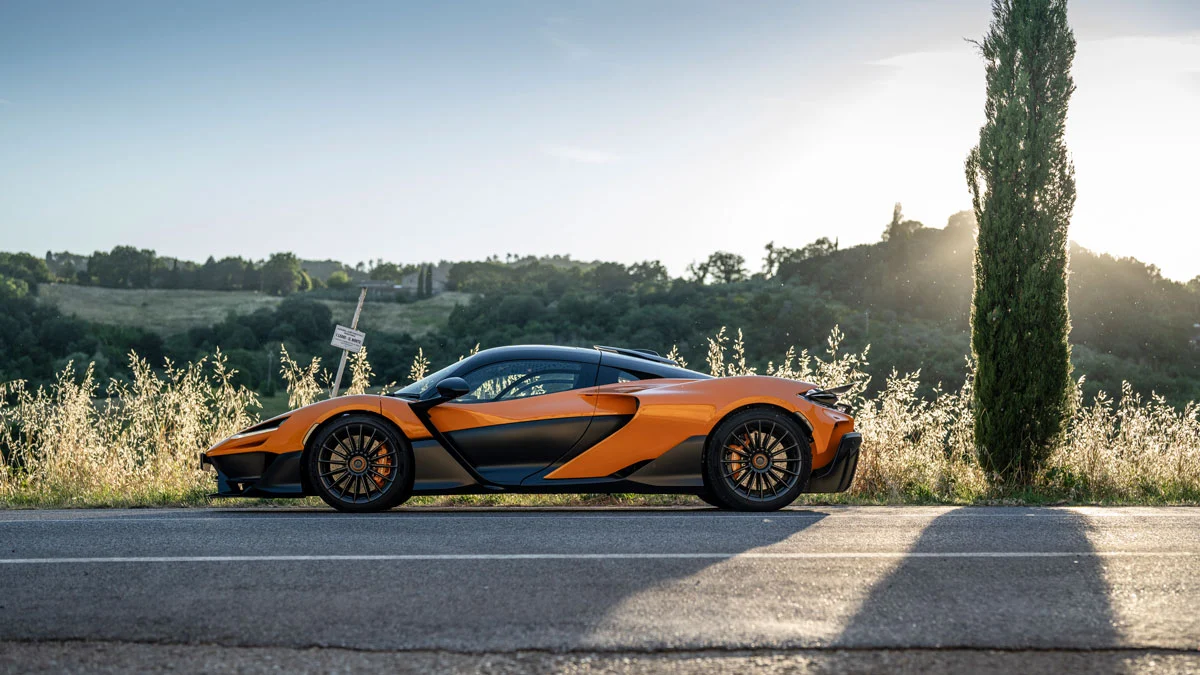
In a move that could only be described as a masterstroke of automotive provocation, McLaren chose to debut its long-awaited successor to the legendary P1 and F1 on the hallowed asphalt of the Mugello Circuit. The location is more than just a world-class track; it is Ferrari’s own backyard, situated a mere 90 minutes from the Maranello headquarters. As opera music boomed across the Tuscan hills at 9:00 a.m., setting a theatrical tone that even the historic British home of Silverstone would struggle to replicate, it became clear: the McLaren W1 is not merely a new car—it is a direct challenge to the throne of the hypercar world.
Under the leadership of new CEO Nick Collins—the man previously instrumental in the development of the Land Rover Range Rover—McLaren is pivoting. The W1 is the first major statement of this new era, discarding the comfort-oriented luxury of SUVs for the uncompromising, raw science of track-bred performance.

The Chronology of an Icon
The lineage of the W1 is nothing short of automotive royalty. To understand the gravity of this launch, one must look at the cars that preceded it. The McLaren F1, born in the 1990s, remains a $20 million-plus collector’s unicorn, defined by its central driving position and analog purity. Then came the 2013 P1, which introduced the world to the potential of hybrid hypercar performance.
The W1 sits at the intersection of these two legends, having been engineered by a team that has collected more Formula 1 World Championship titles than perhaps any other road-car manufacturer in history. The development process, spanning years of secretive testing and iterative refinement, has culminated in a machine that feels less like a production vehicle and more like a road-legal Formula 1 car.

Technical Specifications and Performance Data
The heart of the W1 is an all-new 4.0-liter, twin-turbocharged V-8 engine. Developed over four years, this powerhouse was designed from the ground up to operate as the centerpiece of an advanced electrified powertrain. On its own, the V-8 is a marvel, revving to a staggering 9,200 rpm—a record for a McLaren production engine—and producing 664 ft-lbs of torque.
However, the real magic lies in the E-module. Mounted directly to the transmission, the radial flux electric motor can spin to 24,000 rpm, contributing an additional 342 horsepower. The combined output is a mind-bending 1,258 horsepower. Despite the complexity of the hybrid system, the W1 is remarkably light for its class, with a dry weight of just 3,084 pounds. This gives the vehicle a power-to-weight ratio of approximately 899 horsepower per ton, easily outpacing its primary rival, the Ferrari F80.

Acceleration and Aero-Efficiency
The raw performance figures are, in a word, intergalactic. The W1 launches from a standstill to 124 mph in just 5.8 seconds, and it reaches 186 mph in 12.7 seconds—a full 0.3 seconds faster than the Ferrari F80.
But the W1 is not just about straight-line speed; it is about the mastery of air. It is one of the few road-legal cars in the world to utilize full ground-effect aerodynamics. In "Race" mode, the car drops its ride height by 1.45 inches at the front and 0.66 inches at the rear, creating a vacuum that sucks the car to the pavement. The "Active Long Tail" wing is a visual spectacle, extending rearwards by nearly 12 inches through a 180-degree arc. This system acts as a drag reduction system (DRS) and an airbrake, generating an astonishing 2,205 pounds of downforce at 173 mph.

The Pilot-Centric Experience
Stepping into the W1 is a lesson in ergonomic brilliance disguised as minimalism. Unlike traditional hypercars, where the driver sits in a seat, in the W1, you "wear" the car. The cushions are fixed directly to the carbon-fiber monocoque, a design choice that saves weight and increases structural rigidity.
The cockpit is a triumph of function. The A-pillars are the narrowest ever fitted to a McLaren, providing near-panoramic visibility for the pilot. In a nod to high-performance aviation and race-car design, the "start" button, gear selectors, and window switches are located on an overhead roof panel, keeping the center console clean. For the audiophile, a Bowers & Wilkins sound system is integrated seamlessly into the structure, proving that the W1 doesn’t sacrifice creature comforts entirely. Even with the track-focused nature of the car, there is enough storage space behind the seats for a couple of tailored weekend bags, ensuring that the owner can actually travel in their $2.1 million investment.

Engineering Philosophy: Why No Front-Axle Assist?
In an age where every hypercar manufacturer is turning to all-wheel drive and complex torque-vectoring systems to manage power, McLaren has made a bold, contrarian decision: the W1 is strictly rear-wheel drive.
Nick Collins and his engineering team argued that adding a front-axle motor would have compromised the purity of the steering and the tactile feedback that defines the McLaren experience. By relying on a hydraulic steering setup—widely considered the gold standard for road-car feedback—the W1 offers a level of linearity that electric power steering simply cannot replicate.

The variable drift control, which offers 15 distinct levels of electronic stability program (ESP) intervention, allows drivers of varying skill levels to explore the limits of the car. Whether you are a professional racer seeking to slide the rear end through a corner or an amateur enthusiast looking for a controlled, high-speed touring experience, the W1 provides a level of accessibility that belies its 1,258-horsepower rating.
Official Responses and Market Positioning
McLaren Automotive has positioned the W1 as a "monumental achievement" for the brand. During the launch event in Tuscany, the engineering team emphasized that the W1’s bandwidth—its ability to be both a savage track weapon and a manageable road-going grand tourer—was their primary goal.

While the $2.1 million upfront cost is substantial, it is merely the entry point. The McLaren Special Operations (MSO) division is already working with the 399 lucky owners to personalize their vehicles, with many likely to push the final price well into the multi-million dollar range. Despite the temptation to park these vehicles in climate-controlled hangars as "investments," the consensus from those who have driven the car is clear: this is a machine that demands to be exercised.
The Implications for the Future of Hypercars
The launch of the W1 signals a shift in the hypercar arms race. For years, the industry has been obsessed with ever-increasing weight and complexity. McLaren, by focusing on a lower curb weight, active aerodynamics, and a purely rear-driven powertrain, has challenged the "more is better" philosophy.

As we look toward the future of the automotive industry—a landscape increasingly dominated by heavy, battery-electric vehicles—the W1 serves as a reminder of the pinnacle of internal combustion technology. It is a bridge between the analog soul of the 1990s and the digital precision of the 2030s.
Whether you are a wily investor or a die-hard automotive enthusiast, the W1 is impossible to ignore. It is not merely a tool for speed; it is a declaration of intent from a company that has rediscovered its competitive edge. In a world of increasingly sanitized driving experiences, the W1 stands out as a physical, visceral, and, above all, a "human" machine. It is a rare, fleeting moment where engineering excellence meets the raw thrill of the open road, proving that even in the twilight of the combustion engine, the best is truly yet to come.
 Basiran
 Siti Muinah
 Nana
Nana
