

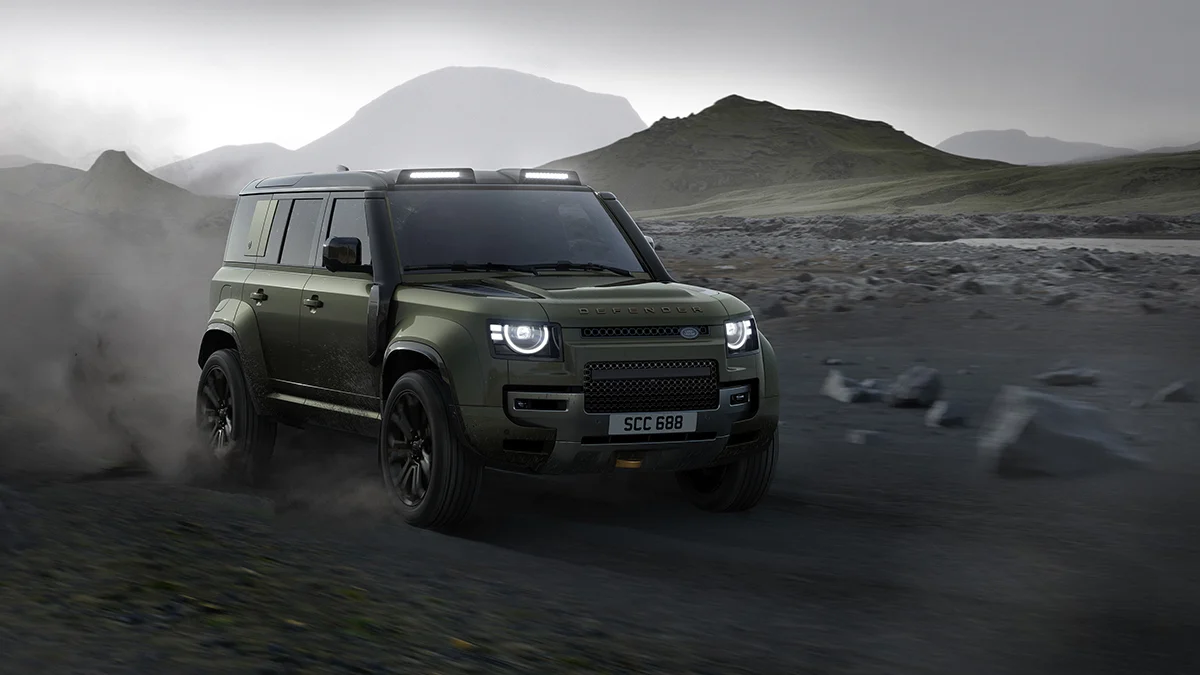
The Land Rover Defender, an icon of British automotive resilience, finds itself at a curious crossroads. As the automaker prepares to launch the 2027 model year, it has unveiled a series of updates that highlight the growing friction between high-performance engineering and tightening global emissions regulations. While the flagship Defender Octa—the most powerful and capable iteration of the nameplate—is receiving a refresh, the news comes with a caveat that has left performance enthusiasts in Europe and the U.K. reeling: a significant reduction in horsepower.
The Core Conflict: Emissions Over Output
The headline-grabbing "downgrade" for the 2027 Land Rover Defender Octa centers on its BMW-sourced 4.4-liter twin-turbocharged V-8 engine. In its current form, this powerhouse is a titan, delivering a staggering 617 horsepower. However, to comply with the stringent new Euro 6e-bis emissions standards, Land Rover has been forced to recalibrate the powertrain.
For markets in the U.K., Europe, and several other international territories, the output of this V-8 will be throttled down to 526 horsepower. This represents a reduction of nearly 90 horsepower. While the raw torque figure remains anchored at a robust 553 ft-lbs, the loss in top-end power is substantial. Consequently, the 0-to-62 mph sprint, once a hallmark of the Octa’s blistering performance, now takes 4.2 seconds—an increase of 0.4 seconds over the outgoing model.
To mitigate the disappointment of these performance figures, Land Rover engineers have turned their attention to the vehicle’s acoustics. By modifying the exhaust manifold, the brand promises a "more characterful and deeper exhaust note," attempting to offer a more visceral auditory experience to compensate for the reduction in sheer kinetic force.
A Tale of Two Markets
It is vital to distinguish the global strategy here: the power cut is not a universal mandate. A representative for Land Rover has confirmed to Robb Report that the American-spec Defender Octa will remain untouched by these specific emissions-driven limitations.
For U.S. customers, the 2027 model year represents business as usual. The American version will retain its full 600-plus horsepower rating and the sub-four-second acceleration times that have defined its market positioning. This divergence highlights the increasingly fractured nature of the global automotive landscape, where luxury manufacturers must navigate a patchwork of regulatory environments that treat the same piece of hardware very differently.

Expanding the Portfolio: The Introduction of the ‘Vertex’
In what appears to be a strategic pivot to maintain buyer interest in the European market despite the performance hit, Land Rover is introducing a new trim level: the Vertex.
The Vertex is described as a "city-centric" specification, shifting the focus from raw, off-road dominance to urban refinement and aesthetic presence. The trim features a significantly redesigned front fascia, more pronounced bumpers, and updated lighting signatures. It is designed to bridge the gap between the utilitarian roots of the Defender and the growing demand for luxury SUV aesthetics in metropolitan environments. The Vertex will be available across the full spectrum of the Defender family, including the two-door 90 and the four-door 110 and 130 body styles, signaling that Land Rover intends to keep the model relevant even as the "Octa" performance brand faces regulatory headwinds.
Chronology of a Challenging Era
The news regarding the Octa’s power reduction is the latest in a series of turbulent events for Jaguar Land Rover (JLR). Over the past eighteen months, the company has navigated a minefield of operational and strategic setbacks:
- Mid-2025: A massive cyberattack crippled manufacturing operations, resulting in hundreds of millions of pounds in losses and disrupting the supply chain.
- Late 2025: Continued supply chain instability and logistical hurdles forced the company to pause production at its historic Solihull factory following a fire, causing ripple effects throughout their assembly timelines.
- Early 2026: A major recall involving over 170,000 hybrid SUVs was initiated to address an electrical fault that could cause a sudden loss of drive power, a significant blow to the brand’s reputation for reliability.
- Mid-2026: The company confirmed the delay of its highly anticipated next-generation Jaguar electric vehicle (EV), a cornerstone of its "Reimagine" strategy, leaving a void in its future product roadmap.
These events, when viewed collectively, suggest that JLR is currently in a state of consolidation and damage control. The decision to de-power the Octa in Europe, while clearly driven by environmental legislation, also reflects the company’s limited capacity to invest in further engine refinement that might have maintained power levels while meeting cleaner standards.
Implications for the Brand and the Industry
The "de-powering" of the Defender Octa is more than just a footnote in a spec sheet; it is a microcosm of the existential challenge facing high-performance internal combustion engines (ICE). As governments push toward zero-emissions targets, the "Golden Age" of the high-output V-8 is being compressed.
For the Land Rover brand, the implication is twofold. First, it risks diluting the "Octa" badge, which was marketed as the absolute pinnacle of performance. If a flagship model is perceived as "slower" than its predecessor, the brand cachet built around it may suffer. Second, it highlights the necessity of the transition to electrification. JLR’s delay in launching its next-generation EVs means that for the time being, the company is stuck relying on aging ICE platforms that are increasingly difficult and expensive to keep compliant with modern green laws.

Official Stance and Market Reception
Land Rover’s messaging remains steadfastly optimistic. By emphasizing the "characterful" sound of the new exhaust and focusing on the introduction of the visually striking Vertex trim, the company is attempting to shift the narrative from "performance loss" to "design evolution."
Industry analysts suggest that this is a prudent, if reactive, strategy. The reality is that for the vast majority of luxury SUV owners, a 0.4-second difference in acceleration is negligible compared to the importance of brand status and exterior aesthetics. If the Vertex trim can capture the imagination of the urban demographic, the loss of those 90 horsepower may prove to be a non-factor in the vehicle’s commercial success.
Conclusion: The Road Ahead
The 2027 Defender Octa will undoubtedly remain a formidable presence on the road. Despite the regulatory-induced power reduction in specific markets, the engineering DNA of the vehicle—its chassis, its off-road capability, and its status—remains intact.
However, the episode serves as a sobering reminder of the hurdles facing legacy automakers. As JLR continues to navigate its internal recovery, the Defender will remain its most critical asset. Whether the company can balance the demands of environmental compliance with the high-performance expectations of its loyal customer base will determine the trajectory of the brand for the remainder of the decade. For now, European buyers will have to settle for a slightly softer, yet perhaps more "characterful," roar from their V-8s, while the company looks toward a future that—eventually—must move beyond the internal combustion engine entirely.
 Evan Lee Salim
 Asep Darmawan
 Laily UPN
