

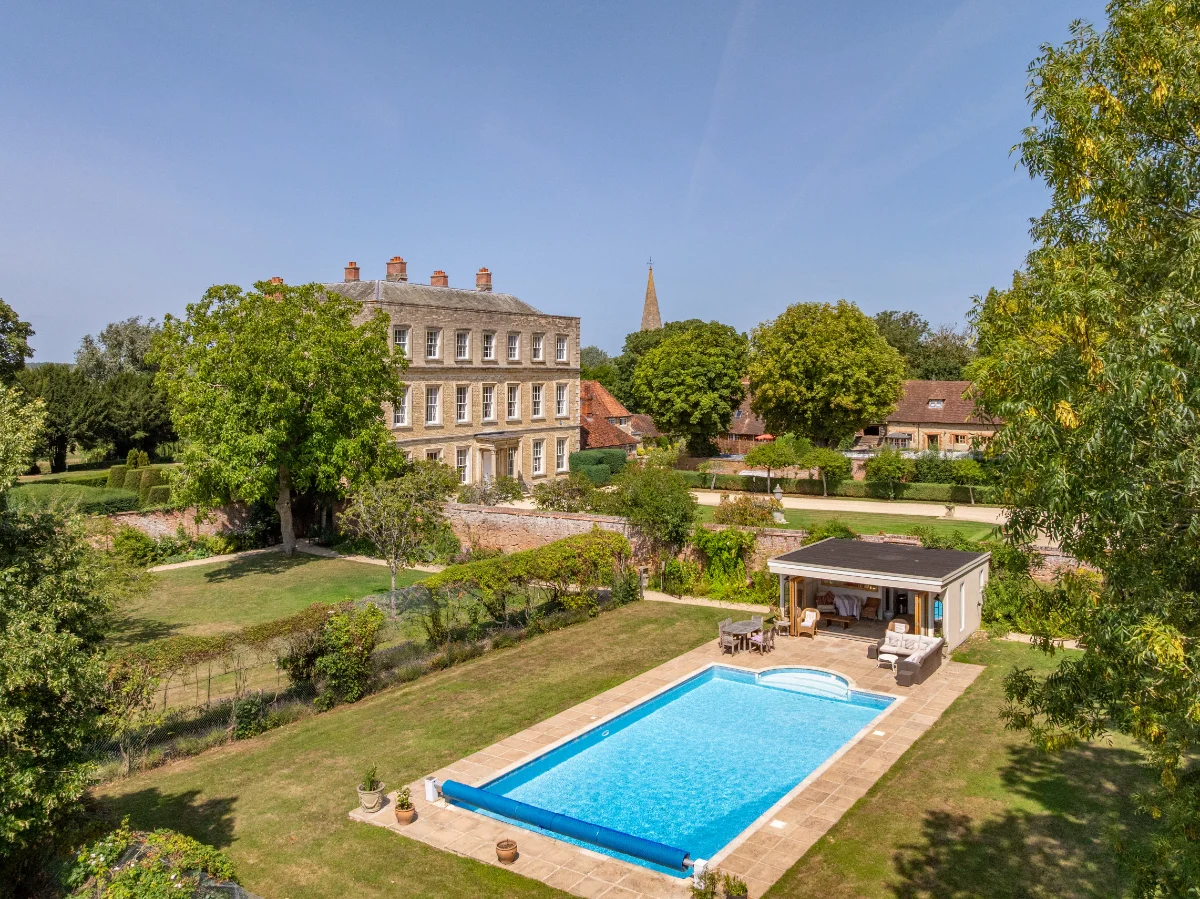
In the heart of the verdant Oxfordshire landscape, nestled between the historic towns of Wallingford and Oxford, lies a testament to the enduring power of architectural romance. Newington House, a Grade II-listed limestone masterpiece, has recently hit the market for £14.25 million (approximately $19 million), offering a rare opportunity to own a property that serves as both a historical monument and a living, breathing family home. Represented by Savills Private Office, the estate is not merely a residence; it is a narrative in stone, reflecting three centuries of artistic passion, social transformation, and, ultimately, the warmth of domestic life.
The Foundations of Romance: A 17th-Century Vision
The story of Newington House begins in the late 1600s, born from a husband’s devotion to his homesick wife. Commissioned by Henry Dunch, the residence was conceived as a tribute to the Italian heritage of his bride, Maria “Mary” Pallavicini. Having grown up in the refined, sun-drenched environments of Genoa, Italy, Mary reportedly struggled with the grey skies and stark architectural shifts of the English countryside.
To bridge the divide between their two worlds, Dunch looked to the Palazzo Pallavicini—the seat of his wife’s noble family—as a blueprint. The resulting facade is a triumph of symmetrical elegance, characterized by the light-hued limestone that seems to capture and soften the Oxfordshire light. It is a structure that defies the conventional tropes of the British manor house, introducing an Italianate precision that remains as striking today as it was over 300 years ago.

A Chronology of Evolution: From Aristocratic Seat to Cultural Salon
Newington House has never been a static object; it has functioned as a canvas for the changing tastes of the British elite. While the core structure reflects the late 17th century, a significant expansion in the late 18th century dramatically altered its silhouette and interior flow. This era saw the addition of an entire floor, transforming the building into a more imposing structure, and the installation of the iconic Corinthian-columned entrance porch—a hallmark of neoclassical ambition.
Inside, the 18th-century renovations introduced the opulent marble fireplaces and intricate plasterwork that continue to define the formal reception rooms. These spaces, designed for the grand hospitality of the Georgian era, maintain their original proportions, creating a sense of volume that is rarely replicated in modern architecture.
The early 20th century marked a pivot toward cultural significance. Under the ownership of the American-born artist Ethel Sands, Newington House became a sanctuary for the intellectual elite of the era. Sands, a prominent figure in the post-impressionist movement, turned the home into a vibrant salon. Her guest list read like a Who’s Who of the early 1900s: Henry James, Arnold Bennett, Walter Sickert, and the luminaries of the Bloomsbury Group, including Virginia Woolf, all found inspiration within its walls. The house was immortalized in paint by Walter Sickert, most notably in his work Ethel Sands Descending the Staircase at Newington, which serves as a visual record of the home’s interior aesthetic during that golden age of English artistic endeavor.

Property Specifications: A Grand Estate Defined
Spanning an impressive 13,000 square feet, the main residence at Newington House is an exercise in period perfection. The interior layout features seven bedrooms, each serving as a quiet alcove of history. Throughout the home, original timber beams, paneled walls, and ornate parquet floors are paired with towering sash windows that frame the rolling Oxfordshire hills like paintings.
The lower level, historically the service quarters, has been thoughtfully repurposed into a modern sanctuary for leisure, now housing a gym, a games room, and additional entertaining spaces. The residence is balanced by its sprawling 43-acre estate, which has been meticulously curated to offer a holistic lifestyle. The grounds are not merely gardens; they are a landscape of utility and luxury, incorporating:
- Formal Gardens and Greenhouse: A testament to the English passion for horticulture.
- Recreational Facilities: A contemporary swimming pool and cabana, a private tennis court, and a croquet lawn for summer gatherings.
- Equestrian and Pastoral Elements: A stable block and paddocks that cater to the traditional use of the land.
- Natural Vistas: A private boating lake and vast swaths of unspoiled woodland that ensure complete privacy and a connection to the local ecosystem.
Flexibility in Acquisition: The Lotting Strategy
Recognizing the shifting dynamics of the luxury real estate market, the property is being offered in three distinct lots, providing flexibility for potential buyers ranging from families to private investors:

- The Main Residence (£9.95 million / $13.3 million): This includes the primary Grade II-listed house and its immediate formal gardens.
- The Manor House (£2.45 million / $3.2 million): A secondary historic residence, ideal for multi-generational living or high-end guest accommodations.
- The Coach House (£1.95 million / $2.6 million): A converted structure providing an intimate, self-contained living space with its own vehicular access and private gardens, perfect for staff or extended family.
Official Perspectives: A Legacy of Love
For the current owners, the Nettleton family, the sale marks the end of a transformative chapter. Having purchased the estate in 1991 for £1.58 million, the Nettletons spent three decades not just preserving, but living in and refining the property.
“To most people, it’s a historic country house with centuries of history behind it, but to me, it has always been home,” says James Nettleton. “The house felt loved rather than preserved, lived in rather than displayed.” This sentiment is at the heart of the property’s appeal; despite its pedigree and formal stature, it lacks the sterile, museum-like quality often found in estates of this magnitude.
Crispin Holborow, Country Director of Savills Private Office, emphasizes the rarity of the offering. “The limestone masterpiece is greatly admired for its elegant scale and symmetry, while its history tells a beguiling story of romance and a passion for Italian architecture,” Holborow notes. He classifies the listing as a “once-in-a-lifetime opportunity,” noting that the combination of proximity to Oxford and the sheer integrity of the original 17th-century craftsmanship makes it one of the most significant properties currently on the market in the region.

The Implications of Ownership
Purchasing a property like Newington House comes with more than just the deed; it involves the stewardship of a cultural asset. The Grade II-listing ensures that the architectural integrity of the building is protected for future generations, yet the modern amenities—from the swimming pool to the renovated lower level—prove that history and contemporary comfort can coexist.
The estate is also a testament to the "Oxfordshire Premium." As the capital continues to push outward and high-net-worth individuals seek refuge from the density of London, the area surrounding the River Thame has become a focal point for those looking for space, heritage, and accessibility. Newington House offers the perfect intersection of these desires. It is a property that commands attention, not through ostentation, but through its quiet confidence and its storied past.
Whether the new owner chooses to keep the estate whole as a private family compound or utilizes the lotting system to create a boutique investment portfolio, the legacy of Henry Dunch and Mary Pallavicini remains secure. Newington House is more than just a home; it is an invitation to inhabit a piece of art, to walk the halls once frequented by Virginia Woolf, and to add one’s own chapter to the long, romantic history of a house built for love.
 Evan Lee Salim
 Asep Darmawan
 Laily UPN
