

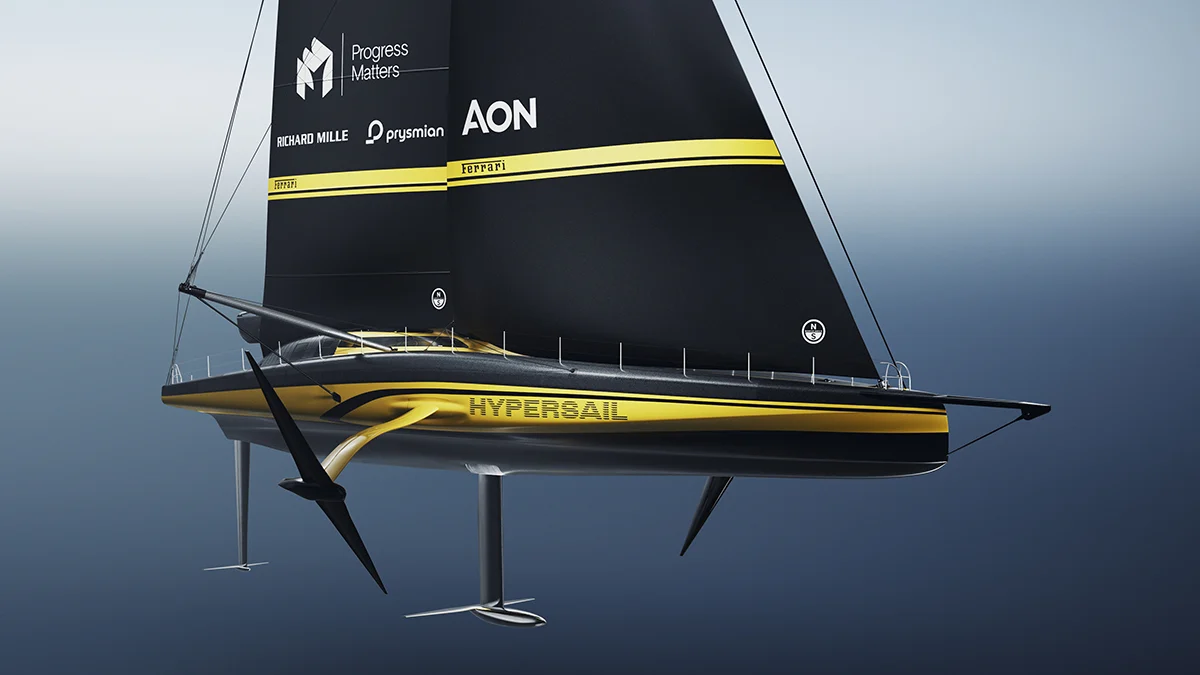
Ferrari has long been synonymous with the pinnacle of terrestrial engineering, crafting high-performance machines that dominate both the racetrack and the open road. However, the Italian marque is now setting its sights on a new frontier: the vast, unpredictable expanses of the world’s oceans. With the unveiling of the "Hypersail," a 100-foot foiling monohull designed specifically for elite ocean racing, Ferrari is not merely entering the yachting world—it is disrupting it.
The most groundbreaking revelation regarding this vessel is its radical approach to power. Ferrari has confirmed that the Hypersail will be entirely energy self-sufficient, a feat previously considered impossible for a high-speed, foiling racing craft of this magnitude. By synthesizing renewable energy harvesting with human-driven power, Maranello is proving that the future of high-performance sailing lies in a harmonious marriage between advanced electrical architecture and raw human effort.
The Core Philosophy: A Symphony of Sustainable Engineering
The Hypersail is more than a yacht; it is a laboratory for Maranello’s most advanced energy management systems. Developed by the specialized Hypersail tech team at the Ferrari headquarters in Italy, the vessel’s energy infrastructure is designed to harvest, store, and distribute power with the precision one would expect from a Formula 1 powertrain.
At the heart of this innovation is the "Winch-by-Wire" system. In traditional offshore racing, winches are mechanically operated by the crew, often requiring immense physical exertion to adjust sail tension under extreme conditions. The Hypersail reimagines this interaction. By converting the crew’s muscular force into electrical energy, the yacht creates a closed-loop system where physical labor is essentially "recycled" to power the vessel’s sail plan.

This mechanism draws inspiration from the sophisticated by-wire systems found in the newly unveiled Ferrari 12Cilindri Manuale, where the tactile, mechanical sensation of shifting gears is digitized into electronic signals. On the Hypersail, this allows the crew to handle the massive forces required to navigate a 100-foot foiling yacht with greater precision and significantly less fatigue, all while simultaneously charging the onboard batteries.
Chronology: From Concept to the 2027 Launch
The trajectory of the Hypersail has been marked by rapid development and a relentless focus on proprietary technology.
- Early 2025: The project is greenlit in Maranello, drawing on the synergy between Ferrari’s aerodynamics department and naval architects specializing in foiling technology.
- Mid-2025: Initial wind tunnel testing and CFD (Computational Fluid Dynamics) simulations are completed, focusing on the reduction of drag and the optimization of foil lift.
- Early 2026: The "Winch-by-Wire" system is successfully bench-tested, proving that human-generated power can be efficiently converted into usable electrical current for hydraulic pumps and winches.
- July 2026: Ferrari officially unveils the energy management specifications, confirming the yacht’s full autonomy.
- Late 2026: The hull is scheduled for completion at the shipyard in Pisa, Italy.
- 2027: The anticipated delivery date, followed by the yacht’s entry into competitive ocean racing circuits.
Supporting Data: The Anatomy of an Autonomous Yacht
The Hypersail’s ability to remain "off-grid" during long-distance racing is supported by an array of sophisticated technologies that ensure a constant flow of power.
Solar and Wind Integration
The deck and topsides of the Hypersail are adorned with over 1,000 square feet of high-efficiency solar panels. These panels are integrated into the aesthetic design of the hull, ensuring that no drag is added while maximizing surface area exposure to the sun. At the stern, three specialized, low-drag wind turbines provide supplemental power, ensuring that even when the sun sets or the sky is overcast, the energy reserves continue to replenish.

The 800V Battery Architecture
All harvested energy is managed through two identical 800V battery banks. This high-voltage architecture is a direct technological transfer from Ferrari’s newest EV projects, including the upcoming "Luce" electric vehicle. The 800V system allows for faster energy transfer and more efficient cooling, which is vital when operating in the heat-intensive, high-pressure environment of ocean racing.
Flight Control Systems
The Hypersail’s stability and speed are governed by an onboard "Flight Control" computer. This system acts as the "brain" of the yacht, using advanced sensors to adjust the foils in real-time. The system operates in two distinct modes:
- Slow Movements: These involve the massive, gradual adjustments of the main foil arms and the canting keel to maintain the vessel’s center of gravity.
- Fast Movements: These involve the rapid-fire adjustment of the foil flaps, reacting to wave patterns and wind gusts in milliseconds.
The foil and keel systems are powered by the same 800V rear e-axle technology utilized in the Ferrari Luce, while the smaller, hyper-responsive flaps are driven by 48V electric motors, optimizing the power-to-weight ratio for every maneuver.
Official Perspectives: The Engineers Speak
Marco Guglielmo Ribigini, the technical team leader for the Hypersail project, has been vocal about the significance of this achievement. In a recent statement, he emphasized that the project was never just about building a fast boat—it was about redefining the limits of energy management.

"Hypersail is the first foiling monohull for ocean racing to achieve complete energy autonomy," Ribigini noted. "The challenge was not just to generate energy, but to ensure the ideal balance between efficiency and performance. Through the Winch-by-Wire system, we have turned the crew from mere operators into active components of the ship’s power plant. Every movement they make contributes to the flight of the vessel."
The implication of this statement is clear: Ferrari is looking to integrate the human element into the digital ecosystem of the boat. The crew is no longer just steering the ship; they are fueling it.
Implications: A New Era for Maritime Racing
The arrival of the Hypersail sends a shockwave through the world of competitive sailing. By proving that a vessel can be entirely energy self-sufficient without sacrificing the high-speed requirements of a foiling monohull, Ferrari is effectively setting a new "Gold Standard" for sustainable racing.
Impact on Environmental Standards
Ocean racing has often been criticized for the waste generated by support vessels and the reliance on fossil-fuel-powered generators for onboard electronics. The Hypersail demonstrates that high-performance racing can exist in total harmony with the environment. If this technology proves reliable in the grueling conditions of the open ocean, it is likely that future racing regulations will begin to mandate similar levels of energy autonomy.

The "Ferrari Effect" in Yachting
Ferrari’s entry into this space suggests that the future of yachting will be increasingly defined by the same technological crossover seen in the automotive world. As electric and hybrid drivetrains become the norm in road cars, the transfer of that tech to the marine sector—where weight and energy density are even more critical—will likely accelerate. We are witnessing the beginning of an era where the same 800V architectures powering the world’s fastest supercars will be the lifeblood of the world’s fastest sailboats.
A Testbed for Future Tech
The Hypersail serves as a high-stakes proving ground for Ferrari’s engineers. The data collected from the yacht’s sensors—how they handle salt corrosion, extreme thermal cycles, and the massive vibration of high-speed foiling—will inevitably find its way back into Ferrari’s road-going fleet.
Conclusion: The Horizon Awaits
As construction continues in Pisa, the anticipation surrounding the Hypersail continues to mount. It is a vessel that represents the intersection of tradition and innovation, where the physical art of sailing meets the cutting-edge science of electric propulsion.
When the Hypersail finally touches the water in 2026 and takes to the starting line in 2027, it will be more than just a competitor. It will be a testament to the fact that when you apply the relentless spirit of Maranello to the challenges of the sea, the impossible becomes merely the next engineering hurdle to be cleared. For the yachting world, the wind has changed direction—and Ferrari is leading the way.
 Basiran
 Siti Muinah
 Nana
Nana
