

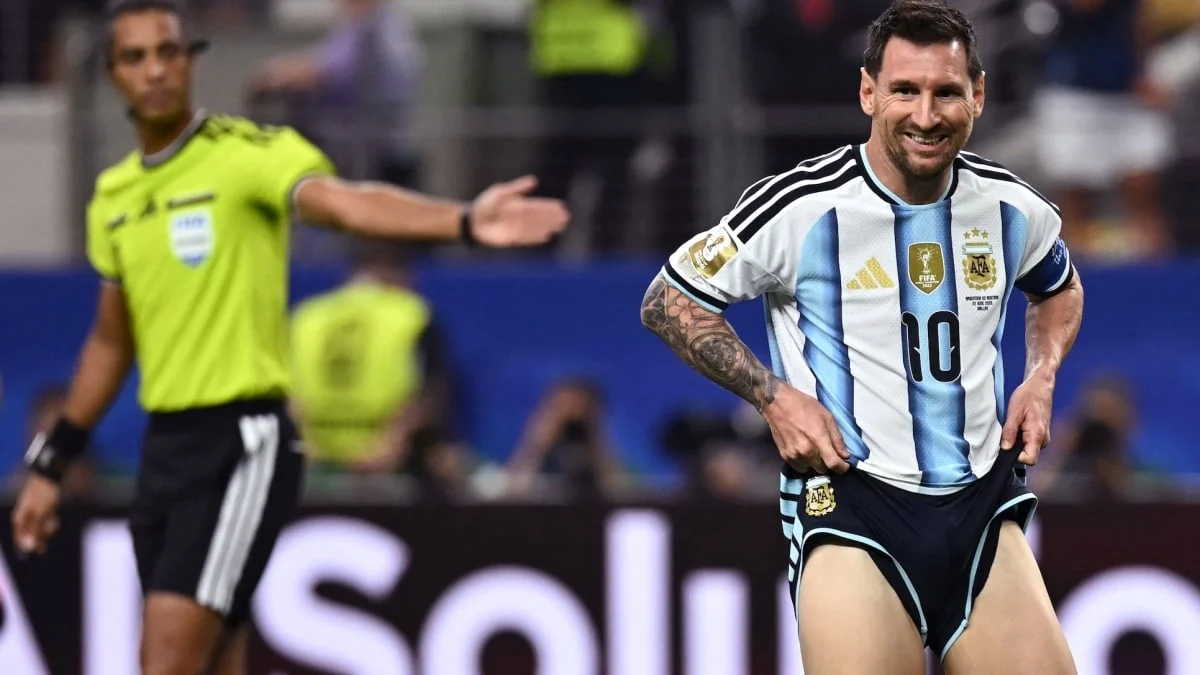
In a sporting narrative that feels more like myth than reality, Lionel Messi has once again redefined the boundaries of human performance. Just days before his 39th birthday, the Argentine maestro delivered a masterclass against Austria that will be etched into the annals of football history for generations. By netting a clinical brace, Messi did more than just secure a victory; he officially ascended to the pinnacle of the sport’s most prestigious competition, becoming the undisputed all-time leading goalscorer in FIFA World Cup history.
With his 17th and 18th goals on the global stage, Messi surpassed the long-standing record held by German legend Miroslav Klose. The achievement serves as the ultimate punctuation mark on a career that has already defied logic, cementing his status as the greatest to ever grace the pitch.
The Chronology of a Record-Breaking Evening
The atmosphere inside the stadium was electric, thick with the anticipation of history in the making. Argentina entered the match against Austria with a singular objective: to facilitate the coronation of their captain.
For much of the match, the record remained tantalizingly out of reach. Messi, ever the focal point of the opposition’s defensive schemes, found himself crowded out by a disciplined Austrian backline. The tension peaked in the second half when Messi stepped up to take a penalty. A goal at that juncture would have equaled the record, but the weight of the moment appeared to manifest in a rare lapse of precision. The strike was thwarted, and for a fleeting second, the narrative shifted toward the heartbreak of a missed opportunity.
However, true greatness is defined by resilience. As the clock ticked into the final minutes of stoppage time, Messi found the space that had eluded him all evening. With the clinical composure that has defined his two-decade career, he slotted home his second goal of the match, pushing his total to 18 and officially eclipsing Klose. It was a dramatic, last-gasp conclusion that mirrored the narrative arc of his entire career: a late-game surge that leaves the world in awe.
Statistical Dominance and the Penalty Paradox
The numbers behind Messi’s achievement are staggering. To surpass Miroslav Klose, who held the record at 16 goals since his final appearance in 2014, is a testament to Messi’s sustained excellence. While Klose was a traditional, lethal striker who relied on positioning and aerial prowess, Messi’s record is a tapestry of long-range screamers, intricate dribbling sequences, and tactical intelligence.
The Penalty Record
The match was not without its complexities. By missing his penalty attempt, Messi unintentionally set a separate, less enviable record: becoming the first player in history to miss a penalty kick in three separate World Cup tournaments.
Social media discourse, however, was quick to defend the Argentine icon. Many fans argued that Messi—ever the perfectionist—seemed reluctant to claim such a monumental record via the "cheap" route of a spot-kick. Whether or not that psychological factor influenced his performance remains a matter of debate, but it fueled a wave of memes and tributes that only underscored his status as a cultural phenomenon. Even his height, 5 feet 7 inches, became a talking point, with fans highlighting how he consistently overcomes physical giants in a sport that increasingly prioritizes raw athleticism over pure technical skill.
Digital Echoes: The World Reacts
The record-breaking moment triggered a massive response in the digital realm. Google, acknowledging the cultural significance of the event, implemented a special "Easter egg" for the occasion: users searching for "Messi" were greeted with a virtual cascade of confetti, a digital celebration of a historic milestone.
The reaction on platforms like X (formerly Twitter) was instantaneous and global. Football analysts, former players, and fans from every corner of the planet flooded the timeline with tributes. The discourse ranged from tactical breakdowns of his movement to humorous observations about his familiar, signature goal-scoring patterns—a "Messi classic" that he has perfected over his years at Barcelona, PSG, and Inter Miami.
Implications: The Shadow of the Rising Sun
While the night belonged to Messi, the future of the record remains a subject of intense speculation. Kylian Mbappé, the French sensation, currently sits at 14 World Cup goals. Given his age and his prolific strike rate, many experts believe Mbappé is the only player currently active with a realistic chance of eventually challenging Messi’s new benchmark.
The irony of the situation is not lost on the football community. Despite being rivals on the field, the mutual respect between the two is profound. Mbappé has frequently spoken of Messi in reverential tones, recently declaring in a high-profile interview that he considers the Argentine the superior player. The prospect of a Messi-Mbappé final in the next tournament is the dream scenario for football fans worldwide, offering a poetic clash between the reigning king and the heir apparent.
Tactical Analysis: Why This Matters
To understand the weight of this record, one must look at the evolution of the World Cup itself. Modern defenses are faster, more organized, and more technologically supported than those of the 20th century. For a player to maintain such a high level of output across nearly two decades of international football is unprecedented.
Longevity as a Skill
Messi’s ability to transition from the explosive winger of 2006 to the tactical playmaker of 2026 is the primary reason he has reached this total. He has effectively "out-thought" the game. His record is not just a result of finishing ability; it is a result of his vision, his passing, and his understanding of space.
Furthermore, the record acts as a final rebuttal to critics who once suggested that his success was solely tied to the specific infrastructure of his club teams. By proving his efficacy on the global stage, in the most high-pressure environment in sports, he has removed the final asterisk that some detractors placed beside his name.
The Cultural Legacy
Lionel Messi is no longer just a footballer; he is a global brand, a source of national identity for Argentina, and a symbol of what is possible through dedication. The sight of an Austrian fan expressing frustration over his own team’s performance compared to the brilliance of the opposition provided a humorous, human element to the night, reminding us that even the most stoic fans cannot help but admire the sublime.
As we look toward the remainder of his career, we must treat every appearance as a historical event. The confetti on Google search engines may fade, and the digital debates will eventually shift to the next big match, but the number "18" attached to Messi’s name in the FIFA history books is permanent.
Whether one considers him the "GOAT" (Greatest of All Time) is a matter of personal opinion, but the data is no longer up for interpretation. Lionel Messi has conquered the mountain, and for the foreseeable future, he stands alone at the summit.
Looking Ahead: What’s Next?
With the record now in his possession, the pressure on Messi to perform may shift into something more liberated. Without the burden of the chase, we may see an even more creative version of the Argentine. For the fans, the focus now turns to the potential for further records. Can he reach 20 goals? Will he play in the next cycle?
Regardless of the answers, one thing is certain: the night the record fell, the world stopped to watch. It was a reminder of why we engage with sport—to witness the impossible become possible, and to see a human being transcend the limitations of their field. As the dust settles, the football world is left to marvel at the fact that we were privileged enough to witness the Messi era in real-time.
He didn’t just break a record; he elevated the standard of what it means to be a champion. And as he approaches his 39th birthday, Lionel Messi is proving that for some, time is not an adversary, but a witness to their greatness.
 Ali Ikhwan
 Raul Delapena Setiawan
 Azzam Bilal Chamdy
