

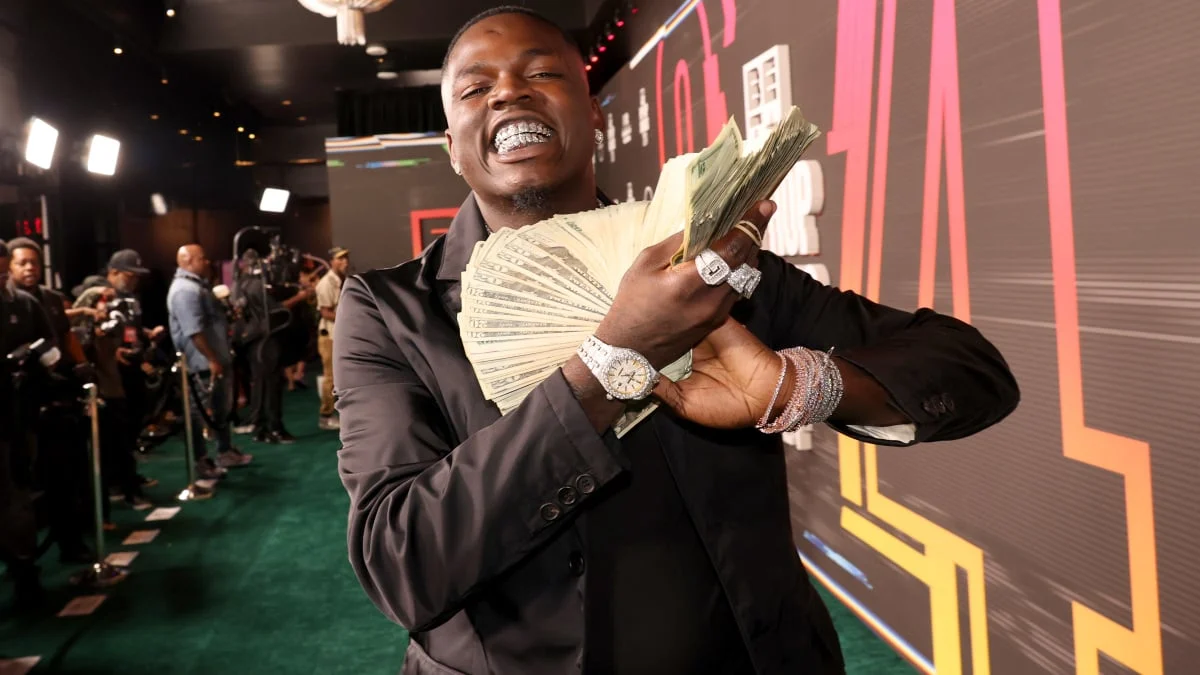
In the hyper-competitive ecosystem of modern hip-hop, the line between personal brand building and outright fabrication has become increasingly porous. Rappers are long accustomed to cultivating an "aura of authenticity"—a carefully curated street mythos designed to secure fan investment. However, every so often, a claim emerges that transcends the standard industry exaggeration and enters the realm of the absurd.
Three years after its initial broadcast, a clip from Memphis rapper Big Boogie’s February 2023 appearance on the Bootleg Kev podcast has resurfaced with a vengeance. It has become a permanent fixture in the digital zeitgeist, not because of its truth, but because of its staggering, almost performance-art level of audacity. In the short, three-minute exchange, Big Boogie claimed he turned down a $15 million scholarship to serve as a drum major at a “big college in Jacksonville.”
The story is a masterclass in the "big lie" technique, and its viral resurgence offers a fascinating look at how internet subcultures deconstruct, meme-ify, and ultimately dismantle the fragile art of the rapper’s tall tale.
The Chronology of a Fabrication
The origin of the narrative is as brief as it is bizarre. Within the first three minutes of his 40-minute appearance on the Bootleg Kev podcast, Big Boogie—a Memphis-based artist signed to Yo Gotti’s Collective Music Group (CMG)—began a story about his academic past that would soon become internet folklore.
According to Boogie, he had been recruited by a prominent university in Jacksonville, Florida, to act as their drum major. He claimed the offer was a life-changing $15 million. Sensing the incredulity in the room, Boogie quickly attempted to "negotiate" his own lie, scaling the figure down to $5 million before eventually settling on a vague, "somewhere in the millions."
The narrative grew more preposterous as he continued: he insisted the school wanted him to hold this position for a full decade—an academic tenure that defies the very nature of a four-year undergraduate degree.
The host, Bootleg Kev, remained visibly stunned throughout the exchange. At one point, the conversation devolved into a confusing back-and-forth regarding whether Boogie was being paid to "play the drums" or lead the band as a drum major—a distinction Boogie seemed to struggle with, despite his alleged status as a high-value recruit.
The Reality Check: Dismantling the Myth
While the segment was intended to bolster the rapper’s profile, it inadvertently provided a textbook case study on why basic fact-checking is the enemy of a good story.
The Geography Problem
The most glaring error in Boogie’s account is the institution itself. The largest academic entity in Jacksonville is Florida State College at Jacksonville (FSCJ). As of the date of the claim, FSCJ does not even maintain a marching band program, let alone one capable of soliciting high-profile talent.
The Financial Impossibility
The fiscal claims made by Big Boogie are equally disconnected from reality. To put the $5–15 million figure in perspective, one must look at the landscape of collegiate athletics. Even the most elite college athletes, operating under the modern Name, Image, and Likeness (NIL) framework—which allows players to monetize their celebrity—rarely reach the $5 million threshold annually. For a marching band, an organization that relies heavily on endowments, a $15 million expenditure for a single drum major would represent a total annihilation of the program’s budget. For context, the world-renowned marching band at The Ohio State University, one of the most prestigious in the nation, operated on a total endowment of roughly $15 million as of 2019.
The Procedural Fallacy
Beyond the finances, the logistics of the position are fundamentally impossible. Drum major positions are rarely, if ever, offered to incoming freshmen. At powerhouse programs like Ohio State, for instance, a candidate cannot even apply to be an assistant drum major until their second year of study. The idea of a university "recruiting" a student for a decade-long stint as a drum major is a concept that exists only in the mind of someone who has never stepped foot on a college campus.
The Internet’s Reaction: A Cultural Phenomenon
If the goal of the initial lie was to go viral, Big Boogie succeeded—just not in the way he likely intended. The clip has become a staple for content farms and reaction channels, some of which have posted the footage daily for over a year.
The longevity of the clip is fueled by the humor of the "relatable liar." We have all known that one person in middle school who claimed to have a cousin who worked at Nintendo or an uncle who was a Navy SEAL. Big Boogie’s performance tapped into that universal experience of witnessing someone commit to a lie so poorly that it becomes hypnotic.
The creative output spawned by the clip has been immense. Instagram creators have utilized the audio as a script for sketches. One popular video features a cameraman "interviewing" a realtor about the biggest deal they ever lost, using the cadence and absurdity of the Boogie interview. Another shows two Mormon missionaries on a doorstep, with one explaining to the other why he chose to forego higher education in favor of a "big band offer."
There is even an Instagram account titled @big_band_in_jacksonville, which posts content from the perspective of a fictional social media intern for the mystery Jacksonville college, desperately trying to defend the legitimacy of the $15 million scholarship offer.
The "Correction" and Its Implications
In 2024, likely sensing that the joke was beginning to define his public image, Big Boogie returned to Bootleg Kev to "clear things up."
In this follow-up appearance, he attempted a pivot. He walked back the $15 million figure, admitting that the numbers were purely performative—a tactic used specifically to "go viral." However, he doubled down on the existence of the offer itself, claiming that while it wasn’t for millions, he was indeed approached to play for a band.
This backtrack did little to settle the matter. In the court of public opinion, the damage—or rather, the entertainment—was already done. The admission that he lied to chase engagement only cemented the clip’s status as a meta-commentary on the current state of internet fame.
Why This Story Matters
The Big Boogie saga is more than just a funny meme; it is a symptom of the "Attention Economy." In an era where algorithms prioritize high-energy, controversial, or bizarre clips, the truth is often relegated to a secondary concern.
Rappers, who have always been masters of self-mythologizing, are now operating in a landscape where the audience is not just a consumer, but an active investigator. When a creator makes a claim that is easily disproven by a quick Google search, they are no longer just "building an aura"; they are providing content for the very people who will inevitably debunk them.
This creates a new type of fame—one built not on talent or genuine accomplishment, but on the ability to generate a "memeable" moment. Big Boogie, whether by accident or by calculated design, managed to secure a permanent place in the digital canon. He may not have earned $15 million for his drum major skills, but he certainly secured the one currency that arguably matters more in the digital age: total, unrelenting, and mocking attention.
Ultimately, the story of the $15 million drum major serves as a reminder that in the age of the smartphone, there is nowhere for a lie to hide. If you are going to weave a tall tale, it is best to ensure your math—and your knowledge of college band programs—is a bit more rigorous than the average middle schooler’s. Otherwise, you may find yourself trending for all the wrong reasons, three years later, while the internet continues to laugh at your expense.
 Suro Senen
 Nana Wu
 Neng Nana
