

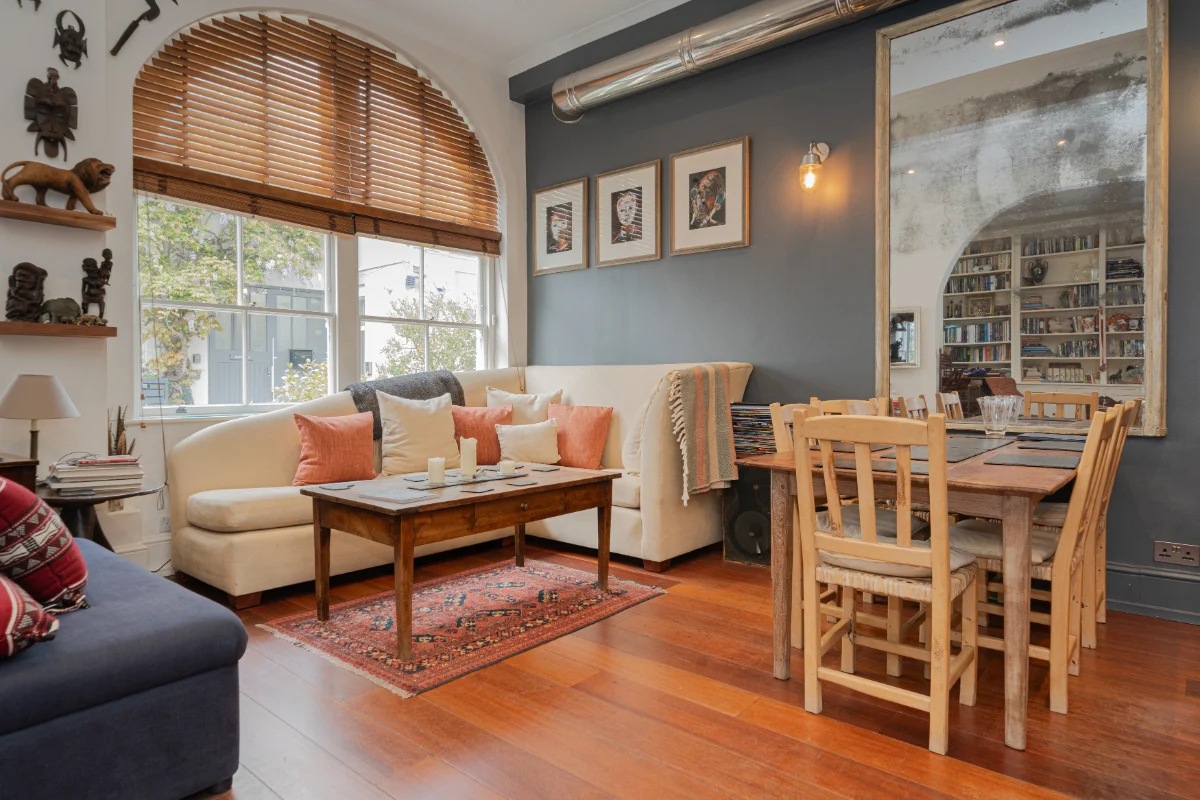
In the landscape of London’s ultra-prime real estate, few addresses carry the dual weight of historical architectural significance and high-wattage celebrity provenance quite like the homes tucked away in the city’s historic mews. Among these, one unassuming, whitewashed residence in South Kensington has re-entered the market, offering a rare glimpse into a lifestyle that once defined the intersection of British grit and global pop culture.
Before Daniel Craig ascended to global superstardom as the face of James Bond, he honed his icy, calculated charisma in Layer Cake, the 2004 crime thriller directed by Matthew Vaughn. The film, which served as a pivotal moment for both director and star, drew much of its aesthetic texture from a specific location: a mews house in South Kensington owned at the time by Vaughn’s close friend, director Guy Ritchie, and his then-wife, the incomparable Madonna. Now, more than two decades later, this 1,540-square-foot sanctuary has returned to the rental market, inviting a new tenant to step into a property that has hosted some of the most influential figures in modern entertainment.

The Architecture of History: A Legacy Built to Last
To understand the allure of this residence, one must look beyond the celebrity headlines and into the very fabric of its construction. Built in the early 1860s by the prolific developer William Jackson, Queen’s Gate Mews is a testament to the Victorian-era ingenuity that transformed utilitarian horse stables and coach houses into the aesthetic jewels of London’s residential districts.
The property is situated within the Queen’s Gate Conservation Area, a designation that ensures the preservation of the area’s architectural integrity. The street itself is a survivor, having weathered the turbulent history of the 20th century, including a direct bomb strike during the Blitz in World War II. Its resilience is matched by its versatility; the cobbled streets of the mews have become a sought-after backdrop for filmmakers seeking to capture the quintessential “London look.” Beyond its association with the Ritchie-Madonna era, the location has served as a key set for classic British cinema, appearing in films such as the 1970 cult classic Performance and the 2008 heist film The Bank Job.

Chronology: A Timeline of Stardom and Sophistication
The narrative arc of this property is inextricably linked to the “Brangelina-esque” media frenzy of the early 2000s, when the marriage of the Queen of Pop and the burgeoning British auteur Guy Ritchie dominated the tabloids.
- 1860s: William Jackson develops the Queen’s Gate Mews, establishing a row of coach houses that would serve the wealthy residents of South Kensington.
- Early 2000s: Madonna and Guy Ritchie acquire the residence during the peak of their marriage. The couple undertakes extensive renovations, aiming to fuse the historic charm of the mews with a masculine, industrial edge.
- 2004: The property gains cinematic immortality as a filming location for Matthew Vaughn’s Layer Cake. The sleek, minimalist, yet rugged interiors provide the perfect contrast to the film’s high-stakes criminal narrative.
- Post-2008: Following the dissolution of their marriage, the couple divests from many of their joint London holdings.
- 2026: The property returns to the rental market via Dexters, marking a new chapter for the historic home as it seeks a high-profile tenant looking for a pied-à-terre in one of the city’s most prestigious postcodes.
The Design Philosophy: Where Industrial Meets Opulence
The interior of the house is a masterclass in contrasts. While the exterior retains the charming, low-slung, whitewashed aesthetic characteristic of a traditional mews house, the interior reflects the eclectic, highly personalized vision of its former owners.

The main floor is defined by an open-plan layout that favors fluidity over formal compartmentalization. Dark timber flooring provides a grounding, moody base, which is artfully juxtaposed against exposed industrial piping—a stylistic choice that bridges the gap between the building’s functional history and modern loft living.
The heart of the home is undeniably the kitchen. Reportedly designed by Guy Ritchie himself, the space is a utilitarian dream, featuring a high-end stainless-steel finish, a robust Falcon range, and a sophisticated stone backsplash. It is a kitchen built for utility, yet it possesses a sharp, masculine aesthetic that feels entirely at home in a bachelor’s lair or a designer’s retreat. A dedicated library nook and a guest bath complete the ground floor, creating an environment that is as suitable for quiet reading as it is for intimate entertaining.

Ascending to the upper level, the design shifts toward a more private, sanctuary-like atmosphere. A dedicated office space provides a quiet environment for the modern professional, while the primary suite offers a serene escape, characterized by an abundance of natural light and a Juliet balcony that overlooks the historic cobbles below. The bathroom serves as a centerpiece of the renovation; here, the designers preserved an original brick archway, marrying the 19th-century structural elements with the modern luxury of Carrara marble finishes and a freestanding soaking tub. The inclusion of full air conditioning throughout the upper level ensures that the residence meets the rigorous standards of contemporary comfort.
Supporting Data: The Cost of Living in History
As of the current market listing, the residence is available for rent through the agency Dexters. The financial commitment required to occupy this piece of cultural history reflects its prime location and unique pedigree.

- Weekly Rental Rate: £2,075 (approximately $2,800 USD)
- Monthly Rental Rate: £8,992 (approximately $12,100 USD)
- Square Footage: ~1,540 square feet
- Location: South Kensington, SW7 (Walking distance to Hyde Park, Royal Albert Hall, and the V&A Museum)
The neighborhood itself is a significant value driver. South Kensington is widely considered one of the most culturally dense areas of London, offering residents immediate access to world-class museums, high-end gastronomy, and the lush, expansive greenery of Hyde Park. For the tenant, the rental price is not merely a reflection of the square footage, but an entry point into an elite lifestyle defined by convenience and prestige.
Official Perspectives and Market Implications
The listing of such a high-profile residence raises questions about the broader luxury rental market in London. Real estate experts note that while the “celebrity tax”—a premium added to properties with famous former owners—is a real phenomenon, the longevity of these properties depends largely on their ability to offer genuine architectural value.

“What we are seeing,” says a spokesperson for the luxury sector, “is a shift toward ‘experiential living.’ Tenants at this level aren’t just buying square footage; they are buying a story. A home that has hosted Madonna and Guy Ritchie, or one that has been immortalized on film, carries a cultural cachet that cannot be replicated by new builds.”
The property serves as a poignant reminder of the enduring nature of London’s historic districts. Even as the city modernizes, the mews house remains a constant, a whisper of the past nestled within the frantic pace of the 21st century.

The Madonna Property Portfolio: A Global Reach
While the Queen’s Gate Mews house is a notable chapter in her history, it represents only a small fraction of the global footprint held by the Queen of Pop. Madonna’s real estate portfolio has long been the subject of architectural fascination, spanning decades and continents.
From the sprawling, triple-wide townhouse on Manhattan’s Upper East Side to an 18th-century mansion in the hills of Sintra, Portugal, her acquisitions have consistently favored properties with deep historical roots and significant architectural character. Her holding in London’s Marylebone, a Georgian townhouse purchased in 2007, remains a jewel in her crown, signaling her enduring connection to the city. Whether in the Hamptons or Los Angeles, her homes have consistently served as laboratories for design and sanctuaries for a life lived under the constant glare of the public eye.

Conclusion: A Rare Opportunity for the Discerning Tenant
The return of the Queen’s Gate Mews residence to the market is more than a simple real estate transaction; it is an invitation to inhabit a slice of British cinematic and pop-culture history. It stands as a rare, preserved fragment of a bygone era, modernized with precision and style.
For the individual seeking a home that transcends the mundane, this property offers a rare synthesis of 1860s Victorian character and the bold, idiosyncratic design sensibilities of the 2000s. It remains a testament to the fact that while trends in music, film, and fashion may shift, the allure of a well-crafted home in the heart of London is truly timeless. As the search for a new tenant begins, the residence waits, ready to host the next chapter in its storied life, standing quietly on its cobbled street, hiding in plain sight behind its whitewashed brick facade.
 rifanmuazin
 Laily UPN
 Suro Senen
