

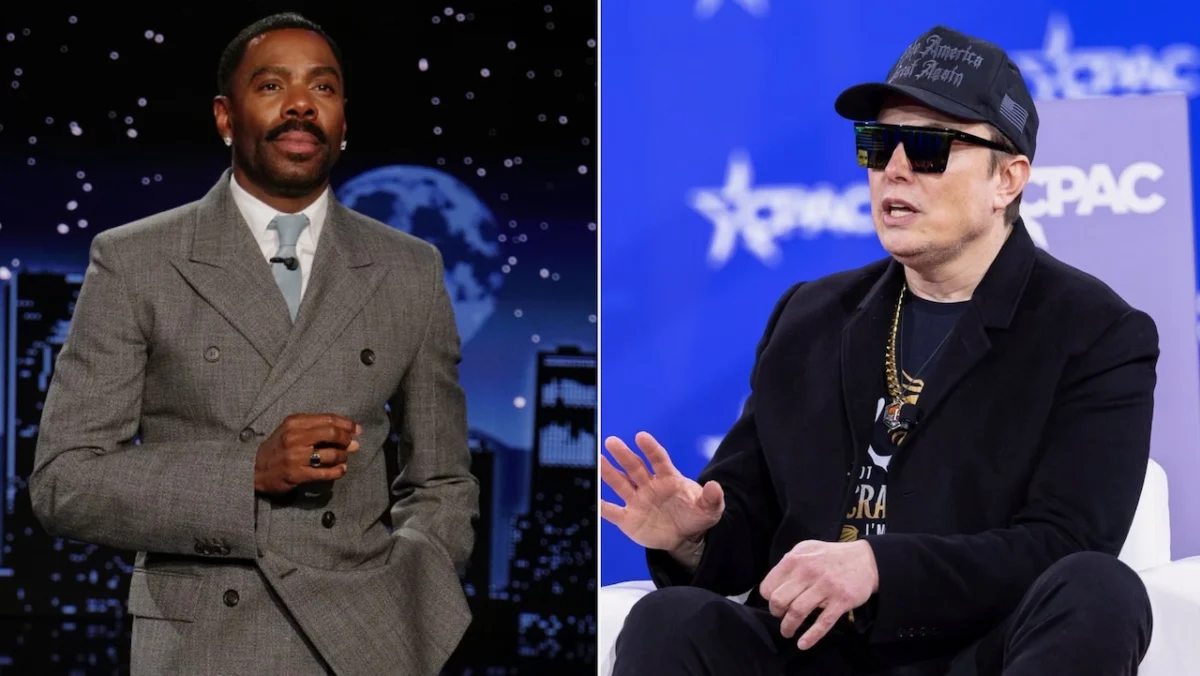
In the rapidly evolving intersection of artificial intelligence, cultural representation, and the modern "culture wars," few figures have managed to bridge the gap between high art and sharp-witted political commentary as effectively as Colman Domingo. During his guest-hosting stint on Jimmy Kimmel Live this week, the Oscar-nominated actor turned his sights toward a burgeoning controversy in the tech world: Elon Musk’s declared intent to produce a "historically accurate" AI-generated adaptation of Homer’s The Odyssey.
The commentary, which has since gone viral, served as a lightning rod for broader debates regarding the ownership of ancient myths, the limitations of artificial intelligence in creative storytelling, and the increasingly polarized nature of Hollywood’s casting practices.
The Core Conflict: What Defines "Historical Accuracy"?
The controversy centers on a recent announcement from the billionaire entrepreneur and Tesla CEO, Elon Musk, who suggested that current cinematic trends—specifically those emphasizing diverse casting in historical and mythological epics—have strayed too far from "historical accuracy." In response, Musk signaled his intention to utilize advanced generative AI tools to create a version of The Odyssey that aligns with his interpretation of the original source material.
For Domingo, the term "historically accurate" in this context is a transparent dog whistle. Addressing the audience during his monologue, the Rustin star did not mince words. "By ‘historically accurate,’ he means whiter than Christmas at Cracker Barrel," Domingo quipped, drawing both laughter and applause from the studio audience.
Domingo’s critique highlights a recurring tension: the tendency for tech moguls and certain cultural commentators to weaponize the concept of "accuracy" to push back against the inclusion of marginalized groups in media. By framing his AI project as a corrective measure, Musk is effectively positing that the "true" version of a Mediterranean epic from the 8th century BCE must, by necessity, exclude the multicultural reality of the modern world.
Chronology of a Cultural Clash
To understand the weight of Domingo’s critique, one must examine the timeline of this escalating narrative:
- Mid-2026: A wave of discourse regarding the casting of classical epics hits social media, spurred by the release of high-profile adaptations. Critics of "diverse casting" begin lobbying for more "traditional" representations of ancient Greek figures.
- Late July 2026: Elon Musk, through his various social media channels, engages with the controversy, explicitly praising the potential for AI to bypass "woke" Hollywood casting directors. He proposes a "historically accurate" version of The Odyssey, promising that AI will restore the "authentic" aesthetic of the poem.
- August 2026: The discourse intensifies as AI-generated concept art begins to circulate online, featuring exclusively Eurocentric character designs for Homeric heroes.
- Wednesday Night: Colman Domingo guest-hosts Jimmy Kimmel Live, delivering a monologue that systematically dismantles the premise of Musk’s project, pointing out the inherent logical fallacy of seeking "historical accuracy" in a work of mythological fiction.
The Logical Fallacy: Fact vs. Myth
Domingo’s most poignant observation was not merely a jab at Musk’s aesthetic preferences, but a fundamental critique of the premise itself. "I don’t want to get technical here," Domingo noted, "but you can’t make a historically accurate version of something that is totally made the fuck up."
Homer’s The Odyssey is an epic poem—a work of oral tradition that blends the divine, the monstrous, and the heroic. It features cyclopes, sirens, vengeful gods, and magical transformations. As Domingo aptly put it, "It’s fiction, like The Hunger Games or the president’s cognitive exams."
The Epistemological Problem
The irony of utilizing artificial intelligence to define "historical accuracy" for a myth is significant. AI models are trained on vast datasets—datasets that are inherently biased toward the existing historical biases present in literature, art history, and previous cinematic portrayals. By asking an AI to render "historically accurate" figures from Ancient Greece, Musk is essentially asking the algorithm to regurgitate the aesthetic tropes of 19th and 20th-century European art, rather than reflecting the actual genetic or cultural diversity of the ancient Mediterranean basin, which served as a melting pot of civilizations.
Supporting Data: The AI and Bias Nexus
The reliance on AI to determine "truth" or "accuracy" in storytelling is a growing concern for media theorists and ethicists. A 2026 report by the Center for Digital Media Ethics noted that generative AI tools often default to stereotypical representations of historical figures when prompted with vague terms like "historical accuracy."
"When you ask an AI to create a ‘Greek hero,’" explains Dr. Elena Vance, a professor of digital humanities, "it doesn’t consult archaeological records of the Bronze Age. It consults the history of Hollywood casting and European oil paintings. It is a closed loop of bias."
Domingo’s critique aligns with this reality. He recognizes that Musk’s "historically accurate" Odyssey is not a pursuit of historical truth, but a reinforcement of a specific, narrow-minded cultural narrative. By using AI as the architect, Musk avoids the accountability of human choices while presenting the output as an objective, technological inevitability.
Official Responses and Public Reaction
As of this writing, Elon Musk has not provided a direct rebuttal to Domingo’s monologue, though he has continued to post broadly about the importance of "preserving Western civilization" via technology.
The entertainment industry’s reaction has been largely supportive of Domingo’s stance. Several directors and screenwriters have echoed the sentiment that art should reflect the world as it exists today, rather than a romanticized, sanitized version of the past. Conversely, a vocal subset of internet users, often aligned with Musk’s platform, has doubled down on the idea that classic literature should remain "untouched" by modern diversity initiatives.
The Jimmy Kimmel Live appearance has served to broaden the conversation, moving it from the niche corners of internet forums into the mainstream political consciousness. By framing the argument with humor, Domingo has made the absurdity of the "historically accurate myth" argument accessible to a wide audience.
Implications: The Future of Myth and Technology
The collision of Colman Domingo and Elon Musk over The Odyssey is a microcosm of a larger war for the soul of digital content. As AI becomes more deeply integrated into the film production pipeline, the question of who curates the "truth" of these stories becomes paramount.
1. The Death of Interpretation
If AI is used to enforce a singular, "accurate" version of every classic story, the art of interpretation—the very thing that keeps myths alive for millennia—will die. Myths survive because they are re-imagined by every generation to fit their current reality. To freeze them in a "historically accurate" amber is to kill their relevance.
2. The Weaponization of Tech
Musk’s project represents a shift where tech platforms are no longer just distributors of media, but active, ideological creators. When a platform owner decides to use their own proprietary tools to "fix" the culture, it creates a dangerous precedent for content regulation and ideological gatekeeping.
3. The Power of Cultural Commentary
Colman Domingo’s role in this debate underscores the importance of public figures who are willing to use their platform to challenge dominant narratives. By injecting logic and humor into the debate, Domingo successfully stripped the veneer of "intellectualism" from Musk’s project, exposing it as a thinly veiled political statement.
Conclusion: Who Owns the Odyssey?
Homer’s The Odyssey has belonged to the world for nearly three thousand years. It has been translated into hundreds of languages and interpreted through countless mediums, from stage plays to modern-day graphic novels. The idea that a single tech entrepreneur, armed with a biased algorithm and a desire to impose a specific cultural aesthetic, can declare his version the "historically accurate" one is as ridiculous as it is arrogant.
As Colman Domingo reminded his audience, the beauty of the myth lies in its fluidity. It is a story about the journey home, the trials of the human spirit, and the complexity of the world. It is not, and has never been, a document of static historical fact.
As we move further into an era defined by artificial intelligence, we must remain vigilant about the stories we allow these machines to tell us—and, more importantly, the stories they are programmed to exclude. In the battle between a cold, algorithmically generated "accuracy" and the vibrant, diverse reality of our shared human history, the latter will always prove to be more true to the spirit of the Odyssey than any computer code could ever hope to be.
 Ammar Sabilarrohman
 Lina Irawan
 Nana Muazin
