

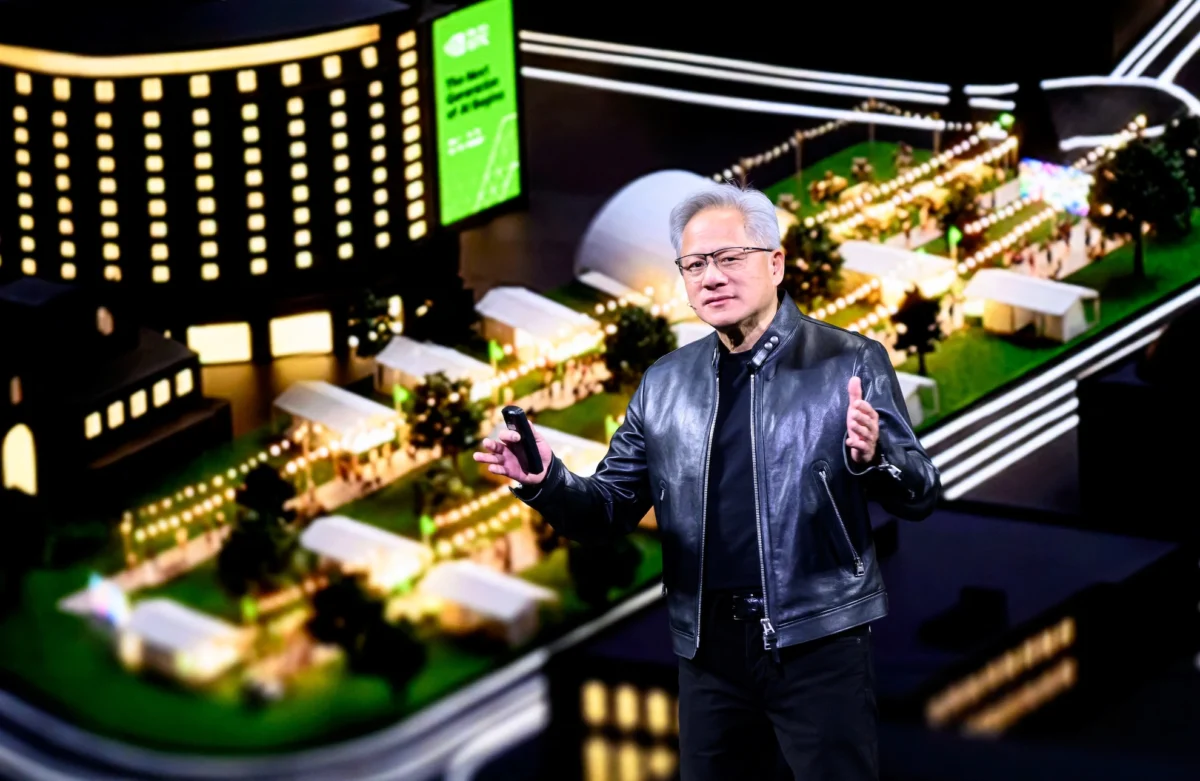
SAN FRANCISCO — In the high-stakes arena of artificial intelligence, few voices carry the commanding weight of Jensen Huang. Speaking before a packed audience of investors, tech executives, and analysts at the Goldman Sachs Communacopia + Technology conference on Thursday, the Nvidia founder, CEO, and chief evangelist delivered a masterclass in corporate optimism.
Amid growing market anxiety regarding intensifying competition, soaring infrastructure costs, and sustainability concerns, Huang doubled down on a staggering projection: Nvidia’s unprecedented revenue streak is not slowing down. In fact, he anticipates the company could achieve a mind-boggling 70% year-over-year revenue growth next year, fueled by a global infrastructure boom that he uniquely positioned Nvidia to foresee, shape, and dominate.
Main Facts: The Anatomy of Nvidia’s Dominance
The core narrative of Huang’s presentation centered on a fundamental misunderstanding that he believes still plagues Wall Street and casual observers alike: the outdated perception of Nvidia as a mere silicon vendor.
- Redefining the "GPU": Huang stressed that Nvidia no longer sells standalone graphics processing units for $399 to PC gamers, a legacy identity the company outgrew years ago. Modern Nvidia hardware is delivered as massive, highly complex computing systems. "One GPU now is not $399. It’s $8.5 million dollars," Huang told attendees. "That’s one GPU, all connected with NVLink, 2 million parts, right? 250,000 kilowatts. That’s a GPU, and we ship thousands of them."
- Massive Financial Guidance: Reaffirming the bold forecasts issued during last month’s record-breaking earnings report, Huang reiterated that Nvidia is on track for jaw-dropping expansion. With analysts projecting the company to close its current fiscal year around $400 billion in revenue, a subsequent 70% jump would push next year’s figures to approximately $680 billion.
- Explosive Product Demand: Highlighting specific enterprise lines, Huang noted that orders for the company’s flagship GB200 NVL72 system—a massive architecture combining 36 Grace CPUs and 72 Blackwell GPUs—are experiencing an extraordinary 27% month-to-month sales growth trajectory.
Despite competitive threats from tech "hyperscalers" (Amazon, Microsoft, and Google developing proprietary silicon), dedicated AI labs (OpenAI and Anthropic building custom chips), and rising hardware startups like Cerebras and Etched, Huang argued that Nvidia remains utterly indispensable.
"Nvidia runs every model. Every single lab can use us," Huang asserted, noting compatibility with systems built by OpenAI, Anthropic, Google, and various open-weight model developers. "We are a foundational platform of the AI ecosystem, foundational platform of the AI industry."
Chronology: From PC Gaming Pioneers to AI Titans
To understand how Nvidia achieved its current stranglehold on the global technology sector, it is helpful to trace the chronological evolution of the company and the modern AI movement:
- The Late 1990s – 2000s (The Gaming Genesis): Nvidia establishes itself as a powerhouse in consumer graphics, inventing the GPU primarily to accelerate 3D rendering for PC video games. Little do consumers know that the parallel processing architecture required for gaming graphics will one day unlock the computational power needed for neural networks.
- The Early 2010s (The Deep Learning Awakening): Researchers discover that Nvidia’s GPUs can drastically accelerate the training of deep learning models. Nvidia pivots early, investing heavily in software ecosystems like CUDA, which allows developers to harness GPUs for general-purpose parallel computing. This software lock-in proves to be Nvidia’s greatest strategic moat.
- 2022 – 2023 (The Generative AI Explosion): The public debut of OpenAI’s ChatGPT triggers a global gold rush. Enterprises, governments, and startups scramble to secure advanced hardware. Nvidia’s H100 and A100 chips become the undisputed gold standard for training large language models (LLMs), catapulting the company into the trillion-dollar market cap club.
- Late 2024 – 2025 (The Blackwell Era and System Sales): Nvidia transitions from shipping individual chips to delivering multi-million-dollar rack-scale server systems like the Blackwell series. Competition begins to mount from both internal corporate chip divisions (hyperscalers) and venture-backed hardware alternatives.
- Thursday at Goldman Sachs (The 70% Growth Declaration): Jensen Huang steps onto the conference stage to forcefully counter the narrative that the AI boom is cooling off, reaffirming hyper-growth targets through the end of next year and offering unprecedented visibility into the global supply chain.
Supporting Data: Tracking Every Gigawatt on Planet Earth
One of the most revealing segments of Huang’s presentation focused on how Nvidia maintains its forward-looking visibility. Rather than relying on standard economic indicators, Nvidia has mapped its business operations directly into the physical infrastructure of the global energy and construction grids.
"We’re tracking every single gigawatt of land, power, shell around the world. Literally everything on the planet," Huang stated, utilizing the industry term "shell" to describe the concrete structures of data centers before server racks are installed.
This macro-level oversight is made possible by Nvidia’s deep integration across the entire technology supply chain:
- The Neoclouds and OEMs: A vast network of specialized cloud providers and original equipment manufacturers constantly report deployment metrics back to Nvidia.
- AI-Native Startups: From early-stage model builders to autonomous agent developers, the broader ecosystem relies on Nvidia hardware, creating a closed-loop feedback mechanism for demand.
- Memory and Logistics: From high-bandwidth memory (HBM) suppliers to specialized shipping logistics ("You need airplanes to ship what we build"), Nvidia maintains a bird’s-eye view of component bottlenecks and production capacities worldwide.
This granular intelligence network gives Huang the confidence to claim that he can "see the future" of enterprise technology demand months—and sometimes years—before it materializes in traditional financial reports.
Official Responses: Addressing the "Circular Financing" Controversy
As Nvidia’s valuation and market reach have expanded, so too have the criticisms. Among the most persistent queries facing the company involve allegations of "circular financing"—a practice where a dominant tech supplier invests heavily in cash-strapped startups or client companies, which then turn around and spend that capital almost exclusively on purchasing the supplier’s products.
Financial historians frequently point to similar financing loops during the telecommunications boom of the late 1990s, which infamously contributed to the collapse of equipment providers like Lucent Technologies.
When pressed on whether Nvidia’s investment strategy mirrors these historical vulnerabilities, Huang offered a characteristically direct, albeit lighthearted, defense.
"Well, it’s not circular because we put a little bit of money in, and a lot of money comes back," Huang quipped, drawing laughter from the Goldman Sachs audience. "I look at the spreadsheet, we put in $1 and $100 comes back in. Is that circular? If that is, let’s do more of that."
Jokes aside, Huang transitioned to a serious defense of Nvidia’s risk management protocols. He insisted that before Nvidia deploys capital into any startup or ecosystem partner, rigorous underwriting is performed to ensure that the recipient company possesses verified, revenue-generating customer contracts.
"I’m not taking any risks," Huang emphasized. "I need a sure thing." According to the CEO, he has personally evaluated $100 billion worth of such underlying customer contracts, ensuring that the capital flowing through Nvidia’s ecosystem is backed by genuine commercial demand rather than speculative circular loops.
Implications: Can Nvidia Defy Gravity Forever?
While Huang’s projections paint a picture of unbridled, long-term prosperity, technology markets operate under historical iron laws. The primary golden rule of the tech sector is simple: all dominant monopolies eventually face disruption, maturation, and margin compression.
Even Huang openly acknowledges the transitional nature of the current market cycle. A substantial portion of today’s immense AI spending is being driven by well-funded AI-native startups that raise billions of venture capital dollars and promptly funnel those funds into cloud compute and Nvidia hardware.
As the artificial intelligence industry matures over the coming years, economic realities will inevitably shift:
- Efficiency Gains: Enterprises and labs will inevitably figure out how to squeeze more performance out of fewer tokens and optimize infrastructure utilization, potentially cooling the ferocious hardware replacement cycle.
- Alternative Architectures: While Nvidia’s software moat (CUDA) remains formidable, alternative processors designed for specific inference workloads—such as those produced by Cerebras, Etched, and custom in-house hyperscaler silicon—will capture slices of the market, particularly as cost-per-inference becomes the primary metric for enterprise buyers.
- Power Constraints: The physical limitations of global electrical grids remain a hard ceiling. As data centers demand gigawatts of power, energy bottlenecks could slow down the physical deployment of Nvidia’s massive server systems regardless of order volume.
For the immediate future, however, Nvidia remains the undisputed tollbooth on the digital frontier. With a finger in every single technological pie—from silicon wafers to data center concrete shells—Jensen Huang and his team are banking on a simple reality: as long as the world continues to race toward artificial general intelligence, every road will lead directly through Nvidia.
Whether that hyper-growth can stretch sustainably toward the $680 billion horizon next year remains the defining question for Wall Street. But if confidence alone could power a GPU, Nvidia would already be running the future.
 rifanmuazin
 Nana Muazin
