

By Sean O’Kane
Published September 20
Main Facts
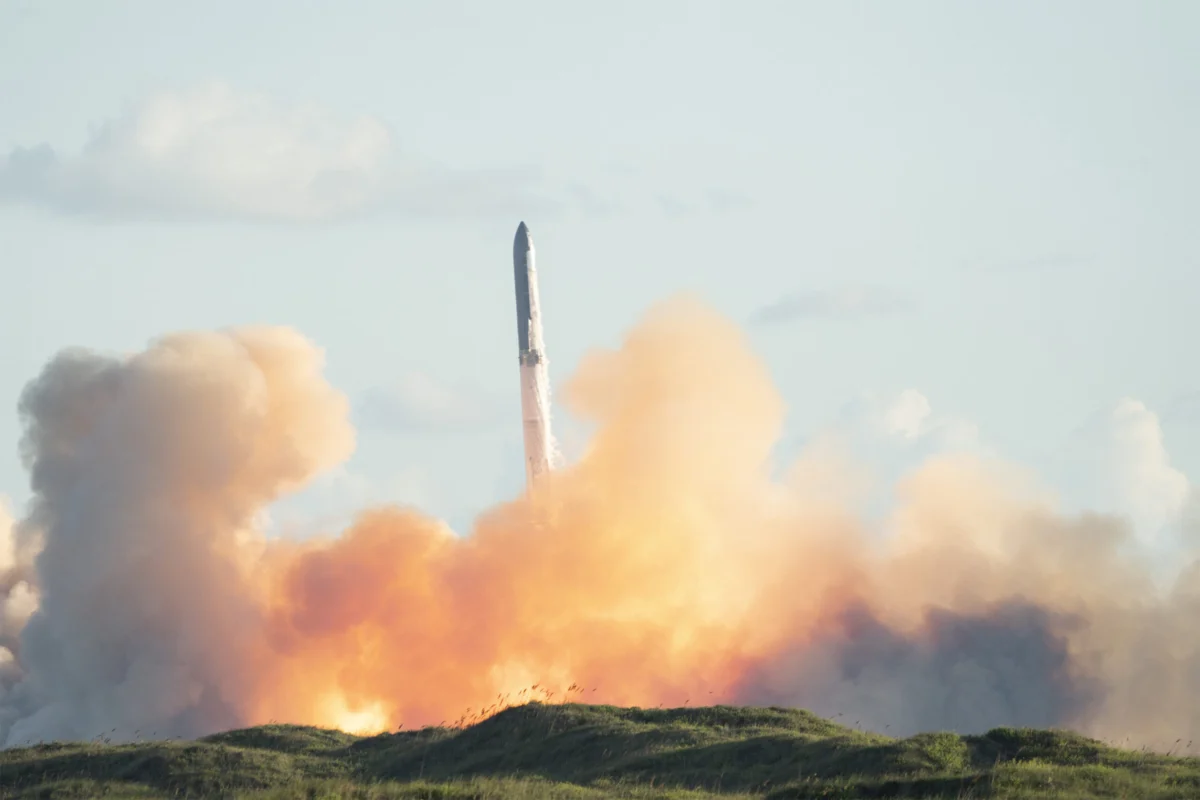
SpaceX is entering a defining moment in its aerospace history. The pioneering private spaceflight company has officially announced that its 14th test flight of the massive Starship mega rocket is scheduled for September 22. The 75-minute launch window will open at 7:15 a.m. CT from the company’s Starbase facility in Boca Chica, Texas.
For the first time in the program’s history, SpaceX will attempt to place Starship’s upper stage into Earth’s orbit. This milestone mission will also carry the first batch of third-generation (V3) Starlink internet satellites into orbit, marking a massive operational transition for the company. SpaceX plans to deploy 26 V3 satellites during the flight, marking a critical step toward populating its next-generation network of 10,000 internet satellites.
If successful, Flight 14 will accomplish several historic benchmarks:
- First Orbital Insertion: It will be the inaugural flight where Starship’s upper stage successfully reaches orbit rather than executing a suborbital trajectory.
- First Revenue-Generating Starship Flight: Although the transaction is internal, the launch division will receive payment from SpaceX’s Starlink division, marking the program’s debut as an economic asset.
- Post-IPO Evolution: This represents the second major test flight since SpaceX completed the largest initial public offering (IPO) in history in June.
However, the mission will not feature full-stack reusability captures. CEO Elon Musk recently confirmed that SpaceX will bypass attempts to catch the Starship upper stage with the launch tower’s "mechazilla" arms, citing the catastrophic risk an explosion would pose to the program at this stage. Additionally, the Super Heavy booster will not be caught, as SpaceX continues to refine hardware and software to resolve persistent engine re-ignition failures experienced during previous flights.
Chronology: The Road to Flight 14
To understand the weight of the upcoming September 22 launch, it is necessary to examine the iterative timeline of the Starship program over the past year, culminating in the post-IPO era.
The Suborbital Foundation (Late 2023 – Early 2026)
For years, SpaceX put Starship through aggressive developmental flight testing, enduring high-profile explosions, structural breakups, and intense regulatory scrutiny. The core objective of these early flights was proving structural integrity during max-Q (maximum aerodynamic pressure), testing hot-staging mechanisms, and mastering controlled ocean splashdowns.
The Historic June IPO
In June, SpaceX crossed a financial Rubicon by going public in the largest initial public offering in corporate history. The massive influx of capital raised public scrutiny and shareholder expectations regarding launch frequency, profitability timelines, and the eventual retirement of the company’s legacy workhorse rockets, the Falcon 9 and Falcon Heavy.
Flight 12 and the July Test (Post-IPO Flight 1)
Following the IPO, SpaceX executed its first post-IPO test flight in July. That mission successfully deployed V3 Starlink satellites for the very first time. However, those payloads were purely functional tests of the deployment mechanism; they were not meant to survive long-term and burned up in the Earth’s atmosphere after roughly 20 minutes.
During that same mission (Flight 13 in the broader sequencing), the Super Heavy booster suffered another engine re-ignition failure after separating from the upper stage. Conversely, the upper stage enjoyed a remarkably smooth flight through a simulated landing profile in the Indian Ocean. Remarkably, the upper stage did not explode when it tipped over into the water. SpaceX recovery teams spent the ensuing weeks capturing, securing, and slowly towing the battered upper stage back to its Texas headquarters for forensic analysis.
The Present: Flight 14 Preparations
Data harvested from the recovered Flight 13 upper stage directly influenced the preparations for Flight 14. Engineers used forensic insights to implement crucial upgrades to Starship’s thermal protection system—specifically the heat shield tiles—to better withstand the brutal thermal loads of orbital re-entry. Furthermore, SpaceX applied a suite of hardware and software modifications to the Super Heavy booster to fix the engine-chill and re-ignition anomalies that plagued the July mission.
Supporting Data and Technical Overview
The engineering metrics surrounding Starship Flight 14 underscore the sheer scale of SpaceX’s ambitions and the technical hurdles the company must clear to satisfy commercial and public market mandates.
Mission Parameters
- Launch Date: September 22
- Launch Window: 75-minute window opening at 7:15 a.m. CT
- Launch Site: Starbase, Boca Chica, Texas
- Primary Objective: First upper-stage orbital insertion and deployment of 26 V3 Starlink internet satellites.
The Fleet Transition: Falcon to Starship
SpaceX has poured billions of dollars into the Starship program with a singular long-term vision: complete obsolescence of its current generation launch vehicles. Founder and CEO Elon Musk has repeatedly stated that the company plans to entirely retire the Falcon 9 and Falcon Heavy rockets once Starship is flying "reliably several times per week."
This transition is driven by economic and engineering necessity. Maintaining parallel production lines for two completely different rocket architectures drains scarce SpaceX engineering and production resources. However, reaching that cadence requires satisfying three interconnected engineering pillars:
- Reliable orbital insertion.
- Controlled, undamaged return to Earth.
- Rapid operational reusability.
While Flight 14 tackles the first pillar (orbital entry), reusability and rapid turnaround remain work-in-progress elements. Musk walked back prior suggestions that the company might attempt to catch the upper stage with the launch tower’s mechanical arms during this flight, noting that an accident of that magnitude would introduce an unacceptable schedule delay for the newly public corporation.
Troubleshooting the Super Heavy Booster
The Super Heavy booster has proven to be one of the most stubborn elements of the heavy-lift system. Despite numerous iterations, the booster struggled to properly re-light its clustered Raptor engines after separating from the Starship upper stage during July’s flight.
In response, SpaceX announced that it has executed "several modifications" to the booster’s plumbing, avionics, and flight software. These updates are specifically engineered to eliminate the propellant-feed anomalies and ignition-transient issues that compromised previous descent profiles.
Official Responses and Industry Context
The stakes for SpaceX have shifted dramatically since the company entered the public markets. No longer shielded entirely by private venture capital cycles and internal risk tolerances, SpaceX now answers to a broad base of institutional and retail shareholders who expect tangible progress toward multi-planetary infrastructure and aggressive commercial revenue streams.
Balancing Innovation and Risk
SpaceX’s engineering philosophy has historically embraced "rapid iterative development through hardware-rich testing"—a mantra that famously normalized rocket explosions as valuable data-gathering events. However, public market realities have forced a subtle calibration of this ethos.
By deciding not to attempt a tower catch of the upper stage on Flight 14, SpaceX is signaling a pragmatic approach to risk management. An orbital insertion success coupled with a controlled ocean splashdown is viewed by leadership as a sufficient victory for this iteration, minimizing the risk of a high-visibility structural disaster at the launch pad.
The Starlink Synergy
The inclusion of 26 V3 Starlink satellites represents the convergence of SpaceX’s two most lucrative business pillars. Starlink has rapidly expanded into a global telecommunications juggernaut, boasting millions of active subscribers across maritime, aviation, enterprise, and residential consumer markets.
To maintain its competitive edge and service 10,000 planned next-generation satellites, SpaceX requires massive volumetric lift capabilities. Falcon 9 can loft batches of earlier-generation satellites, but the sheer size and mass of the V3 architecture demand Starship’s immense payload bay. By using Starship to launch Starlink hardware—and internally billing for those services—SpaceX is validating the internal economic engine that must eventually fund its broader Martian colonization ambitions.
Implications for the Future of Spaceflight
The success or failure of Starship Flight 14 will reverberate far beyond the borders of Starbase, Texas. It carries profound implications for the global space economy, national security launch schedules, and NASA’s lunar ambitions.
1. The Commercialization of Deep Space Infrastructure
If Starship successfully achieves orbit and deploys its payload on September 22, it will silence lingering skepticism regarding the vehicle’s viability as an orbital transport. It transforms Starship from an experimental R&D project into a functioning commercial asset. For investors in SpaceX’s historic IPO, an operational orbital vehicle validates the company’s lofty valuation and clears the path for future interplanetary commercial services, point-to-point Earth travel, and heavy orbital manufacturing.
2. Accelerating NASA’s Artemis Program
NASA has vested immense trust—and billions of dollars—in SpaceX to deliver the Human Landing System (HLS) variant of Starship for the Artemis III mission, which aims to return American astronauts to the lunar surface. For NASA to maintain its timeline, SpaceX must demonstrate the ability to reliably reach orbit, execute orbital propellant transfers (a notoriously complex technological hurdle yet to be tested), and execute precision landings. Flight 14’s orbital attempt is an indispensable stepping stone toward proving out the foundational mechanics required for lunar operations.
3. The Twilight of Falcon
The retirement of the Falcon 9 and Falcon Heavy will mark the end of an era that fundamentally disrupted the global aerospace industry by introducing routine first-stage reusability. Yet, Falcon’s workhorse capabilities are ultimately capped by physics and fairing volume. If Starship achieves the "several times per week" flight cadence promised by Musk, humanity will enter an era of unprecedented mass-to-orbit capability—slashing launch costs by orders of magnitude and permanently altering humanity’s relationship with space.
All eyes will turn to Boca Chica on September 22 as SpaceX counts down to a launch window that could finally bridge the gap between heavy-lift ambition and orbital reality.
 rifanmuazin
 Nana Muazin
