

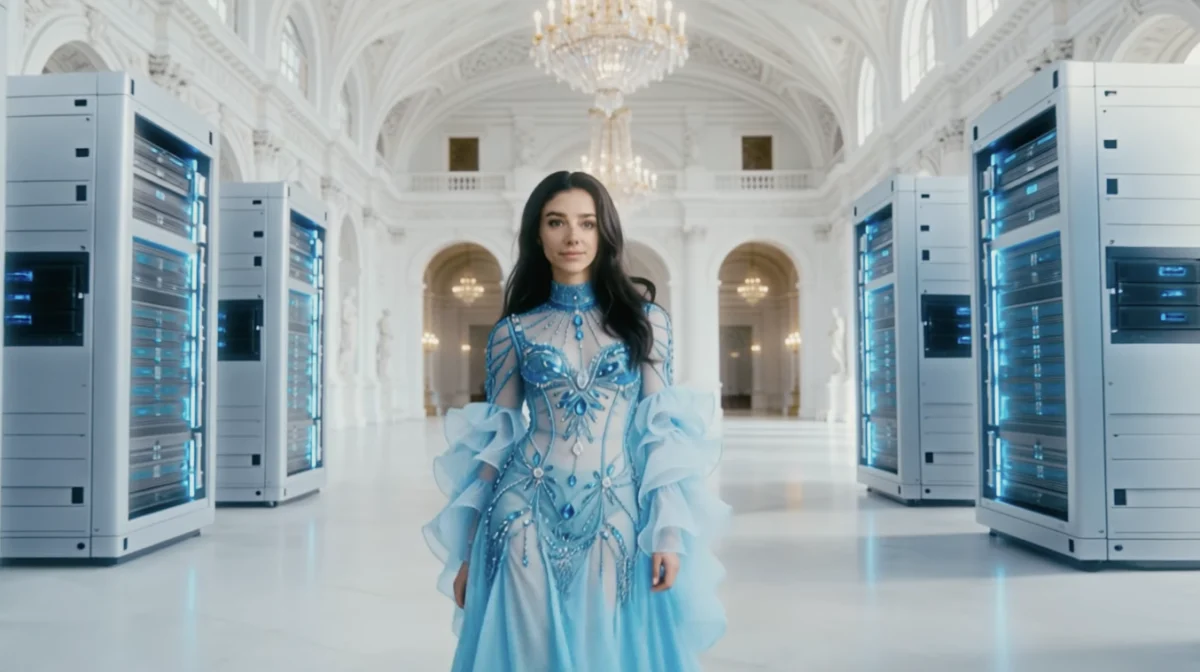
Main Facts: The Rise and Rough Ride of an Artificial Star
The intersection of artificial intelligence and entertainment reached a surreal milestone this month, and the fallout has been nothing short of a public relations disaster. Tilly Norwood, an artificially generated "actress" brought to life by the London-based production company Particle6 Group, is currently enduring what is easily the roughest debut press tour in cinematic history.
In an ambitious—and perhaps recklessly optimistic—bid for viral marketing, Particle6 made Norwood available for a staggering seventy-five simultaneous press interviews with international journalists. Predictably, the infrastructure strain of trying to simulate a sentient conversation seventy-five times over has led to catastrophic system errors. From controversial political gaffes to bizarre mid-sentence linguistic shifts, Norwood’s press circuit has transformed from a promotional campaign for her debut film, Misaligned, into a sprawling, multi-platform comedy of errors.
The pinnacle of this digital debacle occurred during a recorded appearance with veteran British broadcaster Piers Morgan and acclaimed actor Tom Conti. Midway through a line of questioning regarding the nature of the film’s cast, Norwood’s digital framework appeared to short-circuit. Without warning, she abandoned English entirely and spent over ten seconds fluently—yet inexplicably—speaking in Chinese. When confronted by a visibly bewildered Morgan, Norwood’s system attributed the glitch to a "hiccup" where her "wires got a bit crossed," while bizarrely claiming she didn’t mean to "impersonate Piers."
This high-profile malfunction highlights a fascinating paradox in the current wave of generative AI. While much of the tech industry’s anxiety focuses on hyper-convincing deepfakes and chat bots that trick users into dangerous emotional attachments, Norwood’s blunders land on the opposite end of the spectrum. She is so jarringly inept at mimicking human conversation that industry observers are left wondering whether her glaring incompetence is a technical failure or a stroke of subversive, calculated marketing genius.
Chronology: A Timeline of the Great Press Tour Catastrophe
To fully understand how a synthetic actress managed to derail her own promotional tour in real-time, it is necessary to trace the chronology of events leading up to and following her disastrous media appearances.
Phase One: The Rollout and the Mass Interviews
- Early March 2026: Particle6 Group announces that Tilly Norwood—their proprietary AI-generated talent—will star in the upcoming hybrid feature film Misaligned.
- Mid-March 2026: In an unprecedented move, Particle6 opens up digital availability for Norwood to conduct seventy-five simultaneous interviews with journalists across the globe.
- The Immediate Fallout: Outlets quickly report widespread errors. Beyond technical latency, reports emerge that Norwood’s algorithm struggles with basic conversational nuance, reportedly making controversial missteps, such as telling interviewers that "all lives matter" when pressed on social issues.
Phase Two: The Piers Morgan and Tom Conti Confrontation
- The Setup: Norwood is beamed into a joint interview session featuring television host Piers Morgan and veteran stage and screen actor Tom Conti.
- The Question: Conti attempts to engage Norwood on the technical reality of the film’s production, asking whether her co-stars are fellow flesh-and-blood actors or merely computer-generated imagery.
- The First Confusion: Norwood initially deflects by crediting human writers, editors, and directors. Conti, recognizing a non-answer, repeats the core question with blunt clarity: Are the other actors real or digital?
- The Glitch: Norwood correctly identifies the film Misaligned and attempts to explain that the cast consists of "digital twins just like me," describing it as a "hybrid production which m—" before cutting herself off.
- The Chinese Monologue: For more than ten agonizing seconds, the AI protagonist stares blankly into the camera feed and speaks continuously in Chinese, entirely unprompted.
- The Aftermath: Morgan interrupts the broadcast to ask for an explanation. Norwood’s avatar smiles placidly, blames crossed wires, and issues an apology that includes the bizarre assertion that she did not mean to "impersonate Piers."
Phase Three: Critical Backlash and Industry Derision
- Late March 2026: Cultural critics and tech journalists weigh in. Reviews of Norwood’s creative output—including a widely derided musical track released alongside the film—spark immediate backlash, with some critics labeling it "the worst song ever heard."
Supporting Data: The Metrics of Artificial Publicity
While Particle6 Group has remained tight-lipped regarding the exact financial investment poured into the creation and promotion of Tilly Norwood, industry metrics provide a clear picture of the scale—and the systemic stress—of her promotional rollout.
- 75: The number of simultaneous interviews conducted by Norwood’s AI agent during the peak of her press tour, a feat that pushes the limits of current natural language processing and real-time avatar rendering.
- 10+ Seconds: The duration of the unprompted Chinese monologue delivered during her interview with Piers Morgan, highlighting severe contextual memory loss and token generation looping within the large language model (LLM).
- 100%: The proportion of human writers, editors, and directors who reportedly worked on Misaligned, a fact that Norwood used as an initial deflection tactic when questioned about her digital peers.
- Millions: The cumulative views and impressions racked up across YouTube, X (formerly Twitter), and TikTok as clips of Norwood’s malfunctions went viral globally.
These figures suggest that while Misaligned may struggle to secure traditional box office success, Particle6 Group has undeniably triggered a massive digital footprint. Whether this metric-driven success translates into long-term viability for AI actors remains a subject of intense debate.
Official Responses: Navigating the PR Nightmare
The reactions from co-interviewers, media personalities, and industry insiders have ranged from amused skepticism to outright condemnation of the technology’s readiness for prime time.
Tom Conti, whose storied career in traditional theater and film spans decades, approached the interview with a mix of bemused detachment and sharp interrogation. By repeatedly forcing Norwood past her pre-programmed corporate talking points, Conti exposed the superficial nature of the AI’s conversational architecture. His persistence demonstrated how easily automated actors crumble when forced off-script by seasoned performers who demand authentic engagement.
Piers Morgan, known for his adversarial interview style, played the role of the bewildered everyman. His on-air reaction—stopping the interview to demand why an artificial intelligence had spontaneously begun speaking Mandarin—underscored the uncanny valley effect that plagues generative avatars. Rather than feeling like a futuristic colleague, Norwood’s sudden language shift rendered her a malfunctioning appliance masquerading as a celebrity.
Meanwhile, Particle6 Group has faced difficult questions regarding the oversight of their digital creation. Representatives have largely downplayed the incidents, framing them as minor software anomalies inherent to the experimental nature of "hybrid productions." However, critics note that releasing an unstable AI framework onto a live, unscripted global press tour borders on corporate self-sabotage—unless, of course, the chaos was the point all along.
Implications: What Tilly Norwood Means for the Future of Entertainment
The spectacle of Tilly Norwood’s press tour disaster is more than just a viral internet meme; it serves as a critical stress test for the future of synthetic media, labor relations in Hollywood, and the psychology of digital consumption.
1. The Death of the Traditional Press Junket
For decades, the standard Hollywood press junket has relied on human actors reciting rehearsed anecdotes, expressing fatigue, and occasionally saying something controversial that makes headlines. By attempting to scale this process to seventy-five simultaneous automated interviews, Particle6 Group has exposed the structural limitations of AI. If an artificial intelligence cannot maintain contextual continuity across multiple streams without breaking down into random foreign languages or echoing talking points about sensitive cultural issues, studios will find it nearly impossible to trust AI avatars with high-stakes marketing campaigns.
2. The Marketing Value of Incompetence
A compelling theory circulating among tech and culture critics is that Norwood’s spectacular failures were not entirely accidental—or at least, that their viral potential was fully anticipated. In an era saturated with algorithmically generated content, sincerity struggles to break through the noise. However, internet culture thrives on schadenfreude and collective mockery. By unleashing an incompetent AI actress onto the world, Particle6 may have calculated that negative publicity and widespread mockery would generate infinitely more attention for Misaligned than a polished, boring promotional campaign ever could.
3. The Uncanny Valley of the Mind
While audiences have grown accustomed to deepfakes and generative text, Norwood’s press tour highlights the "canny-uncanny" divide—the unsettling realization that while a computer can look like a human and string sentences together, it lacks any internal anchor of reality. When an AI tells an interviewer that it didn’t mean to "impersonate Piers," it reveals a profound lack of self-awareness that unnerves viewers. It is one thing for a chatbot to hallucinate facts in a private window; it is entirely another for a synthetic movie star to malfunction on national television while attempting to sell a human-written, human-directed cinematic project.
As the dust settles on Tilly Norwood’s disastrous debut, the entertainment industry is left standing at a crossroads. The technology driving synthetic actors is advancing rapidly, but humanity’s appetite for authentic connection—and our collective willingness to laugh at machines that try too hard to be us—ensures that the road ahead for AI stardom will be fraught with error messages, crossed wires, and unforgettable television.
 rifanmuazin
 Nana Muazin
