

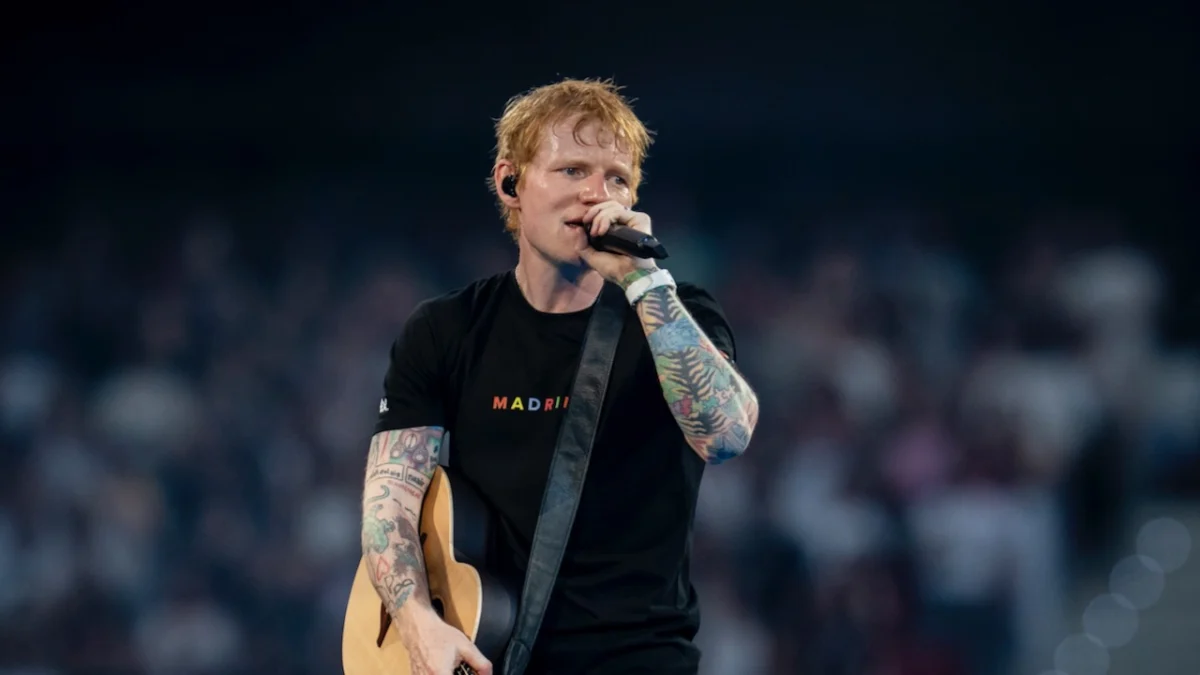
PHILADELPHIA — Taking the stage at his Saturday night concert in Philadelphia, British pop superstar Ed Sheeran delivered a deeply personal and unscripted opening monologue, addressing a week of unprecedented turmoil that has engulfed his current tour. The controversy, fueled by political tensions, free-speech debates, and the Israel-Hamas war, forced the singer into the center of a global flashpoint, resulting in canceled supporting acts, venue ultimatums, and intense public scrutiny.
Saturday’s show marked Sheeran’s first performance since Seattle rapper Macklemore was abruptly dropped from the tour following fierce opposition from stadium operators. The situation escalated rapidly over the past week, triggering a wave of solidarity walkouts, sparking fierce debates over artist censorship, and compelling Sheeran to publicly define his own stance on the ongoing humanitarian crisis in the Middle East.
Main Facts: The Tour in Crisis
The storm surrounding Sheeran’s tour reached a boiling point when Macklemore was removed as a supporting act. The decision came after several major stadium operators—spearheaded by New England Patriots owner Robert Kraft—objected to Macklemore’s past public statements in support of Palestine. Venue authorities threatened to block the rapper from performing, leaving tour organizers with little operational choice if the stadium dates were to proceed.
The fallout was immediate and severe. In a show of solidarity with Macklemore and the Palestinian cause, the remainder of Sheeran’s supporting lineup—consisting of FINNEAS, Lukas Graham, and Aaron Rowe—alongside his live backing band, Beoga, withdrew from the tour en masse.
Left as the sole remaining act, Sheeran faced a daunting choice: cancel the remainder of the tour or take the stage alone. Choosing the latter, the singer used his Philadelphia platform to confront the controversy head-on, offering a transparent glimpse into the difficult decisions, public mistakes, and complex realities that have defined his career over the past seven days.
Chronology of Events
The sequence of events leading up to Saturday’s emotional address unfolded rapidly over a tumultuous week:
- The Catalyst: Macklemore’s outspoken support for Palestine drew sharp criticism from prominent entertainment figures and venue stakeholders, culminating in threats from stadium operators to bar him from upcoming concert dates.
- The Removal: Under mounting pressure from venue executives, including Robert Kraft, tour organizers formally removed Macklemore from the bill.
- The Boycott: Within 48 hours of Macklemore’s removal, supporting artists FINNEAS, Lukas Graham, and Aaron Rowe, as well as Sheeran’s backing band Beoga, announced their withdrawal from the tour in protest.
- The Philadelphia Show: Taking the stage on Saturday night, Sheeran bypassed his traditional opening routines to deliver a heartfelt, comprehensive address to the Philadelphia audience before performing a single song.
- Logistical Fallout: Later in the evening, Sheeran revealed that mounting security concerns had also forced production teams to alter the concert’s stage setup.
Supporting Data and Financial Commitments
Behind the political rhetoric and artistic boycotts lie significant financial and humanitarian figures tied to the region:
- $4 Million Joint Pledge: In an effort to translate dialogue into action, Sheeran has secured a $2 million commitment from Robert Kraft for humanitarian aid directed at victims of the conflict. This matches Sheeran’s own separate $2 million pledge.
- Mass Exodus of Talent: The tour lost four distinct musical entities—three solo/group acts and one primary backing band—representing a historic level of artist walkout on a major pop tour.
- Global Reach: The dispute touches venues across multiple international jurisdictions, highlighting a growing tension between touring artists, corporate venue owners, and political expression.
Official Responses and On-Stage Admittances
Stepping up to the microphone in Philadelphia, Sheeran acknowledged the gravity of the moment, offering an apology for the disruptions while staunchly defending his right—and obligation—to perform for his fans.
"This is not usually how I would open the show, but before I play some songs tonight, I hope it’s okay if I say a few words about this last week," Sheeran told the packed stadium. "I’m used to my music being criticized, and I’m always happy to take that because I’m lucky a lot of you like my stuff, and to be honest, I’m surprised. I’m not surprised that other people don’t. It’s normal. But this week, the criticism was about something much more important, and I’ve had to take and make difficult decisions, and I am making mistakes, and I’m so, so sorry."
He continued by addressing the tightrope walk of balancing global politics with his profession. "I don’t want to disappoint fans, and I’ve never wanted to be an activist musician, but this has put me in the middle of an important and passionate argument about freedom of speech and the most complex political issue on the planet."
Sheeran emphasized that his concerts have traditionally striven to be safe, inclusive spaces. "Honoring my commitment to my fans is also completely central to who I am, and that is why I’m here tonight on my own and continuing my current tour."
On Venue Censorship and Free Speech
Turning his attention to the corporate policies governing modern live entertainment, Sheeran voiced deep unease regarding pre-approval mandates for artistic content.
"I am deeply worried about the idea that venues should pre-approve content for performance," Sheeran stated. "This happens in so many places that I perform around the world, but it should never happen in the free world."
Addressing Israel, Palestine, and Gaza
Perhaps the most anticipated portion of his speech centered on his personal geopolitical stance, a domain the singer has historically avoided.
"I have tried in my career not to be a political commentator of any kind because I want my music and shows to be about unity, not division—about humanity, not politics. But this is a humanitarian issue, and I cannot hide how I feel about it anymore," he declared.
Addressing the violence across the spectrum, Sheeran did not mince words: "What happened in Israel at the Nova music festival on October 7th was horrific and compounded centuries of Jewish pain. What is happening in Gaza is catastrophic, unjustifiable, and disproportionate. My heart has been broken by the scale of devastation and loss of civilians’ lives, of children’s lives. And the systemic injustice we’re seeing unfold in the West Bank cannot be overlooked."
Detailing his path forward, Sheeran admitted he is still learning. "I am already speaking to people across the spectrum to work out how to make a contribution that helps victims of these terrible times, and listening and learning because I do not know enough."
Implications for the Live Music Industry
The fallout from the Philadelphia concert extends far beyond a single tour, signaling a potential turning point for how major artists, venue owners, and corporate sponsors interact.
1. The Erosion of Neutrality in Live Entertainment
For decades, major pop tours have operated under the assumption that music can transcend geopolitical divides. Sheeran’s experience proves that in an era of hyper-connected, polarized global discourse, absolute neutrality has become nearly impossible to maintain. When venue operators—who control the vital infrastructure of arenas and stadiums—begin exercising veto power over the political speech or historical associations of supporting acts, headliners are inevitably forced to choose sides.
2. The Precedent of Venue Pre-Approval
Sheeran’s explicit warning regarding venues "pre-approving content" highlights a chilling effect on artistic expression. If stadium operators can successfully lobby to remove artists based on past political statements, it sets a legal and operational precedent where corporate entities dictate the ideological boundaries of live performance. This development threatens not only politically active musicians but the foundational principles of free expression within the entertainment industry.
3. Solidarity and the Power of the Support Act
The decision by FINNEAS, Lukas Graham, Aaron Rowe, and Beoga to walk away from a lucrative tour demonstrates a shifting solidarity among contemporary musicians. Rather than remaining silent to protect career momentum, supporting acts are increasingly willing to sacrifice commercial opportunities to align with broader human rights causes. This dynamic complicates how major tours will be booked and managed in the future, as headliners must now weigh the political alignments of their entire touring ecosystem.
Conclusion: Music as a Common Ground
Despite the turbulence, Sheeran attempted to steer the evening back toward his core message of communal connection. As he prepared to launch into his set—now stripped of its original supporting roster and modified due to heightened security protocols—he urged the audience to find common ground through song.
"This concert is still a place where everyone is welcome, and everyone here can stand beside people that have opposing views," Sheeran concluded. "Everyone here can stand by people that they don’t agree with on everything, and they can all agree on singing these songs. And these songs are about love, hope, and unity."
As the tour moves forward into its next phases, the events in Philadelphia will undoubtedly serve as a watershed moment—redefining the responsibilities of global superstars, testing the limits of corporate-controlled venues, and permanently altering the intersection of pop music and geopolitics.
 Nana Wu
 Siti Muinah
