

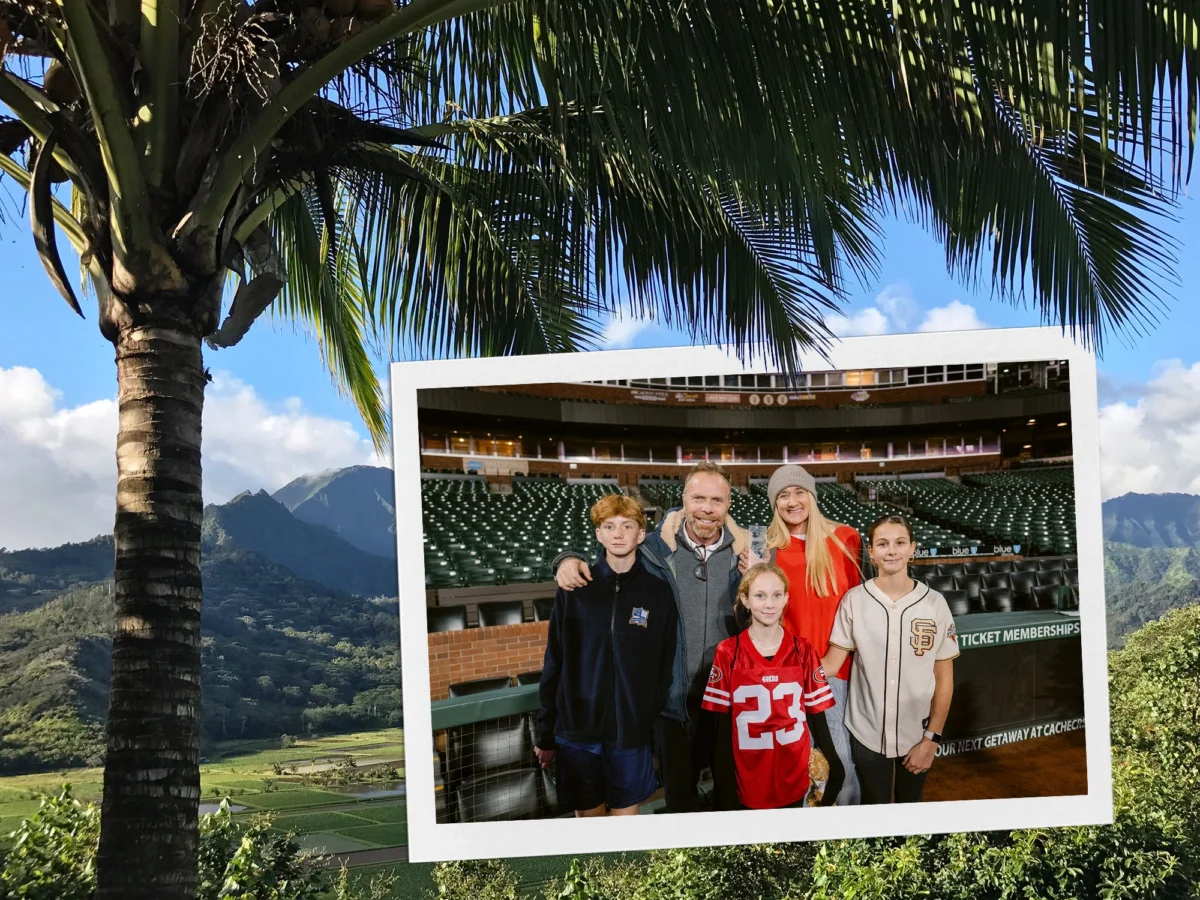
For three-time Olympic gold medalist Kerri Walsh Jennings, the beach has historically served as a battlefield. It is a place of grit, sweat, high-stakes competition, and the relentless pressure of performing under a global spotlight. Throughout a storied career that saw her become one of the most recognizable faces in beach volleyball, the sand was an instrument of labor. However, a recent family retreat to the lush, volcanic shores of Kauai offered a paradigm shift for the athlete: it taught her how to be fully present for no reason at all.
Main Facts: A Shift in Perspective
The Walsh Jennings family—Kerri, her husband Casey, and their three teenagers, Joey (17), Sundance (16), and Scout (13)—recently traveled to Kauai, a destination deeply embedded in the family’s personal history. Having honeymooned on the island in 2005, the couple had returned several times, but this specific journey marked a transition.
As their children approach adulthood, the Walsh Jenningses recognize that the "childhood window"—those fleeting years when family travel is simple and assumed—is closing. The trip was less about a vacation and more about intentional reconnection. While Walsh Jennings’ life is typically defined by the rigid logistics of elite athletics, school schedules, and training cycles, the island served as a sanctuary where the machinery of a high-performance life could be dismantled, if only for a few days.
Chronology of a Disconnected Connection
The journey began with an intentional descent into the island’s rhythm. Upon arrival, the family eschewed the typical "tourist checklist." Instead, the first evening was spent in silent observation as the Kauai sky shifted through colors that seem unique to the Pacific.

In an era defined by digital distractions, the most striking aspect of their first night was the absence of technology. No one reached for a phone; there was no agenda to satisfy. This set the tone for the week. The days followed a loose, organic structure:
- Morning Rituals: The family prioritized slow starts, beginning with coffee on the balcony while watching the island wake up.
- Exploration: The teenagers, often stereotyped as needing distance from their parents, surprised Walsh Jennings by leaning in. They hunted for hidden beaches, surfed the waves of Hanalei Bay, and sought out the island’s best shaved ice spots.
- Evening Rhythms: Every night culminated in a sunset walk—a ritual that functioned as a daily bookend to their shared experiences.
Supporting Data: The Science of "Slow Travel"
While the Walsh Jennings family intuitively sought a slower pace, their experience mirrors a growing body of research regarding the psychological benefits of "slow travel." Experts in family dynamics and psychology suggest that removing the stimuli of modern urban environments allows for a "reset" of the nervous system.
For high-achieving families, the transition from a schedule-heavy home life to an unstructured environment is often difficult. However, the data supports Walsh Jennings’ observation: when the "machinery" of life is paused, the cortisol levels associated with constant scheduling drop. The island’s topography—defined by dramatic cliffs, dense rainforests, and the vast expanse of the ocean—acts as a sensory anchor. By forcing the brain to process the awe of nature, families often find that they stop thinking about the future or the past and settle into the present.
Official Perspectives: The Value of Witnessing
Walsh Jennings, in reflecting on the trip, emphasized that the most valuable commodity was not the destination itself, but the act of witnessing.

"So much of daily life as a parent is logistics, managing, and scheduling," she noted. "There’s rarely time to stop and witness who your children are actually becoming."
This perspective highlights a critical tension in modern parenting: the struggle to balance the "doing" of life with the "being." For an Olympian, whose identity is often tied to outcomes and medals, the ability to pivot to a state of non-performance is a significant accomplishment. She describes the teenagers’ evolving characters—their humor, their kindness, and their curiosity—as the real treasures of the trip, far exceeding any athletic achievement she has garnered in her professional life.
The Conversations That Only Happen in Paradise
Perhaps the most profound implication of the trip was the depth of the conversations that emerged. Walsh Jennings observed that when the "usual distractions" are removed, the defenses that teenagers and parents typically put up begin to lower.
Without the ping of notifications or the looming stress of the next practice, the family engaged in organic, deep-seated dialogues. They discussed the complexities of growing up, the nature of personal purpose, and their individual and collective identities. It was an "unfolding conversation," as she described it, that served to bridge the growing gap between adolescence and adulthood. The island’s wild, unhurried nature created a safe harbor for this honesty, proving that environment is a crucial factor in the quality of family communication.

Implications for Families and Future Travel
The Walsh Jennings experience serves as a blueprint for families navigating the challenging waters of the teenage years. Her advice is starkly simple: "Just book it."
However, the efficacy of her advice lies in the execution:
- Less is More: By refusing to over-schedule, families allow space for spontaneous connection.
- Digital Detoxing: The removal of phones is non-negotiable for the kind of presence she describes.
- Prioritizing Presence: The goal of travel should be to observe the children, not to manage them.
The implications for travel culture are clear. As global travel becomes increasingly curated and "Instagrammable," there is a counter-movement toward reclaiming the "sacred" in travel—seeking locations that offer resonance rather than just scenery.
For the Walsh Jennings family, Kauai was not just a destination; it was a catalyst for a recalibration of their family unit. They learned that while the world moves fast, and while their children are rapidly accelerating toward independence, there is still time to build a foundation of shared memory.

In the final assessment, Kerri Walsh Jennings—a woman who has spent her life chasing gold—found something far more valuable on the shores of Kauai: the realization that the most precious, sacred moments in life are not the ones we win, but the ones we choose to be present for. As she put it, "Those moments go by so quickly, and they’re all precious, truly sacred. That’s the real gold."
This trip, then, stands as a testament to the idea that in a world of constant noise, the greatest luxury is a quiet, undistracted moment with the people who matter most. Whether in Kauai or elsewhere, the lesson remains the same: the rhythm of the ocean, the silence of the mountains, and the simple act of sitting with one’s family are the ultimate antidotes to the pressures of a modern, high-performance life.
 Basiran
 Nana
Nana
 Nana Muazin
