

Introduction and Main Facts
Saturday Night Live (SNL) officially entered its landmark 52nd season with a high-profile pairing: New York Knicks superstar and NBA champion Jalen Brunson serving as host, alongside rising global pop sensations KATSEYE as the musical guest. Stepping onto the storied stage of Studio 8H is a daunting task for even the most seasoned actors and comedians; for a professional athlete anchoring a season premiere, the pressure is magnified exponentially.
While optimistic Knicks fans and sports commentators maintained that Brunson’s charismatic locker-room leadership and media savviness would seamlessly translate to live sketch comedy, the reality of the two-hour broadcast proved far more complicated. By the time the goodnights rolled around, those initial doubts regarding Brunson’s ability to shoulder the weight of an entire live season opener felt largely validated.
Although Brunson was visibly game for whatever the writers threw his way—throwing himself wholeheartedly into physical comedy and sports-centric parodies—the SNL writing staff leaned far too heavily into sports-themed material. These sketches rarely landed with the broader audience, quickly growing repetitive and exhausting the episode’s comedic momentum. Compounding the evening’s uneven tone, the musical performances by KATSEYE suffered from sluggish choreography and heavy reliance on backing tracks, leaving critics wanting more authenticity from the pop group.
Yet, despite an overall sluggish script and a reliance on low-hanging fruit, the premiere was far from a total loss. The episode’s genuine bright spots came almost exclusively from the show’s ensemble cast and recurring players. Veteran standout Ashley Padilla once again demonstrated why she has quietly become the most valuable player of the current cast, while newcomer Grace Reiter made an immediate, confident debut that turned heads. Additionally, the return of Jeremy Culhane as Tucker Carlson provided a much-needed satirical bite during the Weekend Update segment.
Chronology of the Episode
To understand how the Season 52 premiere unfolded, it is necessary to examine the beat-by-beat progression of the broadcast, tracing how the energetic opening momentum gradually gave way to a mixed bag of recurring tropes and surprising highlights.
The Cold Open and Monologue
The evening began with a political cold open that tackled current headlines, setting the table for the live audience before tossing it to Jalen Brunson for his opening monologue. Dressed sharply and radiating the cool confidence of a New York sports hero, Brunson leaned heavily into his identity as a Knick. He addressed the elephant in the room—his lack of acting experience—with self-deprecating humor, drawing cheers from the studio crowd. However, the monologue quickly drifted into predictable territory, relying on standard "athlete trying to act" meta-humor rather than breaking new comedic ground.
Early Sketches: Leaning Too Hard on the Hardwood
Following the monologue, the episode dove headfirst into a sequence of sports-related sketches. The writing staff, seemingly eager to capitalize on Brunson’s athletic pedigree, constructed multiple scenarios involving basketball courts, locker rooms, and athletic competition.
- The High School Musical Parody: In this segment, Brunson played a heavily exaggerated version of himself crashing a Disney-esque musical theater rehearsal. While the visual gag of an NBA champion dominating teenagers in a sing-off had initial comedic potential, the sketch dragged on, recycling the same core joke for far too long.
- Men’s Support Group: A slightly more grounded sketch featured a circle of beleaguered men commiserating over their partners attending massive stadium pop tours. The line, "All I’m saying is this kind of stuff doesn’t happen at the Noah Kahan concert," resonated well with the audience, offering a brief glimpse of relatable, character-driven humor amidst the sports clutter.
The Mid-Show Slump and Musical Interludes
As the middle of the episode approached, the pacing visibly stuttered. KATSEYE took to the stage for their first major performance of the night. Unfortunately, the debut felt lackluster; the choreography lacked the crisp synchronization expected of modern pop acts, and audio cues suggested an over-reliance on lip-syncing.
The sketches immediately following the musical break struggled to recapture the audience’s attention. A mock-reality television segment titled Dream Academy Season Two was ostensibly designed to showcase KATSEYE’s crossover appeal into comedy, but it was ultimately rescued from irrelevance by the scene-stealing debut of new cast member Grace Reiter, whose deadpan delivery injected vital energy back into the studio.
The Late-Night Surge: Physical Comedy and Weekend Update
The latter half of the episode finally delivered the memorable comedic beats fans expect from a premier episode.
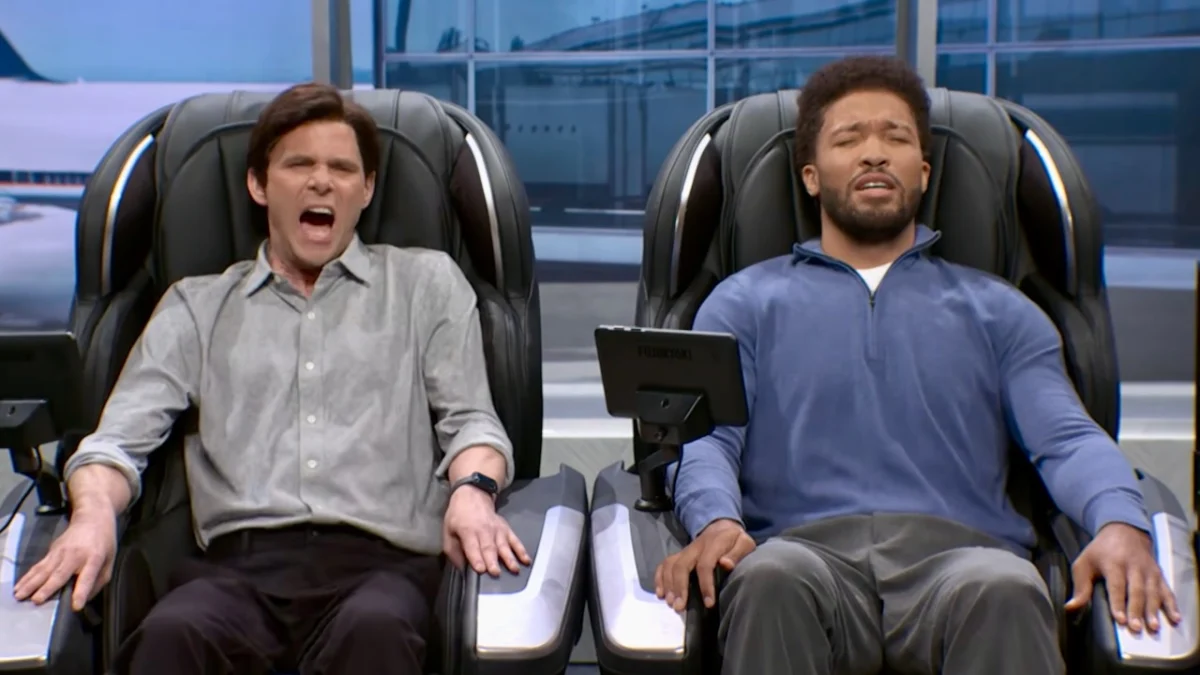
- Airport Massage Chairs: One of the undisputed highlights of the night involved Mikey Day and Jalen Brunson occupying side-by-side public massage chairs in an airport terminal. Day committed fearlessly to an absurdly uncomfortable bit involving a simulated, highly vocal public climax, while Brunson stood mere feet away, fighting a visible, heroic battle not to break character and laugh on live television.
- Weekend Update and Tucker Carlson: Anchors Colin Jost and Michael Che delivered a sharp string of jokes addressing summer news cycles before tossing the desk over to Jeremy Culhane. Reprising his impression of political commentator Tucker Carlson, Culhane delivered a blistering critique/review of the summer’s biggest Hollywood blockbusters, blending deadpan absurdity with spot-on vocal cadence.
Supporting Data and Cast Performance Breakdown
While Jalen Brunson’s hosting stint yielded mixed results, the structural integrity of the episode relied heavily on the resilience of the SNL repertory players. An analytical breakdown of the episode highlights where the comedic labor was concentrated.
Cast Standouts
- Ashley Padilla: Continuing her trajectory from previous seasons, Padilla anchored several sketches with a chameleon-like ability to adapt to any character. Whether playing the exasperated spouse or the bewildered straight-woman, Padilla’s timing remained immaculate, anchoring flimsy premise sketches with grounded realism.
- Grace Reiter: Making her first-ever appearance on the Studio 8H stage, Reiter did not waste a single second of screen time. Her performance in the Dream Academy sketch proved that she possesses the instinctive poise required to hold her own alongside veteran cast members and high-profile guests alike. Her confidence suggests she will be a major utility player for the remainder of Season 52.
- Mikey Day: Day remains the undisputed king of physical absurdity on the cast. His commitment to the airport massage chair sketch—pushing the envelope of what is broadcast on network television—salvaged a late-night slot that otherwise could have easily fallen flat.
Statistical and Structural Observations
- Host Screen Time: Brunson appeared in roughly 75% of the night’s sketches, an unusually high volume for a non-actor host. This heavy utilization exposed the limitations of writing tailored specifically to an athlete’s comfort zone rather than stretching the format into varied comedic territory.
- Musical Guest Reception: Social media sentiment analysis immediately following KATSEYE’s performances reflected the broadcast critique: viewers widely noted the disjointed audio-visual synchronization, leading to widespread online discussions regarding the current state of live pop vocal performances on late-night television.
Official Responses and Industry Reactions
Following the conclusion of the live broadcast, television critics, sports analysts, and social media commentators weighed in on the premiere. The consensus was notably polarized, dividing viewers along sports-fan and traditional-comedy lines.
Late-night television critics noted that booking athletes is a high-risk, high-reward strategy that SNL has historically relied upon. Past successful hosting stints by sports icons like Peyton Manning, Charles Barkley, and Michael Jordan set a high bar. Industry analysts pointed out that while Brunson possesses undeniable charisma and a natural likability, the writers failed to build a protective infrastructure around him, opting instead to place him in repetitive, one-note sports parodies rather than showcasing his potential in slice-of-life or absurdist character sketches.
Representatives for Saturday Night Live and NBC declined to comment directly on the critical reception of the episode’s writing choices, pointing instead to the strong social media engagement generated by clips like the airport massage chair sketch and Jeremy Culhane’s Tucker Carlson segment. Meanwhile, KATSEYE’s management released a brief statement thanking the show for the opportunity, though they did not directly address the online chatter concerning the vocal tracking of their performances.
On sports networks and podcasts, the reaction was largely protective of the Knicks star. Analysts argued that Brunson did his absolute best with the material provided, noting that an athlete should not be held accountable for a script that leaned too heavily on predictable athletic tropes rather than exploring fresh comedic angles.
Implications for Season 52
The premiere of Season 52 carries significant implications for the direction of the long-running NBC institution as it navigates an evolving media landscape.
1. The Pressure on the Writers’ Room
The over-reliance on sports sketches in the premiere signals a potential creative fatigue or an over-correction in how the writing staff approaches non-traditional hosts. Moving forward, the showrunners will need to diversify their approach. If Season 52 is to maintain its cultural relevance and sharp edge, the writing room must resist the temptation to pigeonhole celebrity guests into narrow, predictable archetypes based on their day jobs.
2. The Rise of a New Generation
Perhaps the most encouraging implication of the premiere is the seamless integration of newer cast members like Grace Reiter and the continued ascendancy of Ashley Padilla. As veteran cast members gradually transition away from the show in recent years, the burden of carrying the franchise falls squarely on the shoulders of this new cohort. Their ability to elevate weak material—as seen multiple times during the premiere—proves that the farm system of SNL remains robust, even when individual episodes stumble.
3. The Live Television Experiment in the Age of Social Media
The intense online scrutiny regarding KATSEYE’s performance highlights the unique pressure modern musical guests face on SNL. In an era where every musical cue, vocal pitch, and dance step is instantly clipped, analyzed, and critiqued across TikTok, X (formerly Twitter), and YouTube within seconds of airing, the margin for error is razor-thin. Producers will need to carefully vet future musical acts to ensure they are fully prepared for the unforgiving, unfiltered acoustic environment of Studio 8H.
Conclusion
Ultimately, Saturday Night Live’s Season 52 premiere was a messy, uneven affair that reminded viewers of the inherent volatility of live television. While Jalen Brunson’s infectious enthusiasm couldn’t completely overcome a sluggish and repetitive script, and the musical segment left much to be desired, the show’s talented ensemble cast stepped into the breach, delivering enough memorable moments to keep fans hopeful for the weeks ahead. As the season progresses, the true test for Lorne Michaels and his team will be learning the right lessons from this bumpy start: trusting their performers, expanding their comedic palette, and remembering that even the biggest sports stars need a strong script to truly shine.
 Nana Wu
 Siti Muinah
