

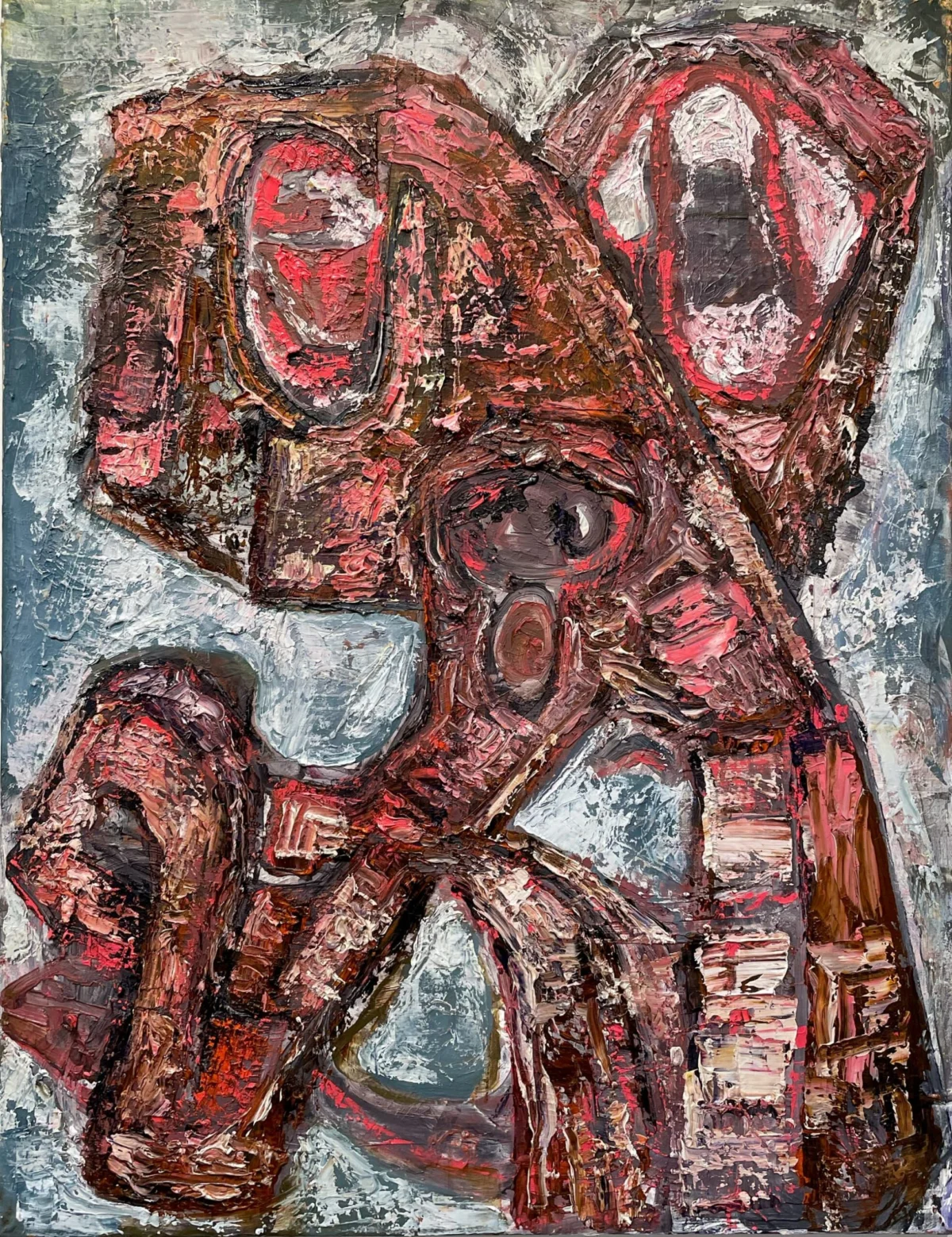
NEW YORK — In an era dominated by predictable aesthetic trends and the twin pressures of immediate social signaling and self-serving commercialism, finding an exhibition that genuinely disrupts expectations is a rare and vital experience. Such is the premise of This Heat, a striking three-person exhibition currently on view at the New York Studio School in Greenwich Village. Curated by Jacob Brooks, the exhibition spans the institution’s recently expanded galleries—which doubled in size following major renovations—and brings together the distinct, fiercely independent practices of veteran New York painters Brenda Goodman and Steve DiBenedetto alongside the lesser-known Danish-based German artist Bendix Harms.
For longtime critics and followers of contemporary abstract-figurative dialogue, the pairing presents a compelling study in contrasts. While Goodman and DiBenedetto have spent decades charting a nuanced course between opacity and transparency, abstraction and narrative, the inclusion of Harms introduces an eccentric, non-New York perspective that destabilizes the school’s traditionally insular pedagogical atmosphere. The result is a challenging, 17-work showcase that forces viewers out of their comfort zones and demands a re-evaluation of what paint can achieve both physically and psychologically.
Main Facts: The Exhibition and Its Players
This Heat is on view through October 18 at the New York Studio School, located at 8 West 8th Street in Manhattan. Curated by Jacob Brooks, the exhibition features 17 total works, creating an unconventional numerical imbalance: three paintings by Bendix Harms, with the remaining 14 evenly split between Brenda Goodman and Steve DiBenedetto.
The exhibition highlights three artists who resist settling into a signature, easily marketable style:

- Brenda Goodman: A veteran painter whose career spans nearly seven decades, working through the emotional weight of grief, isolation, and personal memory.
- Steve DiBenedetto: A New York-based artist known for his process-driven, psychologically charged compositions that frequently incorporate mutated cephalopod forms and cosmic tension.
- Bendix Harms: A 59-year-old German artist working from a remote farm in northern Denmark, whose vividly colored, tragicomic canvases employ a direct palette-knife technique.
Chronology: A Curatorial Disruption
The genesis of This Heat lies in a deliberate curatorial gamble by Jacob Brooks. By juxtaposing two fixtures of the New York art scene with an international outsider, the exhibition subverts the traditional retrospective or thematic group show model.
- The Setup: When the exhibition was first announced, art critics and enthusiasts familiar with Goodman and DiBenedetto questioned the inclusion of Harms. What formal or conceptual thread could tie these seemingly disparate practices together?
- The Installation: Upon entering the newly renovated galleries, visitors are immediately met with an uneven distribution of works. With Harms accounting for less than a third of the show, viewers are forced into a shifting cognitive rhythm—constantly recalibrating their focus to appreciate the artists individually, before attempting to synthesize a dialogue between them.
- The Revelation: Rather than relying on a seamless, academic narrative, This Heat thrives on friction. The non-traditional pairing serves as an institutional intervention, cutting through the historical insularity of the New York Studio School’s exhibition program.
- The Run: The exhibition opened in September 2026 and is scheduled to run through October 18, 2026, offering audiences a multi-week window to engage with its off-kilter energy.
Supporting Data: Examining the Core Works
The power of This Heat rests entirely within the individual canvases, each loaded with psychological density, technical mastery, and unexpected humor.
Bendix Harms and the Comedic Grotesque
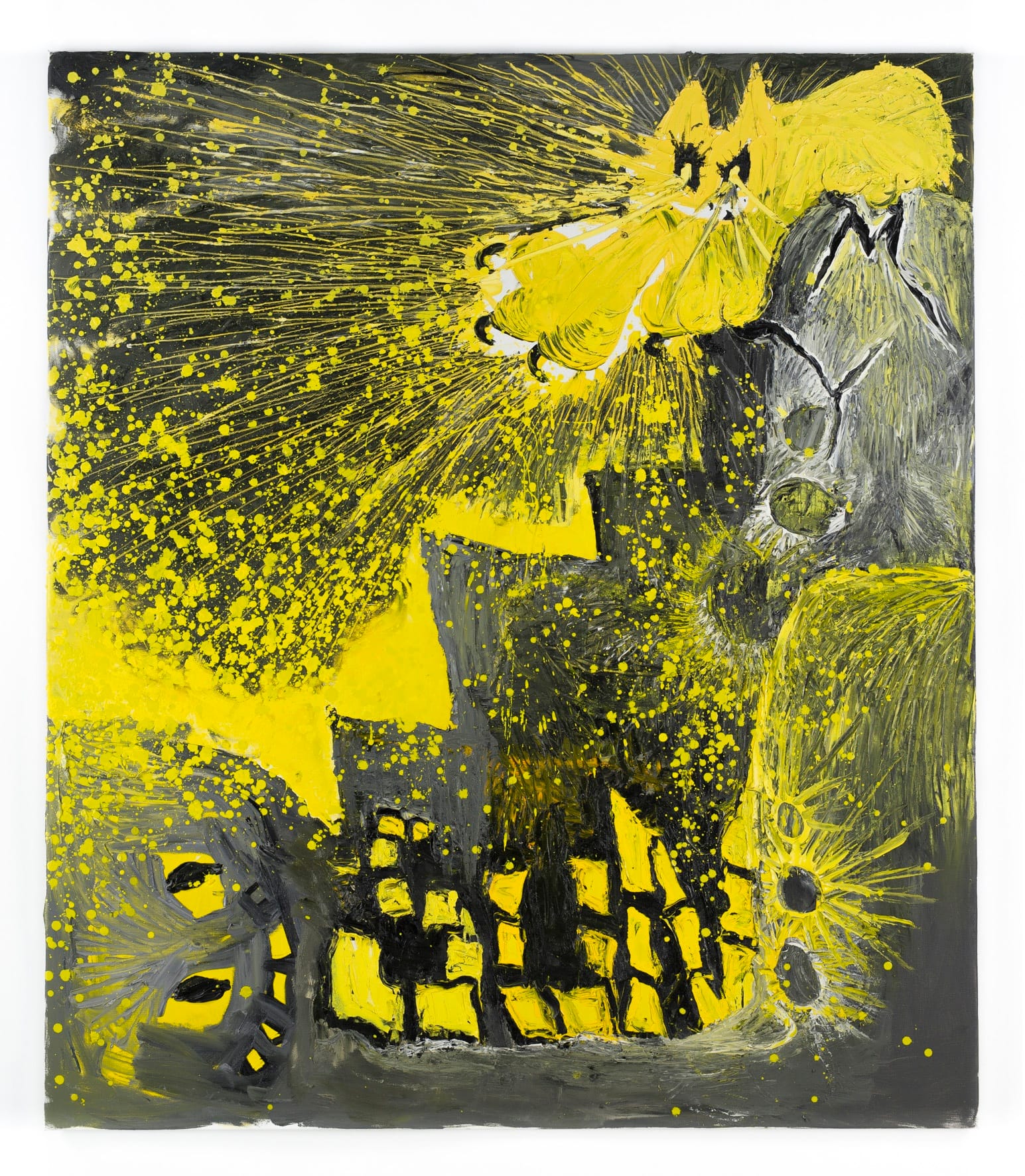
Bendix Harms, operating far from the art-world hubs in northern Denmark, brings a raw, immediate execution to his canvases. Working primarily with a palette knife directly on canvas, his paintings fuse domestic absurdity with visceral violence.
In Tears of No Return (2020), Harms presents a flattened, layered pictorial space populated by a surreal menagerie. Two large birds—one green, one blue—feature prominently with puffed-up chests. A black cat with piercing yellow pupils glares outward, lines of blood dripping from its mouth. Above them, a large turquoise-green face cries, one visible eye leaking sorrow, while a protective turquoise arm hovers over the green bird. The bird bears four red claw marks embedded in its chest.

The painting captures a comically grotesque view of a world governed by raw instinct, where predatory cats and defenseless birds must coexist. The weeping human figure underscores a profound helplessness: how can one enforce harmony without punishing a predator for simply acting on nature? Harms’s distinct brand of humor ripples outward, reframing how viewers interpret the darker psychological undercurrents of his co-exhibitors.
Brenda Goodman: The Opacity of Grief
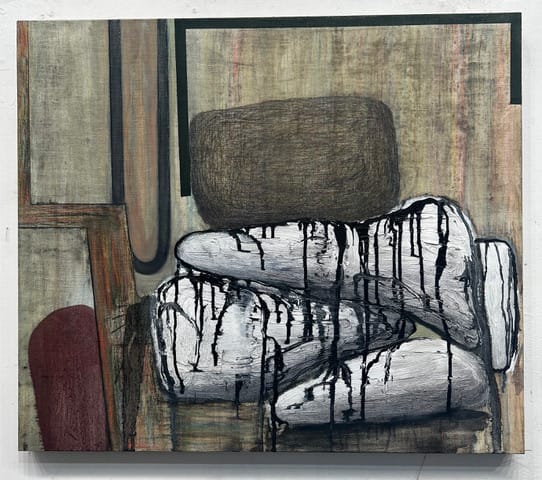
Brenda Goodman’s contribution comprises six paintings produced between 2020 and 2026, alongside an intimately scaled work on paper. Featuring titles such as Covid 3 (2021), Covid 5 (2021), and Not That Again (2024), Goodman’s recent output directly addresses pain, sadness, and the collective trauma of isolation.
However, Goodman resists literal narrative. Her work dances along the razor’s edge between abstraction and figuration. In Mounting Thoughts (2024), Goodman presents a genuinely enigmatic scene. A table tilts upward toward the picture plane, holding a pile of conical shapes. A brown form on the left hints at the tops of single-piece chair backs, establishing a gloomy, claustrophobic interior.
The central pile of grayish-white cones visually echoes the cognitive burden referenced in the title. Yet, what makes the painting linger in the mind is the inexplicable black substance oozing from the spaces between the forms. Over a career spanning seven decades, Goodman has continually oscillated between the explicit and the opaque. Placed in proximity to Harms’s brightly colored, absurd canvases, Mounting Thoughts gains an added layer of oddball absurdity.
Steve DiBenedetto: Ectoplasm and the Shaman Trickster
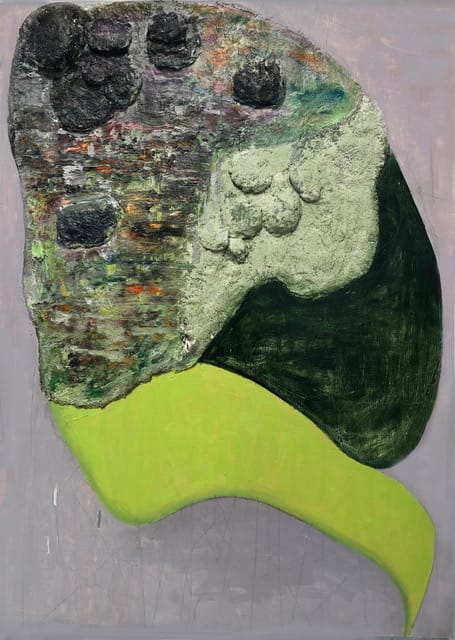
Steve DiBenedetto’s paintings occupy a territory where the grotesque and the comic collide, evoking the image of an armless creature attempting to apply lipstick with its nose. Born out of a volatile mix of anger, despair, and tenderness, his process-driven surfaces teem with primordial, post-apocalyptic lifeforms.
In Isotope Plus (2026), the largest of DiBenedetto’s seven works in the show, a multi-limbed, flattened form dominates a luminous blue ground. Evolving from the artist’s long-standing fascination with octopi, the creature appears turned inside out, its orange and brown surface dotted with cellular vacuoles that oscillate between eyes and biological pores.
Viewing DiBenedetto’s intricate paint application invites a metaphysical reading. His dense, tactile surfaces function less like traditional pigment and more like ectoplasm—the spiritual substance or energy purportedly excreted by bodies in trance states. This aligns his material philosophy with historical figures like Alfred Jensen and Antonin Artaud, who viewed art as a conduit to expanded consciousness. Yet, titles like Lettuce Leaf Control Panel (2026) and Your Problem is Obvious (2026) ground the cosmic spectacle in a self-mocking humor, casting the artist in the role of a modern shaman trickster.
Official Responses and Curatorial Intent
The institutional framework of This Heat reflects a conscious effort by the New York Studio School to expand its critical footprint following major structural and spatial upgrades. Executive leadership and the curatorial team framed the exhibition as an intentional departure from safe, predictable programming.
In exhibition brochures and statements, curator Jacob Brooks emphasized that Harms’s integration into the lineup was designed to challenge prevailing orthodoxies. By sourcing work from an artist rooted in the rural isolation of Denmark rather than the hyper-networked ecosystem of Brooklyn or Manhattan, Brooks sought to dismantle the insular tendencies often associated with studio school pedagogy.
Critics and institutional observers have noted that the exhibition’s refusal to provide a neat, tidy thesis is precisely its greatest strength. By forcing audiences to reconcile Harms’s raw, unmediated expression with Goodman’s mourning abstraction and DiBenedetto’s visionary psychodramas, the New York Studio School has opened a vital space for genuine aesthetic inquiry.
Implications: A Breath of Fresh Air in Contemporary Art
This Heat arrives at a critical juncture for the contemporary art market. In recent years, discourse has frequently stalled between the demands for didactic social relevance and inward-looking, market-driven self-absorption—a modern Scylla and Charybdis that swallows up promising careers.
Goodman, DiBenedetto, and Harms successfully navigate past these hazards by refusing to pander. Their works do not lecture the viewer, nor do they rely on slick, easily digestible branding. Instead, they embrace complexity, humor, absurdity, and psychological depth.
The implications for the broader art world are clear:
- Challenging Institutional Insularity: The success of This Heat proves that pairing regional New York veterans with international outsiders can revitalize historical institutions and shake up stale pedagogical assumptions.
- Rehabilitating Painting as Metaphysical Medium: Through DiBenedetto’s ectoplasmic surfaces and Goodman’s opaque emotional landscapes, the exhibition champions the idea that paint is a living, breathing material capable of opening human consciousness.
- The Vitality of Humor in Tragedy: By weaving dark humor through themes of grief, pandemic isolation, and predatory violence, the artists demonstrate that levity and despair are not mutually exclusive, offering a much-needed antidote to artistic self-seriousness.
This Heat: Brenda Goodman, Steve DiBenedetto, and Bendix Harms remains on view at the New York Studio School through October 18. For those willing to step out of their comfort zones, it offers one of the most compelling visual experiences of the autumn season.
 Muslim
 Ali Ikhwan
 Nana
Nana
