

By Min Park
Published in the Pocket Review Series
Main Facts: The Anatomy of Double Vision
In Maia Ruth Lee’s solo exhibition, Double Vision, currently on view at the Tina Kim Gallery, translation is never presented as a neat arrival or a resolved linguistic equation. Instead, translation is framed as a persistent, living condition—a space of suspension to be embodied, probed, and physically navigated.
Lee’s artistic vocabulary draws heavily on her biographical background. As the daughter of Christian missionaries who worked as Bible translators in Nepal—where they notably helped develop a written alphabet for the oral Sherpa language—Lee grew up intimately familiar with the friction, negotiation, and ultimate loss inherent in transferring meaning from one cultural or linguistic system to another.
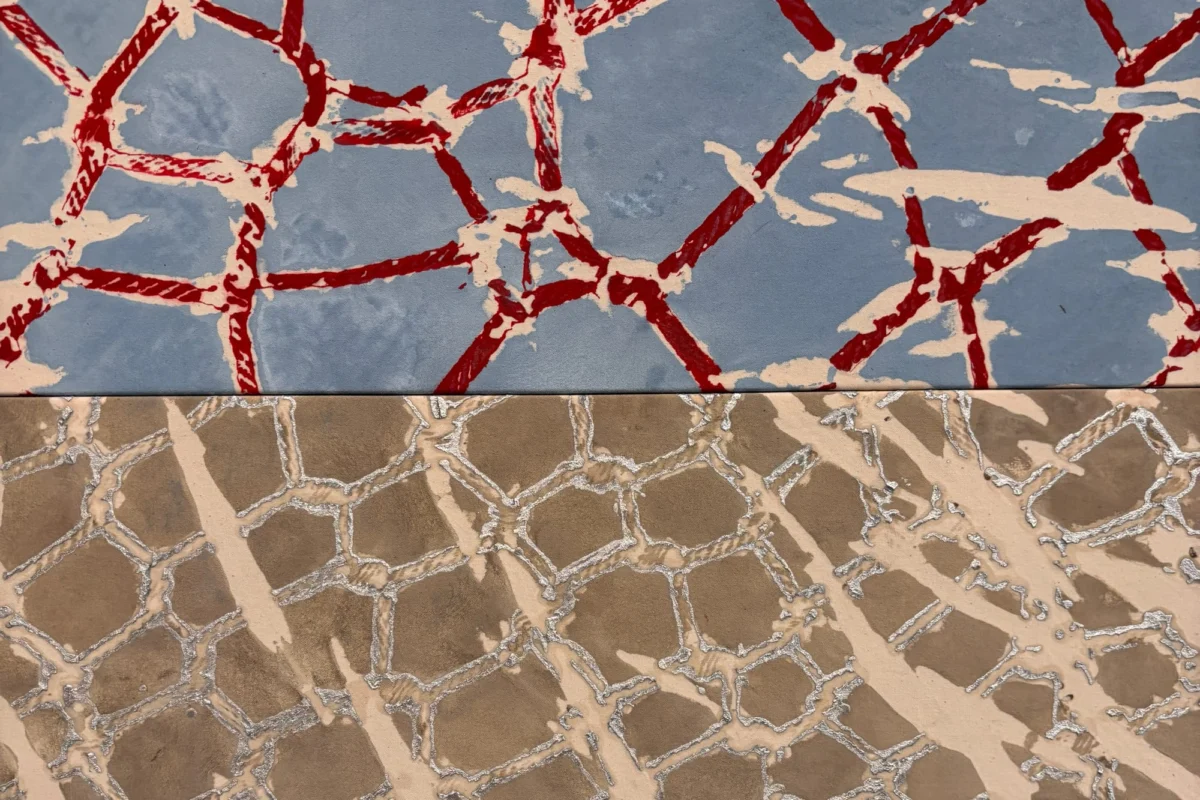
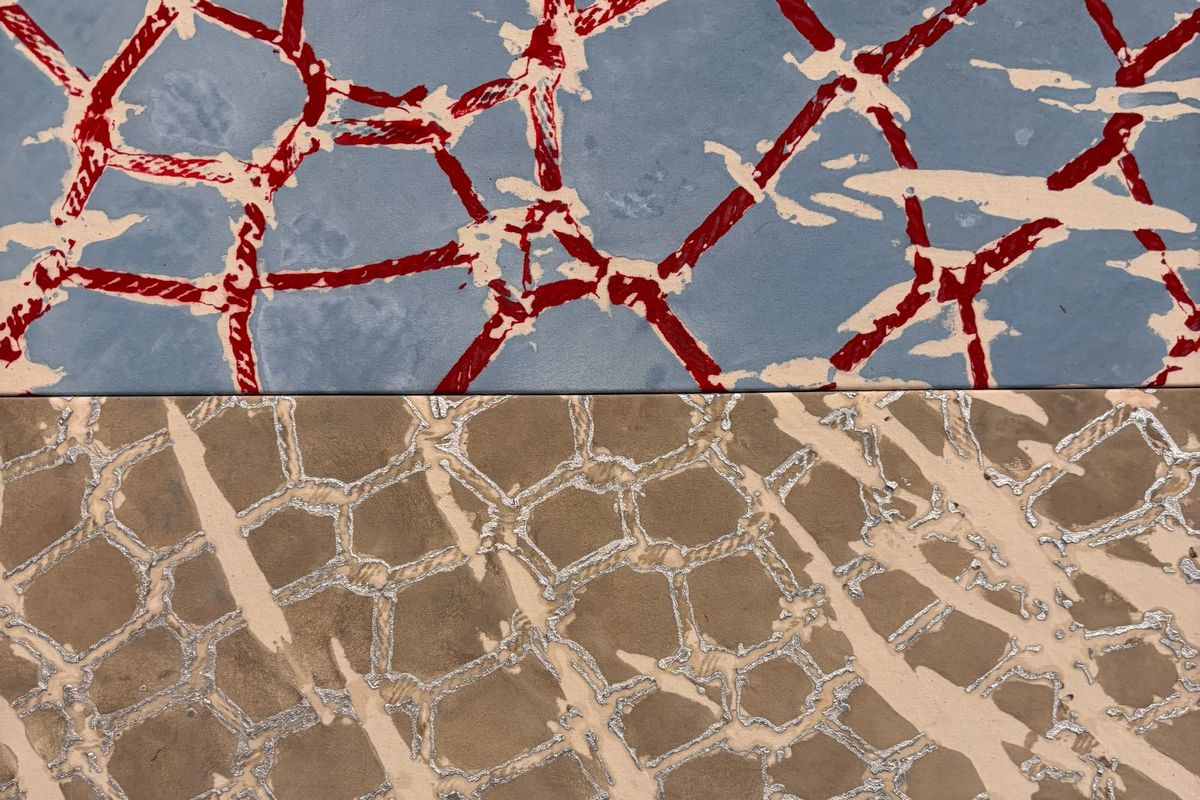
In Double Vision, this personal history expands into a broader meditation on global movement, displacement, and the architecture of transit. The exhibition features a diverse array of media, including canvas, latex, and steel, unified by a recurring visual lexicon. Grid-like patterning—subtly referencing the ubiquitous strapped luggage piled high at Kathmandu’s Tribhuvan International Airport—sits alongside illegible glyphs and archival family photographs.
Crucially, the motifs within the exhibition do not merely represent migration; they perform it. As viewers move through the gallery, these visual elements migrate across different surfaces and sculptural forms, mutating, shifting, and taking on entirely new connotations.
Chronology: The Evolution of Lee’s Artistic Trajectory
To understand the conceptual weight of Double Vision (2026), it is necessary to trace how Maia Ruth Lee’s practice has evolved over the past decade.
- Formative Years and Linguistic Roots: Growing up between South Korea, the United States, and Nepal, Lee’s early exposure to the mechanics of translation planted the seeds for her ongoing exploration of communication barriers. Her parents’ work in creating a written script for an unwritten oral language demonstrated that alphabets are not neutral; they are constructed, physical artifacts born from cultural encounters.
- Early Material Explorations (Late 2010s): Lee first gained widespread recognition for her sculptures and installations utilizing everyday materials associated with transit and labor—most notably canvas bags, zippers, chains, and used luggage. These early works treated baggage not just as a container for personal belongings, but as a surrogate body that bears the physical scars of border crossings.
- The Pivot to Systemic Gridworks (2022–2024): In subsequent bodies of work, Lee began formalizing these messy, organic piles of luggage into rigorous structural grids. The chaotic accumulation of transit gave way to calculated patterns, echoing architectural blueprints, map-making systems, and bureaucratic document management.
- The Synthesis in Double Vision (2026): In her current exhibition at Tina Kim Gallery, Lee synthesizes these disparate threads—biography, material fatigue, and structural gridwork—into a unified installation. Here, new 2026 series such as B.B. Tetris and Expandable Luggage explicitly connect the act of stacking and packing to the psychological burden of perpetual transit, marking a mature high point in her conceptual framework.
Supporting Data and Material Analysis: Inside the Gallery Space
The physical encounter with Double Vision is defined by material contrast and structural repetition. Lee utilizes industrial and domestic mediums to underscore the friction between rigid global systems and fragile human experiences.
The B.B. Tetris Series (2026)
In the modular canvases of the B.B. Tetris series, stacking is infused with a sense of playful geometry. Reminiscent of the iconic video game blocks that must be rotated and forced into alignment, these canvases toy with the modularity of modern life. They suggest that identity and culture, when subjected to the pressures of relocation, can be reconfigured endlessly, snapping into new configurations depending on the spatial and social pressures applied to them.
"Expandable Luggage" (2026)
In stark contrast to the playful modularity of Tetris, the sculptural work "Expandable Luggage" (2026) introduces a heavy, oppressive atmosphere. Here, verticality is pushed to its absolute limits. As the height of the stacked, luggage-like forms grows upward, the structure begins to sag under its own weight, evoking a belabored, exhausted migration. The piece visualizes the crushing accumulation of displacement—how every border crossed, every form filled out, and every language half-learned adds physical and psychological dead weight to the traveler.
The Interplay of Surfaces
Across canvas, treated latex, and cold steel, Lee maintains a delicate balance between legibility and obscurity. The inclusion of illegible glyphs serves as a masterstroke of conceptual design. Viewers are invited to read the walls, yet the text resists comprehension. This intentional withholding mimics the immigrant’s experience of navigating a new society where signifiers are visible, yet their underlying codes remain locked away.
Official Responses and Critical Reception
Art critics and curators have responded to Double Vision with widespread acclaim, noting how seamlessly Lee bridges the gap between intimate family history and global geopolitical discourse.
In early reviews, critics have highlighted the exhibition’s refusal to offer tidy resolutions. Unlike contemporary exhibitions that treat migration as a singular, heroic narrative or a tragic news headline, Lee’s work focuses on the interval—the messy, unglamorous middle ground where translation fails and culture is awkwardly remade.

"Translation never arrives in Maia Ruth Lee’s solo exhibition… instead, it is a condition to be embodied and probed," notes the critical consensus emerging from the gallery. Curatorial essays accompanying the exhibition emphasize that Lee’s use of Kathmandu airport motifs is not merely nostalgic, but structural. By abstracting the airport luggage grid into high art, Lee exposes the invisible logistical infrastructures that govern who gets to move freely and who is subjected to bureaucratic containment.
Furthermore, fellow artists and cultural theorists have praised the exhibition for redefining how material culture can speak to diaspora studies. By choosing materials that degrade, stretch, or bear structural strain (such as latex and worn canvas), Lee grounds abstract political theory in visceral, bodily realities.
Implications: What Double Vision Tells Us About Contemporary Art and Migration
The broader cultural and artistic implications of Double Vision extend far beyond the white cube of the Tina Kim Gallery. In an era marked by unprecedented global migration, climate displacement, and digitized cross-cultural communication, Lee’s work offers a vital philosophical framework.
1. The Aesthetics of the In-Between
Mainstream discourse often demands that immigrant or diaspora artists produce work that explains their heritage, acts as an ethnographic bridge, or offers a neat narrative of assimilation. Lee rejects this demand entirely. By presenting illegible glyphs and untranslatable visual languages, she reclaims opacity as a fundamental human right. Not everything is meant to be translated; some cultural fragments are meant to remain fiercely, protectively private.
2. Migration as a Mutating Motif
By ensuring that her motifs "migrate across the gallery," Lee suggests that displacement is not a one-time event with a definitive starting point and ending point. Rather, migration alters the very DNA of cultural artifacts. Just as her parents’ translation work in Nepal transformed an oral tongue into a written one—permanently changing the Sherpa linguistic landscape—Lee’s sculptures show how artistic motifs mutate when forced to travel across artistic mediums, geographic borders, and generational divides.
3. Embodied Empathy Through Architecture and Material
Ultimately, Double Vision challenges viewers to stop looking at migration as an external statistic and to start embodying the interval. When standing before the towering, straining architecture of "Expandable Luggage" or parsing the impossible rules of B.B. Tetris, the viewer is forced to feel the weight of structural imbalance. Lee’s exhibition reminds us that translation and migration are not merely about crossing physical space, but about the profound, ongoing labor of restructuring oneself in a world caught between multiple realities.
 Muslim
 Evan Lee Salim
