

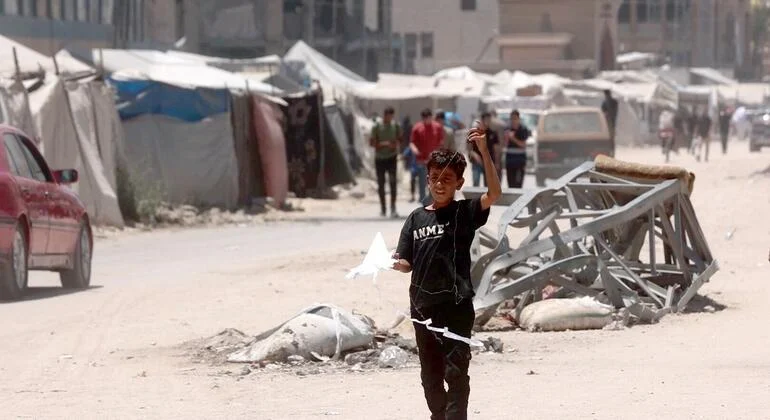
JERUSALEM/GENEVA – As the shadow of winter looms over the Gaza Strip, the World Health Organization (WHO) has issued a desperate plea for the immediate and unimpeded scaling up of humanitarian aid. Nearly 12 months into a fragile ceasefire marred by intermittent airstrikes and ongoing military operations, the humanitarian landscape in the enclave has reached a breaking point, with health officials warning that the window to prevent a widespread health catastrophe is rapidly closing.
The Critical Impasse: A Failure of Supply and Access
"A truck full of non-priority supplies or the right supplies arriving too late, doesn’t save lives. That’s the question that actually matters," stated Dr. Reinhilde Van De Weerdt, the WHO Representative in the Occupied Palestinian Territory (OPT). Her assessment serves as a stark indictment of the current logistical bottlenecks that continue to strangle Gaza’s recovery.
Despite the humanitarian mandate to provide aid, the system remains crippled by restrictive access protocols. Currently, the Kerem Shalom crossing in the southern tip of the enclave serves as the primary artery for aid, while the Rafah crossing remains restricted to the limited movement of patients seeking medical treatment abroad. Four other major entry points—Kissufim, Gate 96, Erez, and Erez West—remain effectively shuttered to humanitarian traffic, forcing a trickle of supplies to sustain a population of over two million.
The WHO’s demand is unequivocal: a transition to a "multi-crossing model" that allows for the predictable, large-scale flow of essential goods. Without this, aid agencies warn that the modest gains made in public health will be entirely erased by the onset of colder, wetter weather.
Chronology: A Year of Precarious Fragility
The current humanitarian crisis is the culmination of nearly a year of instability following the implementation of a ceasefire agreement that has failed to provide the security or infrastructure stability required for long-term recovery.
- Initial Post-Ceasefire Period: The early months were marked by a tentative, albeit inefficient, flow of aid. Infrastructure remained severely damaged, but international agencies held hope for a sustained humanitarian corridor.
- Mid-Year Escalation: As the year progressed, sporadic military activity and airstrikes disrupted aid distribution networks, forcing agencies to constantly recalibrate their logistics in real-time.
- The "Dual Use" Impasse: Throughout the last six months, a systematic pattern of denials has emerged. The WHO has reported that shipments of critical medical equipment, including prosthetics and assistive devices, have been rejected multiple times by Israeli authorities under the "dual use" designation—a policy that classifies items as potentially useful for military purposes by Hamas fighters.
- Current State: As of September 2026, the situation has been categorized as "overwhelming" by the UN Office for the Coordination of Humanitarian Affairs (OCHA). The lack of heavy machinery, fuel, and spare parts has led to a buildup of solid waste and a degradation of sanitation services, creating a breeding ground for disease.
Supporting Data: The Cost of Bureaucratic Denial
The impact of these restrictions is measurable. The WHO notes that while common medicines move with relative success—with nearly 87 percent approved and only one percent rejected—the story for specialized medical equipment is grim.
A single shipment of prosthetics and assistive devices was recently rejected four times. For the victims of the conflict who have suffered limb loss, this represents more than just a logistical hurdle; it is a denial of the fundamental right to rehabilitation. "Every rejection means another delay for someone who has already lost a limb and is simply waiting for the chance to walk again," Dr. Van De Weerdt remarked.
Furthermore, the lack of access to heavy machinery and specialized equipment has hindered the work of mine action partners. In 37 separate assessment missions, experts identified significant hazards from unexploded ordnance buried within the rubble of destroyed buildings, yet they lack the necessary permissions and equipment to neutralize these threats.
Official Responses and the "Dual Use" Conflict
The tension between security and humanitarian necessity is at the heart of the current crisis. Israeli authorities maintain that strict controls on imports are essential to prevent items from reaching militant groups. However, health officials are pushing back against the broad application of "dual use" policies.
Dr. Van De Weerdt has explicitly called for a release of the pressure on medical supplies, arguing that essential health items should not be subject to these restrictions. "They should not be considered as dual use," she said, noting that these items represent "globally accepted standards on medical items anybody needs anywhere to run a hospital or a clinic."
The UN’s position is that the current vetting process is not only inefficient but fundamentally incompatible with the emergency needs of the population. The plea for a multi-crossing model is a direct response to the bottleneck at Kerem Shalom, which is insufficient to process the volume of food, fuel, medicine, and construction materials required to stabilize the enclave.
Implications: A Winter of Biological Hazard
The arrival of autumn and the subsequent winter season threatens to exacerbate an already dire situation. With almost two million people lacking adequate shelter, the population is increasingly vulnerable to the elements.
The Threat of Preventable Disease
The absence of clean water, safe shelter, and functional sanitation has created a secondary crisis: the rapid spread of infectious disease. The destruction of public health laboratories throughout the territory has left local officials largely blind to emerging epidemics, as the capacity to identify and isolate pathogens has been severely diminished.
The Rodent Menace
Of particular concern is the rise in rodent populations, which are thriving in the wake of uncollected solid waste and destroyed infrastructure. Public health experts warn that rat bites are not merely a nuisance; they are a primary vector for infectious diseases that spread quickly in crowded, unsanitary conditions. OCHA has flagged the accumulation of waste in the heart of Gaza City as a "serious public health risk" that requires immediate intervention.
The Infrastructure Deficit
The cycle of decay is self-perpetuating. The lack of fuel and spare parts for waste-management vehicles means that even when a cleaning effort is organized, it is rarely sustained. Without a consistent influx of fuel, the heavy machinery needed to move rubble and clear waste sits idle, rendering the few available medical facilities and residential areas increasingly unlivable.
Conclusion: A Call for Urgent Action
The situation in Gaza stands at a critical juncture. The "extraordinary health workers" who remain in the Strip continue to provide care under conditions that are, by any international standard, untenable. However, their efforts are being undercut by a supply chain that fails to deliver even the most basic necessities at the scale required.
The international community is now faced with a choice: allow the status quo to persist—thereby inviting a winter of preventable suffering, disease, and death—or apply the necessary pressure to secure a predictable, unimpeded, and scaled-up humanitarian corridor.
As Dr. Van De Weerdt noted, the humanitarian requirement has not changed, and it is fundamentally simple: Gaza needs access. Without a fundamental shift in how aid is vetted and transported, the upcoming winter will not only be a period of cold but a period of profound health decline that will haunt the region for years to come. The international mandate to protect human life must, in the eyes of the UN, take precedence over the restrictive security policies that are currently starving a population of its dignity and its health.
 Siti Muinah
 Lina Hope
 Asro
Asro
