

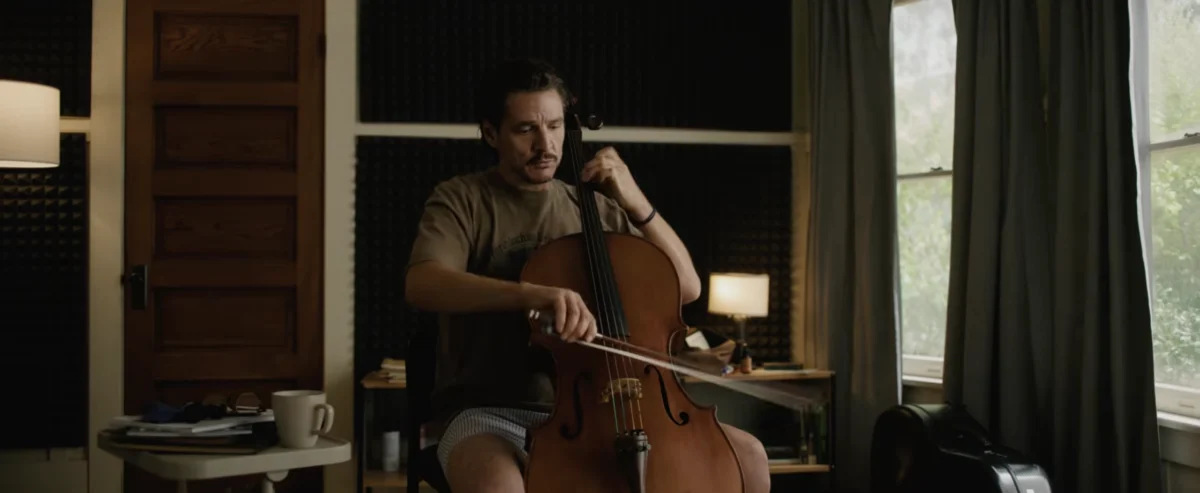
At the New York Film Festival’s prestigious Centerpiece gala, the air inside Alice Tully Hall was thick with anticipation. The film in question, Behemoth!, represents the latest creative pivot for writer-director Tony Gilroy. Known for the sharp, cynical precision of Michael Clayton and the gritty, political tension of Andor, Gilroy has opted for a radically different register here. Behemoth! is a delicately calibrated character study, a film that hinges almost entirely on the internal landscape of a single man: a cellist, played with profound, brooding restraint by Pedro Pascal.
As the credits rolled to a rapturous, if somewhat contemplative, reception, the post-screening discourse turned immediately toward the impending awards season. While the film’s innovative structure and lead performance have solidified its standing as a major player, the path to the Dolby Theatre is fraught with complications—both in the crowded acting categories and in the complex bureaucratic labyrinth of the Academy’s music branch.
A Career-Defining Performance
Pedro Pascal, long celebrated for his magnetic television work—most notably in HBO’s The Last of Us—has stepped into his most ambitious cinematic lead role to date. In Behemoth!, Pascal portrays a musician suffering through a midlife crisis that is as existential as it is professional.
Critics have been quick to praise the performance for its “quiet, almost silent, reactive” quality. In a cinematic landscape often dominated by high-octane dialogue and explosive emotional outbursts, Pascal chooses a different route. He carries the weight of the film on his shoulders, appearing in every scene, often conveying volumes through a flick of the eyes or the tightening of a jaw.
However, industry analysts are already cautioning that Pascal’s path to a Best Actor nomination is a steep climb. The field is historically crowded this year. To secure a spot on the ballot, Pascal must distinguish himself from a roster of heavy hitters whose performances are, by design, louder and more traditionally "showy." He faces stiff competition from Matt Damon (The Odyssey), the enigmatic John Malkovich (Wild Horse Nine), the visceral Andrew Scott (Elsinore), the charismatic Ryan Gosling (Project Hail Mary), and the veteran John Turturro (The Only Living Pickpocket in New York).
Chronology: From Concept to Centerpiece
The development of Behemoth! has been a multi-year labor of love for Gilroy. After the critical and commercial success of his recent television output, the director sought a project that could marry his love for structural experimentation with a intimate, human-scale narrative.

- Pre-Production: Gilroy began drafting the screenplay in early 2024, focusing on the intersection of memory and melody. The conceit—a cellist whose practice sessions trigger involuntary flashbacks—became the film’s heartbeat.
- Production: Filming took place over a tight four-month schedule in New York City and London, focusing on practical lighting and long, uninterrupted takes to allow Pascal’s performance to breathe.
- Post-Production/The Collective: The musical score, a central pillar of the film, was recorded over the summer of 2025. Gilroy’s vision required a diverse array of tonal shifts, leading him to assemble "The Behemoth! Collective," a group of nine high-profile composers, including James Newton Howard, Michael Giacchino, and Alan Silvestri.
- Festival Circuit: The film debuted to a warm, enthusiastic response at the New York Film Festival in October 2026, positioning it perfectly for the late-year release window.
The Musical Gordian Knot: Academy Rules and Innovation
Perhaps the most intriguing aspect of Behemoth!—and the one that poses the greatest challenge to its awards campaign—is its score. The film’s narrative is structured around the music Pascal’s character plays; as he performs different scores in a series of Hollywood sessions, the audience is transported through his memories.
By utilizing nine distinct composers, Gilroy has created a sonic tapestry that is undeniably unique. However, this creates a direct conflict with Academy of Motion Picture Arts and Sciences (AMPAS) regulations. Current rules dictate that no more than three composers can be submitted for consideration for the Best Original Score category.
Searchlight Pictures is currently lobbying the music committee to make an exception, arguing that "The Behemoth! Collective" functions as a single, unified creative entity rather than a disparate group of contributors. The studio points to historical precedents for flexibility. For example, the Academy allowed the multiple songwriters behind K-Pop Demon Hunters to share a single Oscar. Conversely, they are wary of the "Birdman" precedent, where the drumming-heavy score was famously disqualified for not meeting the definition of "original musical composition."
Whether the Academy views the Collective as a groundbreaking collaborative effort or a violation of traditional score-writing norms remains to be seen. If the score is disqualified, it would be a significant blow to the film’s total awards potential, though the studio remains confident in the original song, "Your God Is Sleeping," performed by Lukas Frank, which has already emerged as a frontrunner in the Best Original Song category.
Implications for Tony Gilroy
Beyond the performance of his lead actor and the complexities of his score, Behemoth! stands as a testament to Tony Gilroy’s status as a screenwriter. Having previously secured nominations for his work on Michael Clayton, Gilroy is viewed by many in the industry as a master of the craft.
The screenplay for Behemoth! is being hailed as a defining work of his career. It avoids the easy tropes of the "midlife crisis" genre, opting instead for a non-linear, impressionistic structure that mirrors the fugue state of a musician losing his grip on his own history. If the Academy rewards the film, it will likely be for its script—a category that historically values the very kind of structural intelligence Gilroy has displayed here.

For Searchlight, the implications are clear: they have a "prestige" film that offers the kind of artistic weight that Oscar voters crave, provided the campaign can successfully navigate the bureaucratic hurdles. The studio has slated the film for a limited release starting December 4, perfectly timing it for the end-of-year critical push and the start of the voting period for major guild awards.
The Verdict of the Critics
Early feedback from outlets like Metacritic suggests that Behemoth! is hitting its mark with the critical establishment. While the film is a departure from the high-stakes thrills of the Bourne franchise or the sprawling galactic politics of Andor, it has cemented Gilroy’s reputation as a filmmaker capable of shifting gears without losing his distinct voice.
For Pedro Pascal, the stakes are different. He has already proven his mettle in the arena of global television, but a film of this caliber—one that demands such internal rigor—is the final piece of the puzzle for an actor looking to secure his place in the history of cinema. Whether or not he walks away with a statue in March, Behemoth! will likely be remembered as the moment he transitioned from a beloved cultural icon into an actor of undeniable, quiet power.
As the industry prepares for the upcoming awards season, all eyes will be on the Academy’s music committee and the acting branch. Can a film that defies categorization regarding its score and features a performance defined by its silence rise above the noise of its competitors? If the reception at Alice Tully Hall is any indication, Behemoth! has the gravitas to do exactly that.
Searchlight Pictures opens "Behemoth!" in theaters nationwide starting December 4.
 Pevita Pearce
 Layla Zulfa
 Raul Delapena Setiawan
