

Main Facts: Deconstructing the Modern Masterpiece
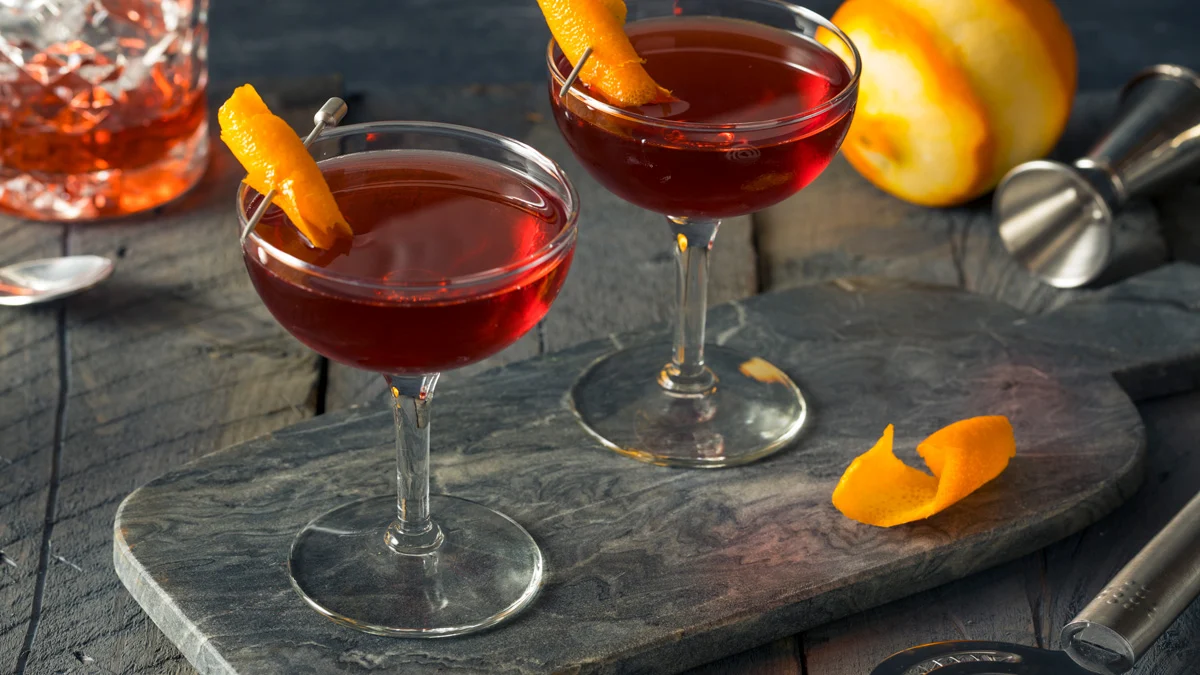
To the uninitiated, the Negroni is a monument to simplicity: equal parts gin, Campari, and sweet vermouth, stirred over ice and garnished with an orange peel. It is the undisputed king of bitter cocktails and a masterclass in balance. Yet, like any great architectural blueprint, its enduring legacy lies not in its rigidity, but in its infinite adaptability. Enter the Mane of Needles, a bold and electric reimagining of the classic template that bridges the gap between historical lineage and avant-garde mixology.
At its core, the Mane of Needles is a hybrid cocktail. It merges two distinct paths of mixological evolution: swapping the base spirit (a lineage that gave us the American whiskey-based Boulevardier) and layering complex modifiers onto the framework (a tradition celebrated by modern craft bars, such as the legendary Autumn Negroni born at Chicago’s Violet Hour in 2011).
The Mane of Needles anchors itself with robust rye whiskey, substituting gin for spice and broad oaky shoulders, before uniting it with Campari and sweet vermouth. But the true magic—and the source of its evocative name—lies in a meticulous supporting cast: orange bitters, the honeyed and spice-warmed French liqueur Bénédictine, and a judicious quarter-ounce of Fernet-Branca. The result is a drink that is smooth, silky, and elegant, yet crackling with tingly, high-voltage energy.
Chronology: The Evolution of a Bitter Legacy
To understand how the Mane of Needles found its place in modern cocktail culture, one must look backward through the timeline of the stirred, bitter cocktail family tree:

- The Early 20th Century (The Birth of the Negroni): Count Camillo Negroni famously asks a bartender in Florence, Italy, to strengthen his Americano cocktail by replacing the club soda with gin, etching a permanent fixture into cocktail history.
- The Mid-20th Century (The Rise of the Boulevardier): As American whiskey gains global prominence, bartenders begin swapping gin for bourbon and rye, giving rise to the Boulevardier—arguably the Negroni’s oldest and most formidable relative.
- 2011 (The Era of Layered Complexity): At The Violet Hour in Chicago, the "Autumn Negroni" debuts, demonstrating that mixologists can successfully layer additional bitter and seasonal elements onto the classic equal-parts template without breaking its structural integrity.
- The Modern Craft Era (The Mane of Needles): Bartenders begin colliding the spirit-swap and complexity-layering methods. By introducing high-proof rye, rich modifiers, and a micro-dose of Fernet-Branca, the Mane of Needles is forged—pushing the boundaries of how much structural tension a single glass can hold.
Supporting Data: Anatomy and Composition of the Cocktail
The Mane of Needles is not a casual, sessionable pour; it is a heavy-hitting, spirit-forward concoction designed for the dedicated enthusiast of bitterness.
The Recipe
- Rye Whiskey (preferably a high-rye mashbill like Bulleit or George Dickel): Standard proportions scale around 1.5 oz to 2 oz.
- Campari: 0.75 oz
- Sweet Vermouth (Carpano Antica recommended): 0.75 oz
- Bénédictine: A measured splash for late-palate honey and baking spice.
- Fernet-Branca: 0.25 oz (the catalyst that sharpens the drink’s profile).
- Orange Bitters: A few dashes for dry, zesty citrus depth.
Technical Specifications & Yield Data
- Total Liquid Volume: A standard single pour of the unscaled recipe measures roughly 3.85 ounces.
- Alcohol By Volume (ABV) Equivalence: Due to the inclusion of high-proof spirits and concentrated modifiers, the drink packs a punch equivalent to nearly 3.5 ounces of vodka.
- Batching Recommendation: Because of its outsized volume, professional bartenders recommend batching the ingredients in advance. Pouring 2.75 ounces of a pre-mixed batch scales the drink down to a manageable 70 percent of the original footprint, preventing dilution issues and oversized glassware demands.
Ingredient Breakdown
- The Rye: The drink demands a high-rye mashbill—specifically the 95 percent rye and 5 percent barley profile popularized by MGP. Traditional Kentucky ryes containing significant corn percentages tend to clash with the aggressive bitterness of the modifiers.
- The Vermouth: Weaker vermouths will be instantly crushed by the aggressive backbone of Campari and Fernet. Carpano Antica is the preferred weapon of choice, offering enough vanilla-laced weight and structural integrity to hold its ground.
- The Bitters & Botanicals: While Angostura Orange was used in the original formulation, the sheer volume of flavor in the glass allows for flexibility. The objective is zesty orange oil with pithy bitterness. Meanwhile, the Bénédictine introduces a honeyed, warming counterweight, leaving the Fernet-Branca to inject aggressive menthol and saffron needles into the finish.
Official Responses and Bartender Insights
Mixologists who work with the Mane of Needles emphasize that it requires a specific consumer mindset. It is not designed to appeal to the mass market or those who shy away from botanical bitterness.
"It’s a black cat of a cocktail," notes one creator behind the recipe. "It’s easy to like—assuming you’re good with bitterness—and not easy to forget."
Professional feedback regarding the preparation highlights the logistical challenges of its formulation. The requirement to scale down measurements by 30 percent if avoiding batching has drawn playful groans from home bartenders, yet purists argue the exactitude is non-negotiable.

"I realize this is an annoying instruction, and I apologize for it," says the recipe’s developer regarding the scaling mathematics. "Good luck." This tongue-in-cheek warning underscores the uncompromising nature of the drink: precision is the price of admission.
Implications: Where the Craft Cocktail Movement Goes From Here
The rise of drinks like the Mane of Needles signals a broader cultural shift in modern mixology. For years, the craft cocktail renaissance focused on accessibility—reviving forgotten classics, clarifying milk punches, and introducing fruit-forward or approachable profiles to entice new drinkers.
However, as the palate of the modern cocktail consumer matures, a counter-movement has emerged: the celebration of extreme profiles. Drinks that lean aggressively into bitterness, high ABVs, and complex, polarizing ingredients (such as Fernet-Branca and high-proof rye) are no longer confined to the industry-only "bartender’s handshake." They are being embraced by adventurous home enthusiasts and upscale cocktail lounges alike.
Furthermore, the Mane of Needles highlights the evolution of the "template cocktail." The Negroni has proven to be nearly indestructible, surviving countless permutations without losing its identity. By proving that a drink can simultaneously be smooth, silky, powerful, bitter, and "tingly like a live wire," the Mane of Needles pushes mixologists to experiment further with structural tension. It challenges the notion that balance means smoothing over rough edges; instead, it proves that true brilliance sometimes comes from letting the edges bite back.
 Siti Muinah
 Ammar Sabilarrohman
 Iffa Jayyana
