

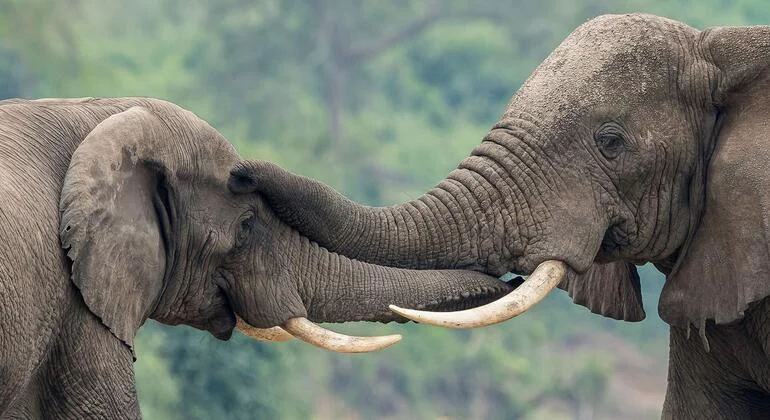
In the high-stakes battle against international wildlife trafficking, the difference between a dismissed case and a landmark conviction often comes down to a microscopic strand of DNA. In the heart of Entebbe, Uganda, a state-of-the-art facility—the Uganda Wildlife Forensics and Timber Laboratory—is providing the scientific rigor necessary to turn raw, often mutilated animal seizures into ironclad courtroom evidence. Supported by the United Nations Office on Drugs and Crime (UNODC), the European Union, and the government of Denmark, this laboratory has become a pivotal weapon in the fight to preserve Africa’s natural heritage.
The Anatomy of a Conviction: A Case Study
In January 2025, investigators from the Uganda Police Force and the Uganda Wildlife Authority (UWA) intercepted a suspicious package destined for the black market. While initial field assessments suggested the presence of illegal wildlife products, suspicion alone is insufficient for prosecution. Under Ugandan law, the burden of proof requires absolute identification, a task made increasingly difficult as poachers adopt more sophisticated methods to hide their tracks.
The seized material was transported to the Entebbe laboratory, where scientists conducted a multi-stage analysis. Initially, technicians identified a distinctive cross-hatched pattern on the material—a hallmark of elephant ivory. However, to ensure the evidence would withstand the scrutiny of a courtroom, DNA sequencing was performed. The results confirmed the sample was elephant-derived, providing the essential link needed to secure an arrest.
Two months later, police apprehended the sender. A subsequent search of the suspect’s residence uncovered a cache of elephant ivory and warthog tusks. The individual was charged with attempted trafficking and illegal possession. Ultimately, the suspect was sentenced to 15 years in prison or a fine of 140 million Ugandan shillings (over $35,000 USD). This case serves as a template for how modern forensics is closing the impunity gap for wildlife criminals.
Chronology of Progress: From Pilot Project to Institutional Pillar
The success of the Entebbe laboratory is the culmination of years of strategic development and international cooperation.
- 2019: The journey began with the establishment of a pilot wildlife forensics facility. A collaborative effort between the UNODC, the TRACE Wildlife Forensics Network, and the Ugandan government, this center provided the initial technical framework for handling evidence.
- 2023: The facility proved its worth in a high-profile case involving the illegal trade of bushmeat. After a suspect was caught with six antelope skins, multiple heads, and a fetus, the lab used DNA analysis to identify the species as bushbuck, leading to a three-year prison sentence.
- April 2026: Recognizing the growing threat of illegal logging, the facility underwent a significant expansion, officially opening as the "Uganda Wildlife Forensics and Timber Laboratory." This expansion integrated timber identification into its mandate, responding to the alarming decline of Uganda’s forest cover.
Supporting Data: The Scale of the Crisis
The 2024 UN World Wildlife Report identifies Uganda as a critical hub for organized trafficking networks. The data highlights a sobering reality: while ivory remains a primary target, the illegal trade has diversified to include pangolins (the world’s most trafficked mammal), primates, and various bird species.
The environmental impact of this trade is profound. In 1990, Uganda’s forest cover stood at 24 percent; by 2025, that figure had plummeted to roughly 13 percent. Much of this deforestation is linked to illegal timber trafficking, which, while distinct from the wildlife trade, shares the same logistical routes and organized criminal structures.
The lab’s methodology for data collection is as rigorous as its science. When a seizure occurs—whether it be a sack of pangolin scales or a shipment of smoked bushmeat—investigators photograph the evidence in situ, document the chain of custody, and collect controlled samples. This meticulous process ensures that the "exhibit" remains admissible in court, stripping away the defense’s ability to claim the samples were tampered with or misidentified.
Official Perspectives: Law Enforcement and the Judiciary
For Patrick Chiyo, the laboratory’s manager, the mission is clear: "Poachers are removing identification features from wildlife carcasses to evade detection. Our work is to ensure that even the smallest fragment of DNA can speak for the animal."
Mr. Chiyo emphasizes that the lab is not merely a scientific facility, but a vital component of the criminal justice system. "DNA reports are increasingly being required by Uganda’s wildlife court," he notes. "Suspects are pleading guilty more often because they know the science is irrefutable."
Bashir Hangi of the Uganda Wildlife Authority underscores the dual nature of the threat. Wildlife crime is driven by a toxic combination of international criminal syndicates seeking commercial profit and local communities facing severe economic hardship. This duality necessitates a nuanced approach. While the laboratory provides the "legal deterrence" required to punish high-level traffickers, Mr. Chiyo advocates for broader systemic changes.
"Enforcement must reach the kingpins, but we must also address the socio-economic drivers," Chiyo says. "A living wildlife is worth more benefits for many more people than a dead one."
Chief Magistrate Gladys Kamasanyu, who presides over the Uganda Wildlife Court, has been a vocal proponent of the laboratory’s integration into the legal system. "The forensic laboratory is critical to the criminal justice system," she stated during the facility’s expansion ceremony. "It significantly enhances the court’s ability to hold offenders accountable by providing objective, scientifically validated evidence to protect Uganda’s natural heritage for future generations."
Implications: The Future of Environmental Justice
The expansion into timber forensics represents a new frontier for Ugandan law enforcement. Unlike animal products, which are strictly regulated or outright banned, timber harvesting often exists in a gray area where legal and illegal operations overlap. Developing the capacity to differentiate between legally harvested wood and poached timber requires advanced botanical and genetic analysis.
The laboratory is currently in the early stages of building its timber reference database. While there is no current evidence that illegal timber is moving through the exact same routes as ivory, the laboratory serves as a proactive deterrent.
Challenges and Sustainability
Despite the successes, the lab faces significant hurdles. The cost of maintaining high-end genetic sequencing equipment and training forensic scientists is substantial. Mr. Chiyo’s long-term goal is the total institutionalization of the facility. "My benchmark for success," he explains, "is a sustainable and fully government-supported wildlife and timber forensic laboratory in Uganda."
The broader implications of this work extend beyond national borders. As Uganda solidifies its role as a leader in wildlife forensics, it provides a blueprint for other nations in the East African region. By formalizing the link between scientific evidence and judicial outcomes, Uganda is setting a precedent: environmental protection is no longer just a conservation goal—it is a matter of national security and the rule of law.
A Pillar of Protection
As the lab continues to process cases, its impact on the ground is becoming increasingly evident. By turning seizures into convictions, the facility is raising the "cost of doing business" for traffickers.
"Enhancing criminal justice through wildlife and timber forensics is an important pillar in environment protection," concludes Mr. Chiyo. "Environmental justice will usually benefit the very vulnerable in society."
Through the lens of a microscope, the future of Uganda’s wildlife is being redefined. In the sterile, high-tech environment of the Entebbe lab, the silent victims of the illegal trade are finally having their stories told, and in the process, the criminal networks that once operated with impunity are finding themselves cornered by the undeniable truth of science.
 Pevita Pearce
 Lina Irawan
