

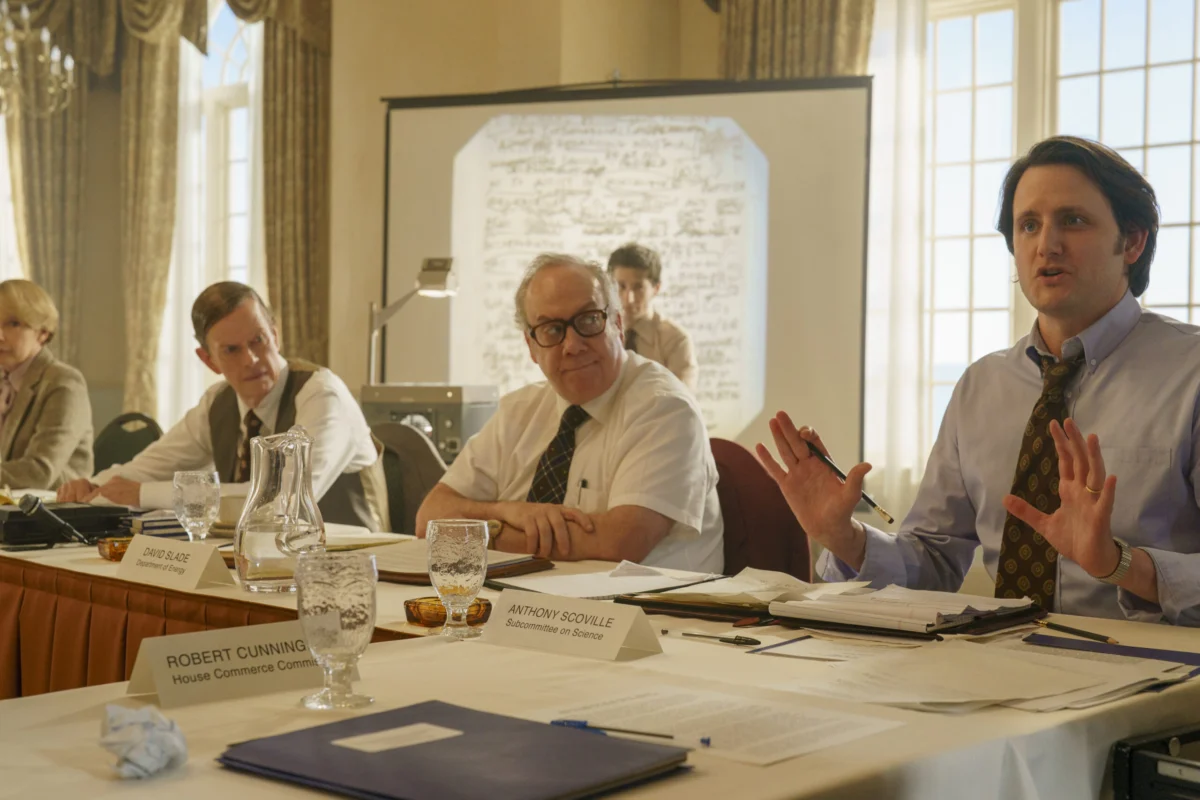
In a sterile, fluorescent-lit conference room at the DonCesar beachfront resort in St. Petersburg, Florida, the air is thick with the scent of stale coffee and the invisible, gathering weight of the future. It is October 1980. Two men pace the perimeter of a cluster of mahogany tables, obsessively adjusting the seating arrangements for a meeting that carries the pretense of world-altering significance. Outside, the Gulf of Mexico stretches toward the horizon, vast and indifferent, oblivious to the fact that the men inside are tasked with deciding the fate of the atmosphere that blankets it.
This is the central tension of Tom McCarthy’s latest film, A Statement. Based on the non-fiction historical account found in Nathaniel Rich’s Losing Earth, the film serves as a somber, claustrophobic autopsy of a pivotal, forgotten moment in American environmental policy. It is a cinematic study of how the machinery of government—and the fragility of human communication—can effectively neutralize a crisis of existential proportions.
A Chronology of Stagnation: October 30–31, 1980
The film reconstructs a two-day conference that occurred less than a week before the 1980 presidential election—a contest that would ultimately usher in the Reagan era and fundamentally reshape the nation’s environmental trajectory. McCarthy, known for his penchant for procedural storytelling in Spotlight, approaches this material with a rigorous, almost clinical dedication to the source text.
The screenplay, penned by McCarthy alongside Thomas Bidegain and Noé Debré, utilizes verbatim transcripts from the original Congressional commission. The result is a film that feels less like a traditional narrative and more like a theatrical reenactment of bureaucracy in terminal decline.
The timeline of the film mirrors the 36-hour window in which twenty of the brightest minds in the country—physicists, industrial consultants, legal scholars, and government advisors—attempted to draft a unified policy response to the looming threat of carbon dioxide emissions. The tragedy, as the film’s closing title card reveals, is not that they debated poorly; it is that they failed to produce a statement at all. The weekend, billed as a historic summit, concluded with a deafening silence.
The Players: A Study in Institutional Paralysis
McCarthy has assembled a formidable ensemble cast to inhabit the roles of the experts caught in this quagmire. Paul Rudd stars as Thomas Jorling, the Clean Air Act advisor serving as the meeting’s moderator, tasked with corralling a room full of egos and conflicting agendas. Evan Peters portrays Rafe Pomerance, the scrappy, idealistic director of Friends of the Earth, who serves as the film’s moral conscience.

The ideological friction is provided by a powerhouse supporting cast: Amy Ryan as the frustrated public health scholar Annemarie Crocetti; Paul Giamatti as the obstructionist Department of Energy director David Slade; John Turturro as the maverick M.I.T. nuclear engineer David Rose; and Tatiana Maslany as legal scholar Edith Brown Weiss.
Through these characters, the film explores the "boys’ club" dynamics of 1980s Washington. Maslany and Ryan are tasked with navigating an environment where their professional expertise is frequently sidelined by the performative posturing of their male counterparts. However, critics have noted that while these performances are technically precise, the characters occasionally drift into archetypes—"poster people" for the systemic sexism of the era—rather than fully realized individuals.
The Semantic Trap: Why Words Failed the Planet
The most compelling aspect of A Statement is its fixation on the failure of language. As the delegates debate the difference between taking "action" on climate change versus merely taking "account" of it, the film highlights how semantics became a weapon of delay.
This is not a film about climate change as a scientific phenomenon; it is a film about climate change as a linguistic hurdle. The delegates are so obsessed with the phrasing of their potential missive that they lose sight of the objective. Every time a breakthrough feels imminent, a lawyerly intervention or a bureaucratic objection pulls the group back into the mire of word-smithing.
The film’s cinematography, handled by Stuart Dryburgh, emphasizes this confinement. The beige palette of the conference room, coupled with the dense, repetitive dialogue, creates a feeling of sensory deprivation. It is a deliberate choice: by keeping the viewer trapped in the room, McCarthy forces us to feel the same mounting frustration as the characters. The only respite comes when Dr. Rose (Turturro) briefly breaks the monotony by crashing a wedding at the hotel, a fleeting, chaotic reminder of the vibrant, messy world that exists outside the stifling confines of the commission.
Official Responses and Historical Context
The backdrop of the film is the waning days of the Jimmy Carter administration. While the characters in the room represent a genuine, if flawed, attempt to address the climate crisis, the film makes it clear that the political winds were shifting elsewhere.

Reagan’s impending victory serves as a ticking clock for the audience, who, unlike the characters, know exactly what happened in the decades following this meeting. The U.S. government’s subsequent pattern of withdrawal from international climate agreements—most notably the 2026 withdrawal from the Paris Agreement—hangs over the film like a shroud.
The film does not shy away from the irony that these individuals were warned. As the narrative notes, Irish physicist John Tyndall first identified the greenhouse effect in 1859. By 1980, the warning had been known for over a century, yet the political will to act remained stuck in the same loop of debate and deferral.
The Implications: A Beckettian Absurdity
Ultimately, A Statement offers a sobering reflection on the human capacity for denial. The film’s conclusion, which feels almost Beckettian in its futility, draws a sharp, cynical parallel to the Coen Brothers’ Burn After Reading. In that film, the characters expend massive amounts of energy on a task that ultimately results in nothing.
The implication for our current moment is clear: if we treat the climate crisis as a problem to be solved through better rhetoric rather than radical systemic change, we are doomed to repeat the cycle of the DonCesar summit indefinitely. The "shrug" with which the film ends is perhaps its most honest moment. It acknowledges that the machinery of our society is currently ill-equipped to confront a threat that requires action rather than administrative posturing.
While A Statement may occasionally suffer from a lack of narrative momentum—a byproduct of its devotion to the transcript—it succeeds as a cautionary tale. It is a stark reminder that history is not just written by the victors; it is often written by the committees that talk until the clock runs out, leaving behind nothing but a blank page.
Critical Reception
- Performance: The cast, particularly Giamatti and Turturro, provide high-level nuance to what could have been a dry procedural.
- Directing: McCarthy’s restraint is both a strength and a weakness, creating a film that is intellectually stimulating but emotionally distant.
- Overall Verdict: A B- grade seems fitting for a project that is a masterful technical exercise but occasionally struggles to bridge the gap between historical transcript and engaging drama.
As the film moves toward its wider release, its impact will likely be measured by how effectively it forces modern audiences to confront the "banality of failure" that continues to define our approach to the climate crisis. The conference room may be in 1980, but the conversation—or the lack thereof—remains alarmingly contemporary.
 Pevita Pearce
 Dwi Wanna
 Nila Kartika Wati
