

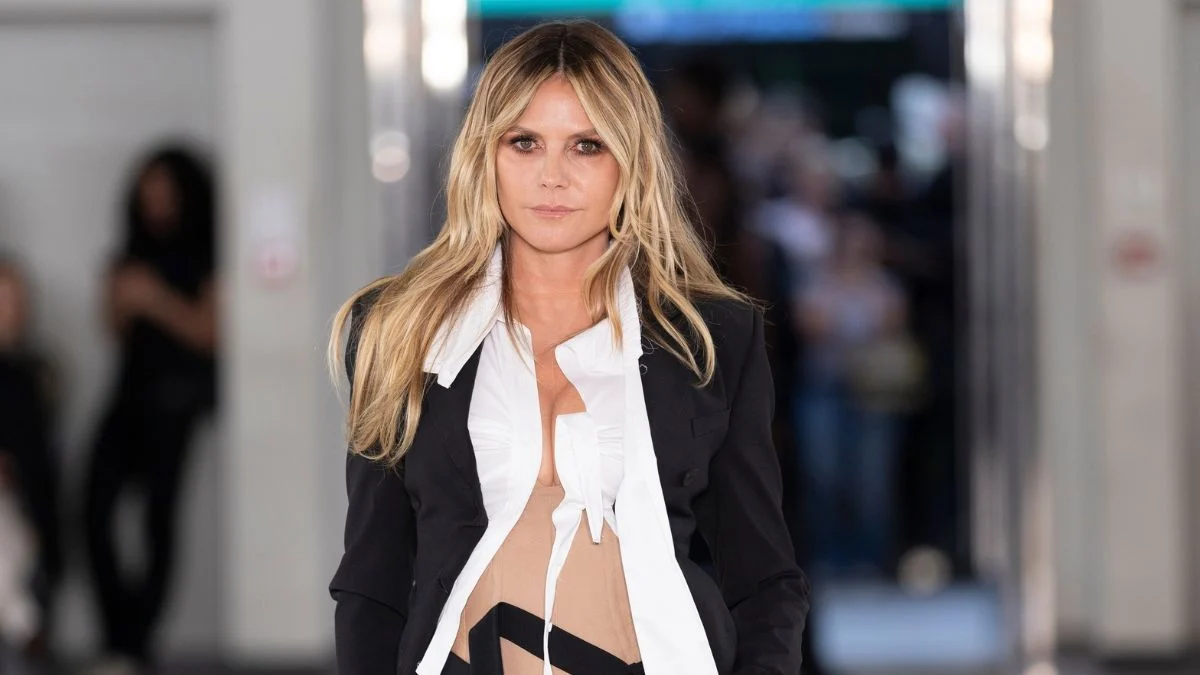
Paris Fashion Week has long served as the global epicenter for avant-garde expression, where the boundaries of silhouette and structure are routinely dismantled and reimagined. However, few moments during the Spring/Summer 2027 season captured the fashion world’s collective attention quite like the surprise return of supermodel Heidi Klum. Closing the highly anticipated Ottolinger showcase, Klum proved that her command over the runway remains as potent and magnetic as it was at the height of her nineties dominance.
The Main Event: A Study in Deconstruction
As the lights dimmed at the Ottolinger presentation, the atmosphere shifted from the rhythmic, industrial-tinged tension of the show’s soundtrack to a sudden, palpable surge of excitement. Heidi Klum emerged to close the show, wearing a look that functioned as a masterclass in the label’s signature deconstructionist philosophy.
The ensemble was a bold juxtaposition of classic tailoring and chaotic, sculptural artistry. At the heart of the look was a dramatically reworked white shirt, stripped of its traditional formal conventions. Instead of a neat button-down, the garment hung in asymmetric panels, strategically falling open to reveal a plunging, skin-toned corset beneath. This deliberate exposure challenged the norms of "workwear" aesthetics, turning a staple garment into an instrument of high-fashion subversion.
Layered over this was a structured black blazer, which provided a grounding, architectural weight to the fluid, undone shirt. The trousers, however, were perhaps the most experimental element of the look. Featuring a shifted, partially unraveled waistband, the pants created provocative cutout details at the hips—a hallmark of the Ottolinger design language that emphasizes the interplay between fabric and the human form. To anchor the look, Klum donned Christian Louboutin’s "Miss Z" slingback pumps. The black patent leather, punctuated by the brand’s iconic red soles and a sharp, pointed silhouette, provided a razor-edged finish that balanced the structural disarray of the garments.
Chronology of a Fashion Moment
The lead-up to the Ottolinger Spring/Summer 2027 show had been shrouded in the typical, frantic secrecy of Paris Fashion Week. While the label’s founders, Christa Bösch and Cosima Gadient, are known for their experimental presentations, the inclusion of a global icon like Klum was not leaked to the press, making her appearance a genuine surprise for the front-row attendees.
Pre-Show Preparations: Hours before the show, the backstage atmosphere was reported to be one of intense, focused collaboration. While models were prepped with the "fresh, glowing" aesthetic that would define the runway look, Klum underwent final fittings, adjusting the deconstructed shirt to ensure the proportions of the asymmetric panels hit exactly the right notes for the runway’s lighting.
The Walk: Klum took to the catwalk with a measured, confident stride. Unlike the frantic, high-energy pace of some contemporary runways, her walk was deliberate, allowing the audience to observe the intricate tailoring of the unraveled waistband and the interplay of the corset against the shirt. The walk concluded with a final turn that cemented the look as the definitive highlight of the collection.
Post-Show Reception: Following the presentation, the digital sphere erupted. Klum took to her personal Instagram account to share behind-the-scenes footage, which quickly garnered millions of impressions. The rapid spread of images showing her in the Ottolinger ensemble served as a reminder of the supermodel’s enduring cultural relevance in an era dominated by social media-native influencers.
Supporting Data: The Ottolinger Aesthetic
To understand why Klum’s appearance was so effective, one must look at the foundation of the Ottolinger brand. Founded by Christa Bösch and Cosima Gadient, the label has built its reputation on the "reconstruction of the classic." Their work is rarely about creating new garments from scratch; rather, it is about taking the familiar—a button-up shirt, a pair of trousers, a blazer—and subjecting it to a process of artistic degradation.
The choice of Klum as the show’s closer was not merely a celebrity cameo; it was a deliberate stylistic choice. Klum, whose career began in an era of polished, high-glamour runway work, represented a "classic" archetype that served as the perfect canvas for Ottolinger’s deconstruction. By placing a figure so synonymous with traditional beauty standards inside a look that actively dismantles the "proper" way to wear clothes, the designers created a compelling tension that resonated with the audience.
Furthermore, the choice of the Christian Louboutin Miss Z pump serves as a bridge between high-concept runway art and luxury commerce. The footwear, with its classic pointed toe and slingback strap, offered a sense of accessibility, proving that while the clothes themselves were experimental, the silhouette remained rooted in an elevated, wearable reality.
Official Responses and Industry Reception
The reaction from the industry was overwhelmingly positive. Fashion critics noted that the pairing of Klum with the brand felt like a "passing of the torch" between eras of modeling.
In a brief statement following the show, a spokesperson for the brand remarked, "Heidi embodies the confidence required to wear our pieces. Her ability to own the space, regardless of how unconventional the tailoring, is exactly the spirit we look for when casting for the runway."
Social media analysts pointed out that the engagement metrics for this specific runway moment outperformed almost every other segment of the show. "There is a nostalgia factor," said one industry analyst, "but it is also about seeing a seasoned professional handle a difficult, avant-garde garment. It’s a reminder that true modeling is a craft."
Implications: The Return of the Supermodel?
Klum’s surprise return to the runway carries broader implications for the fashion industry. For several years, the trend has leaned heavily toward digital-native models and influencers. However, recent seasons have seen a resurgence of interest in veteran supermodels who possess the "catwalk authority" that only decades of experience can provide.
1. The Revalidation of Experience
Klum’s performance highlights that runway modeling is a skill set that goes beyond aesthetics. Her posture, the way she managed the volume of the deconstructed blazer, and her ability to maintain a neutral, high-fashion facial expression while navigating a complex ensemble underscored the value of experience in an increasingly fast-paced industry.
2. The Commercial Viability of Avant-Garde
By placing a recognizable, mainstream face in a challenging, experimental piece, Ottolinger succeeded in bridging the gap between niche conceptual fashion and mass-market interest. This strategy suggests that even the most "unconventional" brands are looking to bridge the divide between high art and high-profile marketing.
3. Sustainability and Re-fashioning
The focus on "deconstruction" is not merely an aesthetic choice; it is also a nod toward the growing industry trend of circularity and the re-imagining of existing garments. By highlighting the potential for old pieces to be reconfigured into modern, high-fashion looks, the show provided a subtle commentary on the future of sustainable fashion.
Conclusion: A Masterclass in Confidence
Heidi Klum’s appearance at the Ottolinger Spring/Summer 2027 show will likely be remembered as one of the defining moments of the Paris Fashion Week season. It was a perfect storm of timing, design, and star power. By embracing the chaos of the label’s deconstructed aesthetic and pairing it with a professional’s poise, Klum didn’t just walk the runway—she commanded it.
As the industry continues to evolve, the demand for authenticity and experience has never been higher. Whether this serves as a one-off return or the beginning of a renewed presence on the global catwalks remains to be seen. However, one thing is certain: for the duration of that walk, all eyes were on Heidi Klum, and she proved, once again, that the runway is exactly where she belongs.
 rifanmuazin
 Sagoh
Sagoh
 Suro Senen
